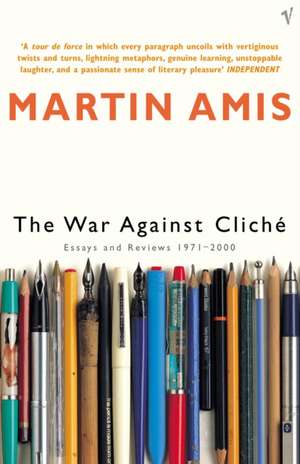
War Against Cliche
Autor Martin Amisen Limba Engleză Paperback – 7 mar 2002
Identificăm în peisajul academic actual o nevoie acută de instrumente critice care să depășească simpla analiză structurală, iar The War Against Cliche de Martin Amis vine să completeze exact această lacună. Volumul nu este doar o culegere de eseuri, ci un manifest împotriva degradării limbajului și a gândirii de-a gata. Considerăm că forța acestei ediții rezidă în capacitatea autorului de a demonta mecanismele literare ale unor titani precum James Joyce sau Jane Austen, păstrând în același timp un ochi critic asupra fenomenelor contemporane, de la fotbalul englez la revistele pentru adulți. Descoperim aici un ritm narativ alert, specific unui scriitor care stăpânește atât ficțiunea, cât și jurnalismul cultural, transformând critica literară într-o formă de artă în sine. Cartea reprezintă o alternativă viabilă la Picked-Up Pieces de John Updike pentru cursurile de critică literară și eseistică, având avantajul unei perspective britanice tăioase și al unei abordări mult mai puțin concesive față de reputațiile „umflate” ale ultimelor decenii. În contextul operei sale, The War Against Cliche funcționează ca un fundament teoretic pentru temele excesului și absurdului explorate în romane precum The Information sau The Rachel Papers. Dacă în The Second Plane Amis aplica această rigoare analitică asupra geopoliticii post-2001, aici el se întoarce la nucleul profesiei sale: cuvântul scris și datoria de a-l păstra viu, ferit de uzura clișeului. Structura volumului, care alternează între recenzii scurte și eseuri de profunzime, facilitează o navigare flexibilă, esențială pentru studenții la litere sau pentru scriitorii aflați la început de drum.
Preț: 87.23 lei
Preț vechi: 106.94 lei
-18%
Carte disponibilă
Livrare economică 09-20 octombrie
Livrare express 22-26 septembrie pentru 46.76 lei
Specificații
ISBN-10: 0099422220
Pagini: 528
Ilustrații: illustrations
Dimensiuni: 131 x 197 x 37 mm
Greutate: 0.37 kg
Editura: Vintage Publishing
Locul publicării:United Kingdom
V-ar putea interesa
-
 Camera Lucida: Reflections on PhotographyRoland Barthes-20%Preț: 61.03 lei76.68 lei
 -
 ExperienceMartin Amis-30%Preț: 73.14 lei103.80 lei
 -
 A Lover's DiscourseRoland Barthes-37%Preț: 57.36 lei91.28 lei
 -
 Koba The DreadMartin Amis-19%Preț: 73.86 lei91.64 lei
 -
 The Rub of TimeMartin Amis-20%Preț: 73.76 lei92.32 lei
 -
 Brideshead AbbreviatedJohn Crace-19%Preț: 63.67 lei78.24 lei
 -
 The InformationMartin Amis-18%Preț: 75.80 lei92.81 lei
 -
 MythologiesRoland Barthes-38%Preț: 55.92 lei90.41 lei
 -
 Einstein's MonstersMartin Amis-22%Preț: 49.30 lei62.85 lei
 -
 Changing My MindZadie Smith-25%Preț: 63.39 lei84.89 lei
 -
 Big Sleep and Other NovelsRaymond Chandler-17%Preț: 77.76 lei93.97 lei
 -
 The King's EnglishKingsley AmisPreț: 77.56 lei
 -
 Lectures on LiteratureVladimir NabokovPreț: 134.38 lei
 -
 Too Loud a SolitudeBohumil HrabalPreț: 67.17 lei
 -
 Higher GossipJohn Updike-17%Preț: 66.90 lei80.18 lei
 -
 Hitch-22Christopher HitchensPreț: 123.19 lei
 -
 A. E. HousmanA. E. HousmanPreț: 69.06 lei
 -
 Red HarvestDashiell HammettPreț: 86.05 lei
 -
 MythologiesRoland BarthesPreț: 97.42 lei
 -
 The Melancholy of ResistanceLászló KrasznahorkaiPreț: 100.29 lei
 -
 Koba the DreadMartin AmisPreț: 125.75 lei
 -
 Grey Area: ReissuedWill SelfPreț: 66.98 lei
 -
 Red HarvestDashiell Hammett-27%Preț: 51.87 lei70.67 lei
 -
 The Correction of TasteDenis DonoghuePreț: 129.78 lei
De ce să citești această carte
Recomandăm acest volum oricărui cititor care dorește să înțeleagă mecanismele din spatele marii literaturi prin ochii unuia dintre cei mai influenți scriitori britanici. Este un câștig cert pentru studenții la filologie și jurnaliști, oferind o lecție magistrală de stilistică și onestitate intelectuală. Veți descoperi un ghid indispensabil despre cum să citiți critic și cum să scrieți fără a cădea în capcanele limbajului previzibil.
Despre autor
Martin Amis (1949–2023) a fost unul dintre cei mai importanți romancieri și eseiști britanici contemporani, inclus de The Times pe lista celor mai mari scriitori de după 1945. Recunoscut pentru stilul său satiric și pentru analiza exceselor societății capitaliste, Amis a fost de două ori nominalizat la Booker Prize și a predat scriere creativă la Universitatea din Manchester. Influențat de Vladimir Nabokov și Saul Bellow, el a lăsat o moștenire literară vastă, de la romane iconice precum „Money” la memorii premiate, fiind considerat un maestru al stilului și un critic necruțător al clișeelor culturale.
Notă biografică
Descriere scurtă
The War Against Cliché is a selection of his reviews and essays. It contains pieces on Cervantes, Milton, Donne, Coleridge, Jane Austen, Dickens, Kafka, Philip Larkin, Joyce, Waugh, Lowry, Nabokov, F. R. Leavis, V. S. Pritchett, William Burroughs, Anthony Burgess, Angus Wilson, Saul Bellow, Philip Roth, Shiva and V. S. Naipaul, Kurt Vonnegut, Iris Murdoch, Norman Mailer, Gore Vidal, Don DeLillo, Elmore Leonard, Michael Crichton, Thomas Harris and John Updike.
Other subjects include chess, nuclear weapons, masculinity, screen censorship, juvenile violence, Andy Warhol, Hillary Clinton, and Margaret Thatcher.
'A tour de force in which every paragraph uncoils with vertiginous twists and turns, lightning metaphors, genuine learning, unstoppable laughter, and a passionate sense of literary pleasure' Independent
Extras
That time now seems unrecognizably remote. I had a day job at the Times Literary Supplement. Even then I sensed discrepancy, as I joined an editorial conference (to help prepare, perhaps, a special number on Literature and Society), wearing shoulder-length hair, a flower shirt, and knee-high tricoloured boots (well-concealed, it is true, by the twin tepees of my flared trousers). My private life was middle-bohemian — hippyish and hedonistic, if not candidly debauched; but I was very moral when it came to literary criticism. I read it all the time, in the tub, on the tube; I always had about me my Edmund Wilson — or my William Empson. I took it seriously. We all did. We hung around the place talking about literary criticism. We sat in pubs and coffee bars talking about W.K. Wimsatt and G. Wilson Knight, about Richard Hoggart and Northrop Frye, about Richard Poirier, Tony Tanner and George Steiner. It might have been in such a locale that my friend and colleague Clive James first formulated his view that, while literary criticism is not essential to literature, both are essential to civilization. Everyone concurred. Literature, we felt, was the core discipline; criticism explored and popularized the significance of that centrality, creating a space around literature and thereby further exalting it. The early Seventies, I should add, saw the great controversy about the Two Cultures: Art v. Science (or F.R. Leavis v. C.P. Snow). Perhaps the most fantastic thing about this cultural moment was that Art seemed to be winning.
Literary historians know it as the Age of Criticism. It began, let us suggest, in 1948, with the publication of Eliot's Notes Towards the Definition of Culture and Leavis's The Great Tradition. What ended it? The brutalist answer would consist of a singe four-letter word: OPEC. In the Sixties you could live on ten shillings a week: you slept on people's floors and sponged off your friends and sang for your supper — about literary criticism. Then, abruptly, a bus fare cost ten shillings. The oil hike, and inflation, and then stagflation, revealed literary criticism as one of the many leisure-class fripperies we would have to get along without. Well, that's how it felt. But it now seems clear that literary criticism was inherently doomed. Explicitly or otherwise it had based itself on a structure of echelons and hierarchies; it was about the talent elite. And the structure atomized as soon as the forces of democratization gave their next concerted push.
Those forces — incomparably the most potent in our culture — have gone on pushing. And they are now running up against a natural barrier. Some citadels, true, have proved stormable. You can become rich without having any talent (via the scratchcard and the rollover jackpot). You can become famous without having any talent (by abasing yourself on some TV nerdothon: a clear improvement on the older method of simply killing a celebrity and inheriting the aura). But you cannot become talented without having any talent. Therefore, talent must go.
Literary criticism, now almost entirely confined to the universities, thus moves against talent by moving against the canon. Academic preferment will not come from a respectful study of Wordsworth's poetic; it will come from a challenging study of his politics — his attitude to the poor, say, or his unconscious 'valorization' of Napoleon; and it will come still faster if you ignore Wordsworth and elevate some (justly) neglected contemporary, by which process the canon may be quietly and steadily sapped. A brief consultation of the Internet will show that meanwhile, at the other end of the business, everyone has become a literary critic — or at least a book-reviewer. Democratization has made one inalienable gain: equality of the sentiments. I think Gore Vidal said this first, and he said it, not quite with mockery, but with lively scepticism. He said that, nowadays, nobody's feelings are more authentic, and thus more important, than anybody else's. This is the new credo, the new privilege. It is a privilege much exercised in the contemporary book-review, whether on the Web or in the literary pages. The reviewer calmly tolerates the arrival of the new novel or slim volume, defensively settles into it, and then sees which way it rubs him up. the right way or the wrong way. The results of this contact will form the data of the review, without any reference to the thing behind. And the thing behind, I am afraid, is talent, and the canon, and the body of knowledge we call literature.
From the Hardcover edition.
Recenzii
“Brilliant prose. . . .[Amis] proselytizes for talent by demonstrating it, by doing it. . . . He is a master.” –The New York Times Book Review
"Whatever the book, there is no one whose review of it you'd rather read than Amis's. His prose is always buzzing, so much so that he doesn't just review books, he rewrites them." --San Francisco Chronicle
"[Written] with intelligence and ardor and panache. . . . Speaks not just to a lifetime of reading but also to a fascination with individual writers mature." --The New York Times