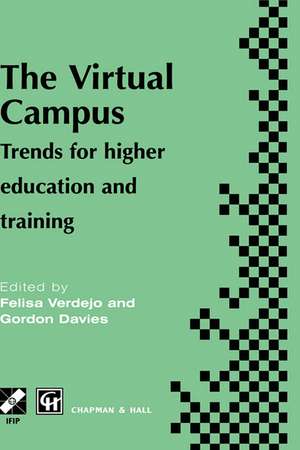
The Virtual Campus
Editat de M F Verdejo, Gordon Daviesen Limba Engleză Hardback – 31 ian 1997
Preț: 1262.82 lei
Preț vechi: 1540.03 lei
-18%
Puncte Express: 1894
Carte tipărită la comandă
Livrare economică 26 noiembrie-10 decembrie
Livrare prin curier în România Termenul estimat este afișat lângă disponibilitate.
Transport gratuit pentru acest produs Plată online sau ramburs, în funcție de opțiunile comenzii.
Retur gratuit în 14 zile Comandă securizată și suport în română.
Specificații
ISBN-13: 9780412835506
ISBN-10: 0412835509
Pagini: 308
Ilustrații: X, 308 p.
Dimensiuni: 160 x 241 x 23 mm
Greutate: 0.65 kg
Ediția:1998 edition
Editura: Springer Us
Locul publicării:New York, NY, United States
ISBN-10: 0412835509
Pagini: 308
Ilustrații: X, 308 p.
Dimensiuni: 160 x 241 x 23 mm
Greutate: 0.65 kg
Ediția:1998 edition
Editura: Springer Us
Locul publicării:New York, NY, United States
V-ar putea interesa
-
 -15%Preț: 666.84 lei784.53 lei
 -
 Educational Media and Technology YearbookMichael Orey-18%Preț: 1000.32 lei1219.90 lei
 -
 Technology Enhanced LearningJean-Pierre CourtiatPreț: 400.98 lei
 -
 Understanding Multimedia DocumentsJean-Francois Rouet-15%Preț: 638.85 lei751.58 lei
 -
 Preț: 317.48 lei
 -
 Instruction Design for Microcomputing SoftwareDavid Jonassen-18%Preț: 908.60 lei1108.05 lei
 -
 Intelligent Language Tutors: Theory Shaping TechnologyV. Melissa Holland-18%Preț: 1126.19 lei1373.40 lei
 -
 Children and Computers in SchoolBetty A. Collis-18%Preț: 1003.51 lei1223.79 lei
 -
 Children and Computers in SchoolBetty A. CollisPreț: 364.51 lei
 -
 Intelligent Instruction Computer: Theory And PracticeMarshall J. Farr-15%Preț: 522.29 lei614.46 lei
 -
 Fishing BC Rivers: Big Fish and Acessible WaterwaysGordon Davies-11%Preț: 113.94 lei128.22 lei
 -
 Instructional Theories in Action: Lessons Illustrating Selected Theories and ModelsCharles M. Reigeluth-18%Preț: 1118.81 lei1364.41 lei
 -
 Networking the LearnerDeryn M Watson-18%Preț: 989.47 lei1206.66 lei
 -
 Quality Education @ a DistanceG. Davies-15%Preț: 635.72 lei747.91 lei
 -
 Activity Systems Analysis MethodsLisa C Yamagata-Lynch-15%Preț: 663.64 lei780.75 lei
 -
 Building University Electronic Educational EnvironmentsStephen D. Franklin-18%Preț: 1188.84 lei1449.82 lei
 -
 TelE-LearningDon Ebdon-15%Preț: 624.56 lei734.78 lei
 -
 Technological Pedagogical Content KnowledgeCharoula Angeli-15%Preț: 672.68 lei791.40 lei
 -
 Preț: 97.80 lei
Public țintă
ResearchCuprins
1 New wine and old bottles? Tele-learning, telematics and the University of Twente.- 2 Virtual learning centers for XXIst century organizations.- 3 New research avenues on multimedia based learning in the EU.- 4 Learning at a virtual campus: Deakin University’s experiences as a dual mode university.- 5 The university for industry pilot project.- 6 Introduction to global approaches.- 7 A Web-based learning environment: applying constructivist teaching concepts in virtual learning environments.- 8 An experience in UNED on building up a virtual campus.- 9 The impact of the Internet on academic research practices.- 10 Comparison of students’ thinking processes when studying with WWW, IMM, and text based materials.- 11 Collaboration between universities and enterprises in the knowledge age.- 12 Cultural contextualisation of learning with the World Wide Web.- 13 Questions and discussion.- 14 New approaches for collaborative learning and group activities.- 15 Towards a model of collaborative support for distance learners to perform joint tasks.- 16 Using the World Wide Web to promote educational discussion on university level courses.- 17 Distance education and distributed virtual environments.- 18 Self organised group activities supported by asynchronous structured conversations.- 19 Web tools and Web applications.- 20 How to distribute learning facilities by means of a network: some issues and a case study.- 21 A GCSE project for the distance evaluation of knowledge of French as a foreign language.- 22 Conceptual learning of sciences supported by Java compliant technologies.- 23 Extending Web educational applications via SGML structuring and content-based capabilities.- 24 SimulNet: virtual tele-laboratories over the Internet.- 25 A distance learning application based ona digital library of courseware.- 26 Authoring tools for network-based training.- 27 Using telematics to overcome educational constraints: teaching differential equations using the World-Wide-Web and multimedia technology.- Index of contributors.- Keyword index.
Recenzii
`This is an information-packed volume. The papers are timely and thought provoking and offer excellent lists of references. Overall, the book provides a perspective on networked learning and is a valuable and up-to-date resource for anyone in the field of distance education. The main topics are of primary concern to today's tele-educator: global approaches, evaluation studies, collaberative activities and web tools. Best of all, the book is international in theme and scope.'
M. Sock McIsaac, Computers & Education, 33:77-82 (1999)
M. Sock McIsaac, Computers & Education, 33:77-82 (1999)