Cantitate/Preț
Produs

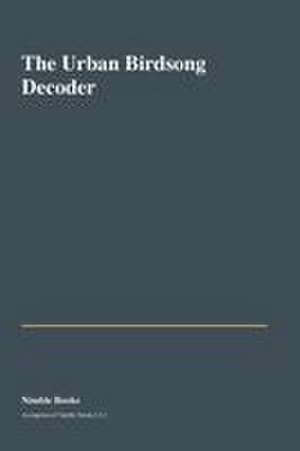
The Urban Birdsong Decoder: Sprint E

Autor Nimble Books LLC
en Limba Engleză Paperback – aug 2026
A city bird is easiest to misidentify when the listener starts with a name instead of a pattern. In Opening Matter: The City Has a Sound Map, the controlling focus is color guide framing, real-audio spectrogram discipline, and differential diagnosis. The Cornell source packet supports species descriptions, occurrence checks, audio-archive use, and spectrogram workflow, but it does not authorize invented recordings or decorative fake sonograms (Cornell Lab of Ornithology, 2025). The first discipline of urban listening is to collect evidence before naming the singer. The reader should listen for pitch, rhythm, phrase length, repetition, texture, habitat, time of day, and season before reaching for a species name. A single cue can start a hypothesis; it should not end the diagnosis (Cornell Lab of Ornithology, 2025). This guide treats birdsong as a field problem with multiple clues, not as a magic trick of perfect memory. Urban acoustics complicate the work. Traffic masks low notes, glass and walls bounce sound, and a singer may be above or behind the listener. The book therefore emphasizes listening position and repeated checks over instant certainty (Cornell Lab of Ornithology, 2025). Cue What to note Caution --------- Pitch high, middle, low; rising or falling Do not identify from pitch alone. Rhythm even, bouncing, accelerating, broken Compare several phrases. Texture clear, buzzy, raspy, liquid, mechanical Account for traffic masking. Place canopy, shrub, roof, wire, ground edge Use habitat as probability, not proof. The safest identification is a convergence: sound, place, season, behavior, and probability. Where the manuscript discusses spectrograms, it labels deterministic teaching diagrams as simulated plates unless they are generated from verified Macaulay Library or xeno-canto audio with license and metadata tracked (Cornell Lab of Ornithology, 2025); (xeno-canto Foundation, 2025). Spectrograms are useful only when their provenance is honest. The field-guide promise is practical: help a reader hear differences among common urban birds, build a careful note-taking habit, and avoid overclaiming an ID from a short chip or an unseen singer (Cornell Lab of Ornithology, 2025). A city bird is easiest to misidentify when the listener starts with a name instead of a pattern. In Opening Matter: The City Has a Sound Map, the controlling focus is color guide framing, real-audio spectrogram discipline, and differential diagnosis. The Cornell source packet supports species descriptions, occurrence checks, audio-archive use, and spectrogram workflow, but it does not authorize invented recordings or decorative fake sonograms (Cornell Lab of Ornithology, 2025). The first discipline of urban listening is to collect evidence before naming the singer. The reader should listen for pitch, rhythm, phrase length, repetition, texture, habitat, time of day, and season before reaching for a species name. A single cue can start a hypothesis; it should not end the diagnosis (Cornell Lab of Ornithology, 2025). This guide treats birdsong as a field problem with multiple clues, not as a magic trick of perfect memory. Urban acoustics complicate the work. Traffic masks low notes, glass and walls bounce sound, and a singer may be above or behind the listener. The book therefore emphasizes listening position and repeated checks over instant certainty (Cornell Lab of Ornithology, 2025).
Citește tot Restrânge

Din seria Sprint E

Preț: 43541 lei

Nou

Puncte Express: 653

Carte tipărită la comandă

Livrare economică 07-13 octombrie

Livrare prin curier în România Termenul estimat este afișat lângă disponibilitate.
Transport gratuit pentru acest produs Plată online sau ramburs, în funcție de opțiunile comenzii.
Retur gratuit în 14 zile Comandă securizată și suport în română.

Specificații

ISBN-13: 9798259503670
Pagini: 180
Dimensiuni: 152 x 229 x 12 mm
Greutate: 0.4 kg
Editura: Nimble Books
Colecția Sprint E
Seria Sprint E