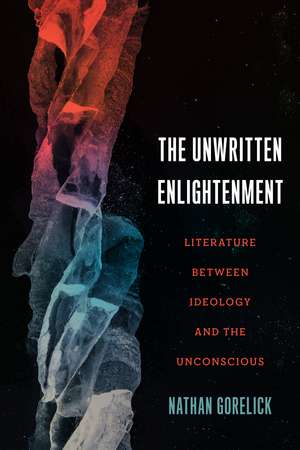
The Unwritten Enlightenment: Literature between Ideology and the Unconscious
Autor Nathan Gorelicken Limba Engleză Paperback – 15 mar 2024
Nathan Gorelick’s The Unwritten Enlightenment: Literature between Ideology and the Unconscious traces the relations between literary criticism and psychoanalysis to their shared origins in the Enlightenment era’s novels and novelistic discourse, where the period’s efforts to invent new notions of subjectivity and individualism are most apparent. Gorelick shows how modern concepts of literature and the unconscious were generated in response to these efforts and by an ethical concern for what the language of the Enlightenment excludes, represses, or struggles to erase. Troubling the idea of the Enlightenment on its own terms, subverting its supposed authority from within, Gorelick thus reveals the workings of unconscious fantasy at the foundations of our contemporary political realities. The Unwritten Enlightenment makes clear that to criticize the Enlightenment’s deficiencies, ambiguities, and legacies of violence without regard for the unconscious fantasies that drive them risks reproducing the very patterns of thought, action, and imagination that the Enlightenment novel already unsettles.
Preț: 247.55 lei
Puncte Express: 371
Carte indisponibilă temporar
Doresc să fiu notificat când acest titlu va fi disponibil:
Se trimite...
Specificații
ISBN-13: 9780810146761
ISBN-10: 0810146762
Pagini: 186
Ilustrații: 1 b-w image
Dimensiuni: 152 x 229 x 15 mm
Greutate: 0.23 kg
Editura: Northwestern University Press
Colecția Northwestern University Press
ISBN-10: 0810146762
Pagini: 186
Ilustrații: 1 b-w image
Dimensiuni: 152 x 229 x 15 mm
Greutate: 0.23 kg
Editura: Northwestern University Press
Colecția Northwestern University Press
Notă biografică
NATHAN GORELICK is an assistant professor in the Department of English at Barnard College.
Cuprins
Acknowledgments
Introduction: Literature, the Unconscious, the Enlightenment
I. The New World Delusion: Robinson Crusoe and the Psychosis of Enlightenment
II. Pedagogy of the Repressed: Rousseau, Sade, and the End of Education
III. The Novel — Broken Sex Machine: Tristram Shandy and the Writing of the Impossible
Epilogue: Between Ideology and the Unconscious
Bibliography
Notes
Introduction: Literature, the Unconscious, the Enlightenment
I. The New World Delusion: Robinson Crusoe and the Psychosis of Enlightenment
II. Pedagogy of the Repressed: Rousseau, Sade, and the End of Education
III. The Novel — Broken Sex Machine: Tristram Shandy and the Writing of the Impossible
Epilogue: Between Ideology and the Unconscious
Bibliography
Notes
Recenzii
"Gorelick’s initiation of his readers into this ethics of reading, and of “reading otherwise,” is one of the great services to thought that his book provides . . . Prying a minimal distance from monadic self-enclosure and from the social link, for Gorelick, requires an ethics of reading that dissolves the distinction between the critical and the creative. It is here, in this critical-creative practice that construction is authored, and it is here that the 'invitation to think literature with psychoanalysis is most apparent.'"—European Journal of Psychoanalysis
"Gorelick’s book refuses the rote application of psychoanalytic theory to otherwise recalcitrant literary works. More specifically, Gorelick argues for a psychoanalytic criticism that is not exactly a method—i.e., a series of general rules or techniques that can be applied readily to otherwise particular and disparate cases—but rather an “ethics,” one focused, as in the analytic session itself, on listening to, and taking seriously, the aspects of a discourse (whether it be a patient’s free associations or a written work’s poetry) that appear, at least at first, as odd, singular, out of place, disruptive, uncanny,
or disavowed." —Eighteenth-Century Studies
"This is the work of a confident and erudite thinker, offering startlingly brilliant formulations on every page and lucid distinctions that powerfully integrate philosophy, politics, and poetics. Nathan Gorelick faithfully champions the literary in prose that is commanding and often beautiful.” —Anna Kornbluh, University of Illinois, Chicago
“Nathan Gorelick’s bold intervention into the interdisciplinary framing of psychoanalysis explores the ways that literature informs its critical capacity. As he moves from conception to illustration, his textual work rethinks the Enlightenment, resituates psychoanalysis, and repositions literature’s critical mission.” —Michael J. Shapiro, University of Hawai’i, Manoa
"Gorelick’s book refuses the rote application of psychoanalytic theory to otherwise recalcitrant literary works. More specifically, Gorelick argues for a psychoanalytic criticism that is not exactly a method—i.e., a series of general rules or techniques that can be applied readily to otherwise particular and disparate cases—but rather an “ethics,” one focused, as in the analytic session itself, on listening to, and taking seriously, the aspects of a discourse (whether it be a patient’s free associations or a written work’s poetry) that appear, at least at first, as odd, singular, out of place, disruptive, uncanny,
or disavowed." —Eighteenth-Century Studies
"This is the work of a confident and erudite thinker, offering startlingly brilliant formulations on every page and lucid distinctions that powerfully integrate philosophy, politics, and poetics. Nathan Gorelick faithfully champions the literary in prose that is commanding and often beautiful.” —Anna Kornbluh, University of Illinois, Chicago
“Nathan Gorelick’s bold intervention into the interdisciplinary framing of psychoanalysis explores the ways that literature informs its critical capacity. As he moves from conception to illustration, his textual work rethinks the Enlightenment, resituates psychoanalysis, and repositions literature’s critical mission.” —Michael J. Shapiro, University of Hawai’i, Manoa
Descriere
Unveiling the fantasies that drove the Enlightenment and created modern literature