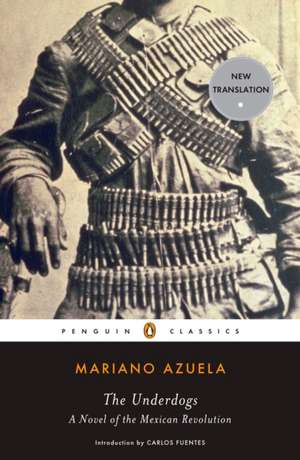
The Underdogs
Autor Mariano Azuela Traducere de Sergio Waismanen Limba Engleză Paperback – aug 2008
The greatest novel of the Mexican Revolution, in a brilliant new translation by an award-winning translator
The Underdogs is the first great novel about the first great revolution of the twentieth century. Demetrio Macias, a poor, illiterate Indian, must join the rebels to save his family. Courageous and charismatic, he earns a generalship in Pancho Villa?s army, only to become discouraged with the cause after it becomes hopelessly factionalized. At once a spare, moving depiction of the limits of political idealism, an authentic representation of Mexico?s peasant life, and a timeless portrait of revolution, The Underdogs is an iconic novel of the Latin American experience and a powerful novel about the disillusionment of war.
The Underdogs is the first great novel about the first great revolution of the twentieth century. Demetrio Macias, a poor, illiterate Indian, must join the rebels to save his family. Courageous and charismatic, he earns a generalship in Pancho Villa?s army, only to become discouraged with the cause after it becomes hopelessly factionalized. At once a spare, moving depiction of the limits of political idealism, an authentic representation of Mexico?s peasant life, and a timeless portrait of revolution, The Underdogs is an iconic novel of the Latin American experience and a powerful novel about the disillusionment of war.
| Toate formatele și edițiile | Preț | Express |
|---|---|---|
| Paperback (8) | 42.04 lei 3-5 săpt. | |
| – | 42.04 lei 3-5 săpt. | |
| Penguin Publishing Group – aug 2008 | 65.18 lei 3-5 săpt. | |
| KUPERARD (BRAVO LTD) – 31 mai 2002 | 88.36 lei 3-5 săpt. | |
| Hackett Publishing Company – 14 sep 2006 | 89.63 lei 3-5 săpt. | |
| Neeland Media – 8 iun 2019 | 50.28 lei 6-8 săpt. | |
| SMK Books – 9 feb 2012 | 70.19 lei 6-8 săpt. | |
| 1st World Publishing – aug 2013 | 78.32 lei 6-8 săpt. | |
| Book Jungle – 30 apr 2008 | 106.12 lei 6-8 săpt. | |
| Hardback (3) | 113.91 lei 6-8 săpt. | |
| Hackett Publishing Company, In – 14 sep 2006 | 202.91 lei 3-5 săpt. | |
| SMK Books – 3 apr 2018 | 113.91 lei 6-8 săpt. | |
| Viz Media – 2 aug 2013 | 169.22 lei 6-8 săpt. |
Preț: 65.18 lei
Puncte Express: 98
Preț estimativ în valută:
11.54€ • 13.44$ • 10.02£
11.54€ • 13.44$ • 10.02£
Carte disponibilă
Livrare economică 03-17 februarie
Preluare comenzi: 021 569.72.76
Specificații
ISBN-13: 9780143105275
ISBN-10: 0143105272
Pagini: 176
Dimensiuni: 130 x 191 x 15 mm
Greutate: 0.14 kg
Editura: Penguin Publishing Group
ISBN-10: 0143105272
Pagini: 176
Dimensiuni: 130 x 191 x 15 mm
Greutate: 0.14 kg
Editura: Penguin Publishing Group
V-ar putea interesa
-
 I Heart HollywoodLindsey KelkPreț: 62.47 lei
 -
 Kennedy, E: Shoes for AnthonyEmma KennedyPreț: 109.38 lei
 -
 Los de AbajoMariano AzuelaPreț: 111.88 lei
 -
 The PraetoriansJean Larteguy-20%Preț: 65.78 lei82.54 lei
 -
 The MissingTim Gautreaux-26%Preț: 51.28 lei69.70 lei
 -
 The Story of BDaniel Quinn-21%Preț: 91.55 lei115.94 lei
 -
 I Am Scrooge: A Zombie Story for ChristmasAdam Roberts-28%Preț: 38.97 lei54.50 lei
 -
 The WeddingJulie GarwoodPreț: 57.99 lei
 -
 Belle Boy: A Sister in the Rebel RanksAnne FullerPreț: 65.42 lei
 -
 Sword of Shiva: The Heart of the QuarterJeff EdwardsPreț: 105.01 lei
 -
 Operation Last AssaultRichard JoycePreț: 118.36 lei
 -
 RainBarney Campbell-21%Preț: 70.49 lei88.96 lei
 -
 Preț: 183.53 lei
 -
 One HitJack Coughlin-25%Preț: 82.83 lei110.91 lei
 -
 The Physiology of Taste or Transcendetal GastronomyBrillat SavarinPreț: 123.38 lei
 -
 Renehan, J: The ValleyJohn Renehan-26%Preț: 47.04 lei63.26 lei
 -
 Memento MoriMuriel Spark-29%Preț: 48.55 lei68.02 lei
Notă biografică
Recenzii
Pellon's translation marks a clear improvement over the previous English versions of this seminal novel. Pellon captures the crisp, tense, and terse dialogue of Azuela's original, and I believe that his decision to leave some words in Spanish is a good one, given that most of the words involved are already well known to the non-Spanish speaking public. The retention of these Spanish words adds flavor to the translation without turning it into a 'Taco Bell' version of the novel. I am so enthusiastic about Pellon's translation that I believe it should become the standard edition of Los de Abajo read in America. . . In short, this new translation is worthy of the classic on which it is based. I will certainly use it in my courses, but more to the point, I will recommend it to my colleagues teaching courses on English literature, Comparative literature, and American studies. --Roberto Gonzlez Echevarria, Sterling Professor of Hispanic and Comparative Literatures, Yale University
Gustavo Pellon has produced a flowing, readable new translation of Mariano Azuela's Los de Abajo that avoids the sometimes stilted English of the still popular 1929 translation by Enrique Mungia. Not only is Professor Pellon's English more readable but the translation is made smoother by his decision to leave certain difficult-to-translate words in the original Mexican Spanish. For those who cannot grasp the meaning of these words from the context, a glossary is provided at the end of the book. In addition to the new translation Professor Pellon has provided an important service to those who will use this novel in college classes by including an appendix that outlines the most important events of the Mexican revolution, discusses the novel in historical context, and explains Azuela's particular literary contributions. Finally Pellon attempts to come to grips with Azuela's views of the revolution. Also extremely welcome are the selections from John Reed's and Anita Brenner's writings on Mexico from approximately the same period. In short, this volume provides an integrated analysis of a novel that, while always said to be revelatory of the nature of the revolution, is generally not adequately contextualized. . . . To his credit, in his appendix Professor Pellon addresses the question of whether the novel is revolutionary or counter-revolutionary. --Ann Zulawski, Metamorphoses
This edition of Los de Abajo is a most welcome addition to the available literature for undergraduate teaching of the history of Mexico as well as Mexican and Latin American literature. As a teaching tool, it strikes me as clearly superior to the other editions. Pellon's Introduction and appendices are quite accessible and touch on the major historical and literary aspects of the novel. Pellon sincerely wants to help students understand and appreciate the novel. --Timothy J. Henderson, Auburn University Montgomery
Gustavo Pellon has produced a flowing, readable new translation of Mariano Azuela's Los de Abajo that avoids the sometimes stilted English of the still popular 1929 translation by Enrique Mungia. Not only is Professor Pellon's English more readable but the translation is made smoother by his decision to leave certain difficult-to-translate words in the original Mexican Spanish. For those who cannot grasp the meaning of these words from the context, a glossary is provided at the end of the book. In addition to the new translation Professor Pellon has provided an important service to those who will use this novel in college classes by including an appendix that outlines the most important events of the Mexican revolution, discusses the novel in historical context, and explains Azuela's particular literary contributions. Finally Pellon attempts to come to grips with Azuela's views of the revolution. Also extremely welcome are the selections from John Reed's and Anita Brenner's writings on Mexico from approximately the same period. In short, this volume provides an integrated analysis of a novel that, while always said to be revelatory of the nature of the revolution, is generally not adequately contextualized. . . . To his credit, in his appendix Professor Pellon addresses the question of whether the novel is revolutionary or counter-revolutionary. --Ann Zulawski, Metamorphoses
This edition of Los de Abajo is a most welcome addition to the available literature for undergraduate teaching of the history of Mexico as well as Mexican and Latin American literature. As a teaching tool, it strikes me as clearly superior to the other editions. Pellon's Introduction and appendices are quite accessible and touch on the major historical and literary aspects of the novel. Pellon sincerely wants to help students understand and appreciate the novel. --Timothy J. Henderson, Auburn University Montgomery