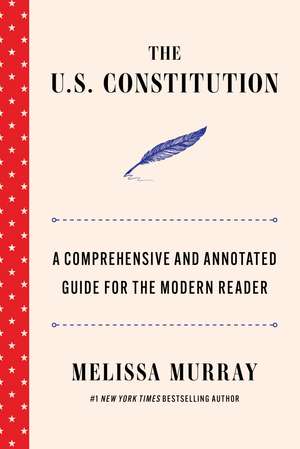
The U.S. Constitution: A Comprehensive and Annotated Guide for the Modern Reader
Autor Melissa Murrayen Limba Engleză Hardback – 18 iun 2026
Think of this as the U.S. Constitution explained by America’s favorite law professor, Melissa Murray. On her podcast, Strict Scrutiny, Murray and her cohosts, Kate Shaw and Leah Litman, provide in-depth, accessible, and irreverent analysis of the Supreme Court and its cases, culture, and personalities.
On that podcast, on MSNOW—where she is a frequent contributor—in opinion pieces, and when providing commentary as she did in a recent New York Times piece on Justice Brown Jackson, Murray spends an awful lot of time demystifying laws for everyone else. In this book, she tackles one of the founding American documents: the Constitution. Each amendment will be annotated with some historical context provided, as well as examples of how it is relevant to our present day.
More necessary than ever, as we look to the Supreme Court and their interpretation of the Constitution as the last institution upholding our democracy, this book is an indispensable read for every thinking American.
Preț: 81.12 lei
Puncte Express: 122
Carte disponibilă
Livrare economică 06-18 noiembrie
Livrare prin curier în România Termenul estimat este afișat lângă disponibilitate.
Transport gratuit de la 400.00 lei Plată online sau ramburs, în funcție de opțiunile comenzii.
Retur gratuit în 14 zile Comandă securizată și suport în română.
Specificații
ISBN-13: 9781668221938
ISBN-10: 1668221934
Pagini: 352
Dimensiuni: 152 x 229 x 30 mm
Greutate: 0.49 kg
Editura: S&s/37 Ink
Colecția 37 Ink
ISBN-10: 1668221934
Pagini: 352
Dimensiuni: 152 x 229 x 30 mm
Greutate: 0.49 kg
Editura: S&s/37 Ink
Colecția 37 Ink
Notă biografică
Melissa Murray is the Frederick I. and Grace Stokes Professor of Law at New York University’s School of Law. She is the coauthor of the #1 New York Times bestseller The Trump Indictments: The Historic Charging Documents with Commentary, cohost of a top-ranked podcast, Strict Scrutiny—which is about the Supreme Court and the legal culture that surrounds it—and a regular commentator on MSNBC. Her writing appears regularly in major national publications, including The New York Times, The Washington Post, Los Angeles Times, The Atlantic, Mother Jones, and The Nation. She is frequently called upon by national media outlets such as NPR and PBS to offer expert—yet accessible—commentary on the Supreme Court’s decisions and other pressing legal matters of national importance. Her academic publications have appeared (or are forthcoming) in the California Law Review, Columbia Law Review, Harvard Law Review, Michigan Law Review, Pennsylvania Law Review, Virginia Law Review, and Yale Law Journal, among others. Murray is a graduate of the University of Virginia, where she was a Jefferson Scholar and an Echols Scholar, and Yale Law School, where she was notes development editor of the Yale Law Journal. While in law school, she earned special recognition as an NAACP-LDF/Shearman & Sterling Scholar and was a semifinalist of Morris Tyler Moot Court. Following law school, Murray clerked for Sonia Sotomayor, then of the US Court of Appeals for the Second Circuit, and Stefan Underhill of the US District Court for the District of Connecticut. Prior to joining the NYU faculty, Murray was on the faculty of the University of California, Berkeley, School of Law, where she was the recipient of the Rutter Award for Teaching Distinction. From March 2016 to June 2017, she served as interim dean of Berkeley Law. Murray is a member of the New York bar. She lives in New York City with her family.
Extras
1. Preamble PREAMBLE
We the People of the United States, in Order to form a more perfect Union, establish Justice, insure domestic Tranquility, provide for the common defence, promote the general Welfare, and secure the Blessings of Liberty to ourselves and our Posterity, do ordain and establish this Constitution for the United States of America.
The Preamble in a Nutshell
The Preamble is the introductory statement that precedes the various provisions of the Constitution. In it, the Framers announced their goals for the Constitution as a governing document and the values underlying its provisions. The Preamble makes clear that the Constitution’s power and authority proceed from the American people.
Origin Story
It is not surprising that the Framers chose to introduce the Constitution with a preamble. Preambles were common features of legal documents, including the English Bill of Rights of 1689, the Habeas Corpus Act of 1679, and other documents that informed the Framers’ understanding of constitutionalism. Indeed, the Articles of Confederation, the governing document that preceded the Constitution, contained a preamble that declared the end of the thirteen colonies and the birth of a new “Confederation and perpetual Union.”
Today, the Preamble is arguably the part of the Constitution that most Americans know best. Yet the question of whether to include a preface—and if so, what that prefatory text would say—was not a topic of debate at the Constitutional Convention. Indeed, it was late in the drafting stage when Virginia delegate Edmund Randolph mused that “[a] preamble seems proper.”1 From there, the Preamble underwent various iterations, ultimately settling on a statement articulating the purposes of the new governing charter (and by implication, outlining the failures of the predecessor Articles of Confederation). Ironically, the Preamble’s famous opening line, “We the People,” was something of an afterthought.
Commentary
We the People…
An initial draft of the Preamble, which identified all of the thirteen states by name, was unanimously approved by all the delegates at the Constitutional Convention. However, when this draft was referred to the Committee of Style—a smaller subset of the convention delegates who were charged with editing the document—the committee eliminated the names of the thirteen states, replacing them with “We the People.” The convention records are silent as to the exact rationale for the change, but the records of the various state ratification conventions suggest that the shift was not merely rhetorical. When the Constitution was submitted for ratification, a number of Anti-Federalists raised objections to the use of “We the People.” As they argued, the states, rather than the people, were the “soul of a confederation” and for that reason, the true “agents of this compact.”2 Prominent Federalists, like John Marshall (later a chief justice of the Supreme Court), countered by noting that the powers of the states and the federal government were themselves derived from the consent of the people.3
… in Order to form a more perfect Union,…
The need to form “a more perfect Union” responded directly to the deficiencies of the Articles of Confederation, the United States’ first governing charter. Adopted in 1777 by the Continental Congress, the Articles established a “league of friendship” between the thirteen states, but this loose framework was incapable of constructing a strong national government that could mediate interstate conflicts, wage war, negotiate peace, and manage foreign commerce and diplomacy. When the war ended, the states sent delegates to Philadelphia for the purpose of amending the Articles. But it immediately became clear that modification would not cure what ailed this first charter. So, the delegates pivoted and began to draft a new governing document from scratch.
… establish Justice, insure domestic Tranquility,…
In The Federalist Papers, a series of essays arguing for ratification of the Constitution, Alexander Hamilton, James Madison, and John Jay, under the pseudonym “Publius,” emphasized the threat of interstate conflicts as evidence of the need for a strong federal government.
… provide for the common defence, promote the general Welfare,…
Fresh from the Revolutionary War with Britain, it is unsurprising that national security was a critical concern for the Framers—indeed, John Jay addressed the subject in Federalist 25.4 The Preamble’s references to the “common defence” and “general Welfare” reflect the language of the Articles of Confederation, which made similar stipulations. However, the Articles of Confederation did not make provisions for federal or national authority to provide for either. Instead, the effort was a cooperative endeavor among the thirteen states. The prospect of relying on the states to “crowdsource” the national defense struck Alexander Hamilton as wrongheaded. In Federalist 23, he dismissed as “ill-founded and illusory”5 the hope that the states might secure the nation’s defense and welfare. Responsibility for protecting the “national interests,” Hamilton maintained, must rest with the federal government.
… and secure the Blessings of Liberty to ourselves and our Posterity,…
The reference to “Posterity” underscores the Constitution’s status as the oldest written Constitution in continuous use in world history. In memorializing the Constitution as a written document, the Framers struck an immediate contrast with Great Britain and its unwritten Constitution. As the Framers intended, the written Constitution has endured as a guiding charter of American government. Its example, too, has inspired other nations to set down their own governing principles in writing.
We the People of the United States, in Order to form a more perfect Union, establish Justice, insure domestic Tranquility, provide for the common defence, promote the general Welfare, and secure the Blessings of Liberty to ourselves and our Posterity, do ordain and establish this Constitution for the United States of America.
The Preamble in a Nutshell
The Preamble is the introductory statement that precedes the various provisions of the Constitution. In it, the Framers announced their goals for the Constitution as a governing document and the values underlying its provisions. The Preamble makes clear that the Constitution’s power and authority proceed from the American people.
Origin Story
It is not surprising that the Framers chose to introduce the Constitution with a preamble. Preambles were common features of legal documents, including the English Bill of Rights of 1689, the Habeas Corpus Act of 1679, and other documents that informed the Framers’ understanding of constitutionalism. Indeed, the Articles of Confederation, the governing document that preceded the Constitution, contained a preamble that declared the end of the thirteen colonies and the birth of a new “Confederation and perpetual Union.”
Today, the Preamble is arguably the part of the Constitution that most Americans know best. Yet the question of whether to include a preface—and if so, what that prefatory text would say—was not a topic of debate at the Constitutional Convention. Indeed, it was late in the drafting stage when Virginia delegate Edmund Randolph mused that “[a] preamble seems proper.”1 From there, the Preamble underwent various iterations, ultimately settling on a statement articulating the purposes of the new governing charter (and by implication, outlining the failures of the predecessor Articles of Confederation). Ironically, the Preamble’s famous opening line, “We the People,” was something of an afterthought.
Commentary
We the People…
An initial draft of the Preamble, which identified all of the thirteen states by name, was unanimously approved by all the delegates at the Constitutional Convention. However, when this draft was referred to the Committee of Style—a smaller subset of the convention delegates who were charged with editing the document—the committee eliminated the names of the thirteen states, replacing them with “We the People.” The convention records are silent as to the exact rationale for the change, but the records of the various state ratification conventions suggest that the shift was not merely rhetorical. When the Constitution was submitted for ratification, a number of Anti-Federalists raised objections to the use of “We the People.” As they argued, the states, rather than the people, were the “soul of a confederation” and for that reason, the true “agents of this compact.”2 Prominent Federalists, like John Marshall (later a chief justice of the Supreme Court), countered by noting that the powers of the states and the federal government were themselves derived from the consent of the people.3
… in Order to form a more perfect Union,…
The need to form “a more perfect Union” responded directly to the deficiencies of the Articles of Confederation, the United States’ first governing charter. Adopted in 1777 by the Continental Congress, the Articles established a “league of friendship” between the thirteen states, but this loose framework was incapable of constructing a strong national government that could mediate interstate conflicts, wage war, negotiate peace, and manage foreign commerce and diplomacy. When the war ended, the states sent delegates to Philadelphia for the purpose of amending the Articles. But it immediately became clear that modification would not cure what ailed this first charter. So, the delegates pivoted and began to draft a new governing document from scratch.
… establish Justice, insure domestic Tranquility,…
In The Federalist Papers, a series of essays arguing for ratification of the Constitution, Alexander Hamilton, James Madison, and John Jay, under the pseudonym “Publius,” emphasized the threat of interstate conflicts as evidence of the need for a strong federal government.
… provide for the common defence, promote the general Welfare,…
Fresh from the Revolutionary War with Britain, it is unsurprising that national security was a critical concern for the Framers—indeed, John Jay addressed the subject in Federalist 25.4 The Preamble’s references to the “common defence” and “general Welfare” reflect the language of the Articles of Confederation, which made similar stipulations. However, the Articles of Confederation did not make provisions for federal or national authority to provide for either. Instead, the effort was a cooperative endeavor among the thirteen states. The prospect of relying on the states to “crowdsource” the national defense struck Alexander Hamilton as wrongheaded. In Federalist 23, he dismissed as “ill-founded and illusory”5 the hope that the states might secure the nation’s defense and welfare. Responsibility for protecting the “national interests,” Hamilton maintained, must rest with the federal government.
… and secure the Blessings of Liberty to ourselves and our Posterity,…
The reference to “Posterity” underscores the Constitution’s status as the oldest written Constitution in continuous use in world history. In memorializing the Constitution as a written document, the Framers struck an immediate contrast with Great Britain and its unwritten Constitution. As the Framers intended, the written Constitution has endured as a guiding charter of American government. Its example, too, has inspired other nations to set down their own governing principles in writing.
Recenzii
"At long last, we have an annotated and explanatory guide to our Constitution that ordinary people, lawyers, and democracy advocates can understand. Constitutional law scholar Melissa Murray does the hard work of distilling the meaning of our Constitution into a book that should be in every home library, on every desk, and in every school. This is a critical work for our time."—Sherrilyn Ifill, President and Director-Counsel Emeritus, The Legal Defense Fund
"With this timely and readable annotated Constitution, Prof. Melissa Murray has yet again done what she does best: Locating current disputes over constitutional powers, authority and limits within her expansive knowledge of history, caselaw, legal movements and daily headlines. Equal parts legal doctrine and owners manual, this deep dive into the founding documents serves as a vital reminder that it is emphatically the province of the people to know what the law is, so that they can defend it and also build it to serve its highest purposes."—Dahlia Lithwick, author of the New York Times bestseller Lady Justice and host of Amicus
"Murray is without peer in her ability to translate the law to a general audience. With this book, Murray convincingly and succinctly explains how under the Constitution, the people are supreme and empowers us all to claim the Constitution as our own, to hold the government to account, and to continue the Constitution's project of becoming a more perfect Union."—Leah Litman, author of the New York Times bestseller Lawless
"Murray does so much more than annotate the Constitution, she illuminates it, and in the process exposes its dark secrets and hidden myths. She tells us not only what the Constitution says, but what it really means."—Elie Mystal, Justice Correspondent for The Nation Magazine
"With this timely and readable annotated Constitution, Prof. Melissa Murray has yet again done what she does best: Locating current disputes over constitutional powers, authority and limits within her expansive knowledge of history, caselaw, legal movements and daily headlines. Equal parts legal doctrine and owners manual, this deep dive into the founding documents serves as a vital reminder that it is emphatically the province of the people to know what the law is, so that they can defend it and also build it to serve its highest purposes."—Dahlia Lithwick, author of the New York Times bestseller Lady Justice and host of Amicus
"Murray is without peer in her ability to translate the law to a general audience. With this book, Murray convincingly and succinctly explains how under the Constitution, the people are supreme and empowers us all to claim the Constitution as our own, to hold the government to account, and to continue the Constitution's project of becoming a more perfect Union."—Leah Litman, author of the New York Times bestseller Lawless
"Murray does so much more than annotate the Constitution, she illuminates it, and in the process exposes its dark secrets and hidden myths. She tells us not only what the Constitution says, but what it really means."—Elie Mystal, Justice Correspondent for The Nation Magazine
Descriere
From the #1 New York Times bestselling author Melissa Murray, comes a beautiful, accessible guide on how to read the U.S. Constitution.