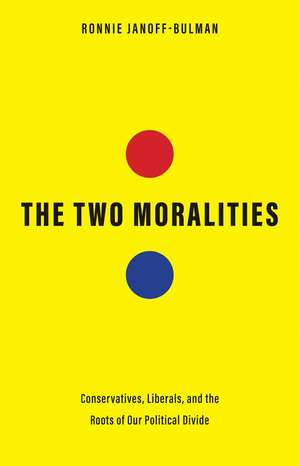
The Two Moralities: Conservatives, Liberals, and the Roots of Our Political Divide
Autor Ronnie Janoff-Bulmanen Limba Engleză Hardback – 18 apr 2023
The left and right will always have strong policy disagreements, but constructive debate and negotiation are not possible when each side demonizes the other. We need to move past our poisonous politics. In this book, social psychologist Ronnie Janoff-Bulman provides a new framework for understanding why and how we disagree.
Janoff-Bulman asks readers to consider the challenging possibility that both liberalism and conservatism are morally based and reflect genuine concern for the country. Moral psychology is an invaluable lens for understanding the roots of political differences. She presents a “Model of Moral Motives” that maps the most fundamental motivations recognized by psychology—approach and avoidance—onto these differences. Liberal morality focuses on providing for the group’s well-being and ensuring social justice. Conservative morality focuses on protecting the group from threats and preserving order.
These moralities can account for the psychological differences between liberals and conservatives and for why certain positions resonate on each side of the political spectrum. Why, for example, do conservatives oppose abortion and favor unfettered free markets while liberals favor a woman’s right to choose and economic regulation? Understanding that our political differences are rooted in two natural forms of morality can help us begin to detoxify our politics.
Preț: 217.36 lei
Puncte Express: 326
Carte disponibilă
Livrare economică 21 octombrie-04 noiembrie
Livrare express 06-10 octombrie pentru 32.26 lei
Livrare prin curier în România Termenul estimat este afișat lângă disponibilitate.
Transport gratuit de la 400.00 lei Plată online sau ramburs, în funcție de opțiunile comenzii.
Retur gratuit în 14 zile Comandă securizată și suport în română.
Specificații
ISBN-13: 9780300244083
ISBN-10: 0300244088
Pagini: 360
Ilustrații: 8 b-w illus.
Dimensiuni: 140 x 216 x 27 mm
Greutate: 0.52 kg
Editura: Yale University Press
Colecția Yale University Press
ISBN-10: 0300244088
Pagini: 360
Ilustrații: 8 b-w illus.
Dimensiuni: 140 x 216 x 27 mm
Greutate: 0.52 kg
Editura: Yale University Press
Colecția Yale University Press
Recenzii
“The Two Moralities provides a very valuable review of the basis of the dangerous partisan divide in American politics. . . . An excellent book.”—J. M. Stonecash, Choice
“This cogent, brilliant book reveals the morality at both ends of the political spectrum. Janoff-Bulman is one of the smartest people in the room, and she says we need both. Listening to her might save our democracy.”—Susan T. Fiske, author of Social Cognition
“Ronnie Janoff-Bulman expertly debunks recent canards in moral psychology: that liberals are more individualistic than conservatives; that conservative morality is broader or more extensive than liberal morality; and that we, as a society, can hope to succeed on the basis of a social order that is lacking in social justice.”—John T. Jost, author of Left & Right: The Psychological Significance of a Political Distinction
“What’s the fundamental difference between conservatives and liberals? Ronnie Janoff-Bulman delivers a cogent, evidence-based answer that challenges the received wisdom and dissipates the partisan fog—an illuminating book.”—Joshua Greene, author of Moral Tribes: Emotion, Reason, and the Gap Between Us and Them
“This cogent, brilliant book reveals the morality at both ends of the political spectrum. Janoff-Bulman is one of the smartest people in the room, and she says we need both. Listening to her might save our democracy.”—Susan T. Fiske, author of Social Cognition
“Ronnie Janoff-Bulman expertly debunks recent canards in moral psychology: that liberals are more individualistic than conservatives; that conservative morality is broader or more extensive than liberal morality; and that we, as a society, can hope to succeed on the basis of a social order that is lacking in social justice.”—John T. Jost, author of Left & Right: The Psychological Significance of a Political Distinction
“What’s the fundamental difference between conservatives and liberals? Ronnie Janoff-Bulman delivers a cogent, evidence-based answer that challenges the received wisdom and dissipates the partisan fog—an illuminating book.”—Joshua Greene, author of Moral Tribes: Emotion, Reason, and the Gap Between Us and Them
Notă biografică
Ronnie Janoff-Bulman is professor emerita of psychology and brain sciences at the University of Massachusetts, Amherst, and the former editor of the journal Psychological Inquiry. She is the author of Shattered Assumptions: Toward a New Psychology of Trauma. She lives in Amherst, MA.
Descriere
The most complete picture to date of the moral worlds of the political left and right and how their different views relate to specific political issues