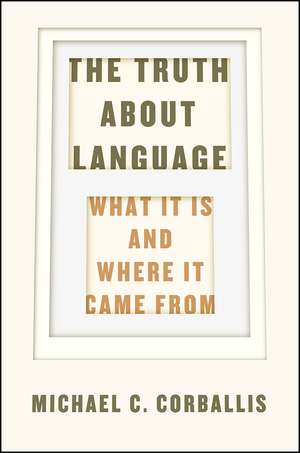
The Truth about Language: What It Is and Where It Came From
Autor Michael C. Corballisen Limba Engleză Hardback – 29 mar 2017
Capitolul dedicat „călătoriei mentale în timp” (mental time travel) constituie nucleul argumentației din The Truth about Language, oferind o perspectivă proaspătă asupra modului în care ne raportăm la trecut și viitor. Considerăm că abordarea lui Michael C. Corballis este esențială pentru înțelegerea limbajului nu ca un accident genetic subit, ci ca o adaptare lentă, biologică și socială. Autorul demonstrează că limbajul a apărut din nevoia de a împărtăși gânduri complexe și scenarii imaginate, facilitând cooperarea umană prin capacitatea de a „citi” intențiile celorlalți.
Structura volumului este riguroasă, fiind împărțită în trei secțiuni care ghidează cititorul de la fundamentele evoluționiste („Background to the Problem”), prin precondițiile cognitive precum „Mind Reading”, până la construcția propriu-zisă a structurilor gramaticale. Merită menționat modul în care Corballis integrează tranziția de la comunicarea gestuală la cea vocală, un subiect pe care l-a explorat anterior și în From Hand to Mouth – The Origins of Language. Dacă în lucrarea sa precedentă, The Recursive Mind – The Origins of Human Language, Thought, and Civilization, se concentra pe recursivitate ca trăsătură distinctivă a minții umane, aici extinde analiza către funcția socială a narațiunii și a partajării experiențelor mentale.
Această lucrare acoperă aceeași arie tematică precum The Origins of Complex Language de Andrew Carstairs-McCarthy, dar cu o abordare mai interdisciplinară, făcând punți neașteptate între psihologia cognitivă, neuroștiințe și lingvistică. Tonul este precis și academic, însă presărat cu anecdote care fac conceptele abstracte accesibile. Este o replică argumentată la adresa teoriilor care văd limbajul ca pe un miracol biologic izolat, plasându-l ferm în fluxul selecției naturale.
Preț: 243.38 lei
Carte disponibilă
Livrare economică 03-17 noiembrie
Livrare express 20-24 octombrie pentru 40.75 lei
Specificații
ISBN-10: 022628719X
Pagini: 288
Ilustrații: 10 halftones
Dimensiuni: 152 x 229 x 28 mm
Greutate: 0.63 kg
Ediția:1
Editura: University of Chicago Press
Colecția University of Chicago Press
V-ar putea interesa
-
 The Surgeon of CrowthorneSimon Winchester-26%Preț: 62.66 lei85.23 lei
 -
 Old English GrammarAlistair Campbell-28%Preț: 498.63 lei696.69 lei
 -
 Possessives in English: An Exploration in Cognitive GrammarJohn R. Taylor-28%Preț: 375.14 lei521.12 lei
 -
 Outline of Hindi Grammar: With ExercisesR. S. McGregor-29%Preț: 490.55 lei686.52 lei
 -
 -28%Preț: 350.87 lei490.64 lei
 -
 Chinese Grammar: Synchronic and Diachronic PerspectivesHilary Chappell-28%Preț: 415.20 lei577.20 lei
 -
 Linguistic Diversity in Space and TimeJohanna NicholsPreț: 311.22 lei
 -
 A Very Short Tour of the MindMichael Corballis-21%Preț: 42.54 lei54.08 lei
 -
 An Introduction to Syntactic TheoryDr. Edith A. Moravcsik-11%Preț: 331.35 lei372.76 lei
 -
 English Grammar for Today: A New IntroductionGeoffrey Leech-23%Preț: 279.17 lei362.71 lei
 -
 Preț: 566.46 lei
 -
 Thinking SyntacticallyHaegeman-23%Preț: 436.74 lei567.20 lei
De ce să citești această carte
Recomandăm această carte cititorilor interesați de antropologie și lingvistică care doresc să înțeleagă rădăcinile biologice ale comunicării. Veți câștiga o perspectivă clară asupra modului în care imaginația și empatia au modelat gramatica. Este o lectură esențială deoarece demontează mitul apariției subite a limbajului, oferind în schimb o explicație logică, ancorată în evoluția cognitivă a speciei noastre.
Despre autor
Michael C. Corballis este profesor emerit de psihologie la Universitatea din Auckland și un reputat comunicator de știință. Cariera sa a fost dedicată explorării originilor minții umane, fiind cunoscut pentru lucrări de referință precum The Psychology of Left and Right sau The Wandering Mind. Expertiza sa în asimetria cerebrală și funcțiile cognitive superioare îi permite să abordeze lingvistica dintr-o perspectivă psihologică unică, reușind să sintetizeze date complexe în volume accesibile publicului larg.
Descriere scurtă
But as Michael C. Corballis shows in The Truth about Language, it’s time to reconsider those assumptions. Language, he argues, is not the product of some “big bang” 60,000 years ago, but rather the result of a typically slow process of evolution with roots in elements of grammatical language found much farther back in our evolutionary history. Language, Corballis explains, evolved as a way to share thoughts—and, crucially for human development, to connect our own “mental time travel,” our imagining of events and people that are not right in front of us, to that of other people. We share that ability with other animals, but it was the development of language that made it powerful: it led to our ability to imagine other perspectives, to imagine ourselves in the minds of others, a development that, by easing social interaction, proved to be an extraordinary evolutionary advantage.
Even as his thesis challenges such giants as Chomsky and Stephen Jay Gould, Corballis writes accessibly and wittily, filling his account with unforgettable anecdotes and fascinating historical examples. The result is a book that’s perfect both for deep engagement and as brilliant fodder for that lightest of all forms of language, cocktail party chatter.
Notă biografică
Cuprins
1 The Rubicon
2 Language as Miracle
3 Language and Natural Selection
Part Two: The Mental Prerequisites
4 Thinking without Language
5 Mind Reading
6 Stories
Part Three: Constructing Language
7 Hands On to Language
8 Finding Voice
9 How Language Is Structured
10 Over the Rubicon
Recenzii
what language is and where it comes from. I also liked the puns from a wise, successful man looking back on his career and at the ways the world around him is evolving."