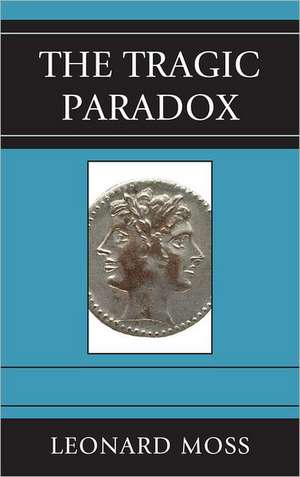
The Tragic Paradox
Autor Leonard Mossen Limba Engleză Hardback – 19 apr 2012
Preț: 659.73 lei
Preț vechi: 1053.85 lei
-37%
Puncte Express: 990
Carte tipărită la comandă
Livrare economică 16-30 noiembrie
Livrare prin curier în România Termenul estimat este afișat lângă disponibilitate.
Transport gratuit pentru acest produs Plată online sau ramburs, în funcție de opțiunile comenzii.
Retur gratuit în 14 zile Comandă securizată și suport în română.
Specificații
ISBN-13: 9780739171219
ISBN-10: 0739171216
Pagini: 262
Dimensiuni: 160 x 236 x 23 mm
Greutate: 0.56 kg
Ediția:New.
Editura: Bloomsbury Publishing
Colecția Lexington Books
Locul publicării:New York, United States
ISBN-10: 0739171216
Pagini: 262
Dimensiuni: 160 x 236 x 23 mm
Greutate: 0.56 kg
Ediția:New.
Editura: Bloomsbury Publishing
Colecția Lexington Books
Locul publicării:New York, United States
Descriere
Paradox informs the narrative sequence, images, and rhetorical tactics contrived by skilled dramatists and novelists. Their literary languages depict not only a war between rivals but also simultaneous affirmation and negation voiced by a tragic individual. They reveal the treason, flux, and duplicity brought into play by an unrelenting drive for respect. Their patterns of speech, action, and image project a convergence of polarities, the convergence of integrity and radical change, of constancy and infidelity. A fanatical drive to fulfill a traditional code of masculine conduct produces the ironic consequence of de-forming that code-the tragic paradox.
Tragic literature exploits irony. In Athenian and Shakespearean tragedy, self-righteous male or female aristocrats instigate their own disgrace, shame, and guilt, an un-expected diminishment. They are victimized by a magnificent obsession, a fantasy of un-alloyed authority or virtue, a dream of perfect self-sufficiency or trust. The authors of tragedy revised the concept of "nobility" to reflect the strange fact that grandeur elicits its own annulment. "Strengths by strengths do fail," Shakespeare wrote in Coriolanus.
The playwrights made this paradoxical predicament concrete with a narrative format that equates self-assertion with self-detraction, images that revolve between incredible reversals and provisional reinstatements, and speech that sounds impressively weighty but masks deception, disloyalty, cynicism, and insecurity. Three heroic philosophers, Plato, Hegel, and Nietzsche, contributed invaluable but contrasting accounts of these literary languages (Aristotle's Poetics will be discussed in connection with Plato's attitude toward poetry). Their divergent descriptions can be reconciled to show that invalidations as well as affirmations-the transmission of contraries-are essential for tragic composition.
An equivocal rhetoric, a mutable imagery, and an ironic progression convey the tortuous pursuit of personal preeminence or (in later tragic works by Kafka and Strindberg) family solidarity and communal safety. I am trying to integrate the disparate arguments offered by several notable theorists with technical procedures fashioned by the Athenian dramatists and recast by Shakespeare and other writers, procedures that articulate the tragic paradox.
Tragic literature exploits irony. In Athenian and Shakespearean tragedy, self-righteous male or female aristocrats instigate their own disgrace, shame, and guilt, an un-expected diminishment. They are victimized by a magnificent obsession, a fantasy of un-alloyed authority or virtue, a dream of perfect self-sufficiency or trust. The authors of tragedy revised the concept of "nobility" to reflect the strange fact that grandeur elicits its own annulment. "Strengths by strengths do fail," Shakespeare wrote in Coriolanus.
The playwrights made this paradoxical predicament concrete with a narrative format that equates self-assertion with self-detraction, images that revolve between incredible reversals and provisional reinstatements, and speech that sounds impressively weighty but masks deception, disloyalty, cynicism, and insecurity. Three heroic philosophers, Plato, Hegel, and Nietzsche, contributed invaluable but contrasting accounts of these literary languages (Aristotle's Poetics will be discussed in connection with Plato's attitude toward poetry). Their divergent descriptions can be reconciled to show that invalidations as well as affirmations-the transmission of contraries-are essential for tragic composition.
An equivocal rhetoric, a mutable imagery, and an ironic progression convey the tortuous pursuit of personal preeminence or (in later tragic works by Kafka and Strindberg) family solidarity and communal safety. I am trying to integrate the disparate arguments offered by several notable theorists with technical procedures fashioned by the Athenian dramatists and recast by Shakespeare and other writers, procedures that articulate the tragic paradox.
Cuprins
Introduction: The Languages of Paradox
Part I: The Narrative Language
Chapter 1: The Masculine Model
Chapter 2: The Tragic Female
Chapter 3: The Tragic Sequence
Chapter 4: Shakespeare's Dangerous Companion
Chapter 5: The Relevance of Hegel
Part II: The Metaphorical Language
Chapter 6: The Artistry of Flux
Chapter 7: The Logic of Dreams
Part III: The Rhetorical Language
Chapter 8: Plato's Paragon
Chapter 9: Milton's Potpourri
Chapter 10: Shakespeare's Paradox
Conclusion: The Truth of Tragedy
Notes
Two Checklists, 1900-2010
The Theory of Tragedy
Plato and Aristotle on the Craft of Literature (Annotated)
Part I: The Narrative Language
Chapter 1: The Masculine Model
Chapter 2: The Tragic Female
Chapter 3: The Tragic Sequence
Chapter 4: Shakespeare's Dangerous Companion
Chapter 5: The Relevance of Hegel
Part II: The Metaphorical Language
Chapter 6: The Artistry of Flux
Chapter 7: The Logic of Dreams
Part III: The Rhetorical Language
Chapter 8: Plato's Paragon
Chapter 9: Milton's Potpourri
Chapter 10: Shakespeare's Paradox
Conclusion: The Truth of Tragedy
Notes
Two Checklists, 1900-2010
The Theory of Tragedy
Plato and Aristotle on the Craft of Literature (Annotated)
Recenzii
With The Tragic Paradox, Leonard Moss succeeds admirably in demonstrating how major tragic figures in Western literature are defined not by monolithic grandeur, but by self-contradiction. Shakespeare's phrase in Coriolanus-'Strengths by strengths do fail'- encapsulates the paradox at the heart of tragedy: it is not exterior forces or inner weakness but rather the striving for greatness itself that causes the tragic protagonist to fall. In some cases it is a stubborn adherence to a model of masculinity, in others a threat to pride or position that triggers an emotional blindness. Discussing major theoreticians of tragedy (Plato, Aristotle, Hegel, and Nietzsche) as well as major practitioners (Aeschylus, Sophocles, Euripides, Shakespeare, and Milton), Moss works on both the macro and the micro level. In the first part of the book, titled 'The Narrative Language,' he shows how narrative design in tragedy carries out the paradox and in the second two parts, 'The Metaphorical Language' and 'The Rhetorical Language,' he analyzes how paradox functions on the level of figures and images. On both levels, Moss's readings illuminate a fruitful approach to the understanding of tragedy.