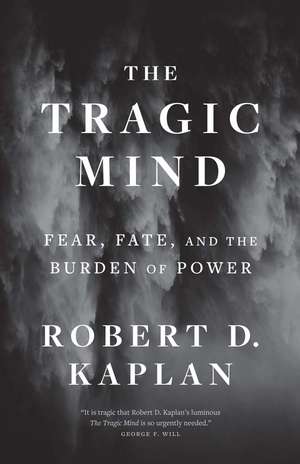
The Tragic Mind: Fear, Fate, and the Burden of Power
Autor Robert D. Kaplanen Limba Engleză Paperback – 13 feb 2024
A moving meditation on recent geopolitical crises, viewed through the lens of ancient and modern tragedy
“Spare, elegant and poignant. . . . If there is a single contemporary book that should be pressed into the hands of those who decide issues of war and peace, this is it.”—John Gray, New Statesman
“It is tragic that Robert D. Kaplan’s luminous The Tragic Mind is so urgently needed.”—George F. Will
Some books emerge from a lifetime of hard-won knowledge. Robert D. Kaplan has learned, from a career spent reporting on wars, revolutions, and international politics in Europe, the Middle East, and East Asia, that the essence of geopolitics is tragedy. In The Tragic Mind, he employs the works of ancient Greek dramatists, Shakespeare, German philosophers, and the modern classics to explore the central subjects of international politics: order, disorder, rebellion, ambition, loyalty to family and state, violence, and the mistakes of power.
The great dilemmas of international politics, he argues, are not posed by good versus evil—a clear and easy choice—but by contests of good versus good, where the choices are often searing, incompatible, and fraught with consequences. A deeply learned and deeply felt meditation on the importance of lived experience in conducting international relations, this is a book for everyone who wants a profound understanding of the tragic politics of our time.
Preț: 113.33 lei
Carte disponibilă
Livrare economică 07-21 noiembrie
Livrare express 24-30 octombrie pentru 17.39 lei
Specificații
ISBN-10: 030027677X
Pagini: 152
Dimensiuni: 140 x 216 x 12 mm
Greutate: 0.17 kg
Editura: Yale University Press
Colecția Yale University Press
Recenzii
“Spare, elegant and poignant. . . . If there is a single contemporary book that should be pressed into the hands of those who decide issues of war and peace, this is it.”—John Gray, New Statesman
“A brilliant study of how, as foreign policy often comes down to a search for the lesser evil, self-knowledge is a better guide than the CIA Factbook.”—Dominic Green, Washington Examiner
“Classical drama provides crucial lessons for policymakers. . . . A road map for effective, well-considered policy.”—Kirkus Reviews
“[A] short but profound book. . . . [Kaplan] brings to his work a knowledge of the inextricable link between history and geography, experiences of the chaos of war as a foreign correspondent embedded with American forces, and a careful study of the relevance of classical geopolitics to international relations.”—Francis Sempa, New York Journal of Books
“[An] eloquent meditation on war, geopolitics, and the human condition.”—G. John Ikenberry, Foreign Affairs
“Both a personal and a professional meditation. . . . Written in an aphoristic style that begs quotation.”—Robert D. Granieri, Chronicles
“Robert Kaplan . . . has a talent for accessible writing that conveys great insight. . . . Leaders will want to read this book and learn from it. For those anxious about the direction of America’s own leadership, the book includes plenty of evidence that there is a good deal to worry about.”—Graham McAleer, Law & Liberty
“If anyone is qualified to talk about war and conflict, it’s Robert Kaplan and his forty years as a foreign correspondent. He is on everyone’s list of top policy thinkers and has written 20 books to back up his reputation. He has now added another, The Tragic Mind, his most personal book, . . . about deep regret by a keen observer of war.”—Patrick Luciani, The Hub
“[At] an efficient 150 pages, [the book] is a deep meditation on the concept of tragedy as developed by the Greeks, German philosophers, and an array of Western literary figures from Shakespeare to Camus. The book is engrossing, both as literary survey and personal essay on what it takes to navigate crises.”—John Waters, RealClear Defense
“It is tragic that Robert D. Kaplan’s luminous The Tragic Mind is so urgently needed.”—George F. Will
“Robert Kaplan has augmented his many penetrating studies of societies, regions, and strategies with The Tragic Mind. It deals brilliantly with the impact on the human mind of the changes wrought by conflicts and transformations in various historical periods. A moving culmination by one of America’s most thoughtful observers of international trends.”—Henry A. Kissinger, author of Leadership: Six Studies in World Strategy
“This is a brilliant and unique philosophical journey from the ancient Greeks through Shakespeare’s canon and on to modern existential literature. But above all, it is a meditation on geopolitics grounded in a lifetime of global reporting.”—Admiral James Stavridis, 16th Supreme Allied Commander at NATO and author of To Risk It All
“Robert Kaplan combines his knowledge of the classics with four decades of firsthand experience with wars and crises to wisely warn ahistorical Americans that all could have been helped by a greater tragic sensibility. He shows that tragedy is not fatalism or despair, but comprehension. A beautifully thoughtful essay.”—Joseph S. Nye, Jr., author of Do Morals Matter?
“Robert Kaplan has long been his own toughest critic. Now, in The Tragic Mind, he draws on Aeschylus, Euripides, and Sophocles for an unflinchingly courageous course correction: a deeply significant book for troubled times.”—John Lewis Gaddis, author of On Grand Strategy
“This is an author who has made it his business to see the world we live in. I have always read his work with awe. In this book, Kaplan takes the reader beyond the realm of information and knowledge and into the territory of wisdom. It is a profound must-read for all who wish to understand the world as it is.”—Ayaan Hirsi Ali, author of Prey: Immigration, Islam, and the Erosion of Women’s Rights
“If there's a single volume that should be required reading—and deep reflection—for all leaders and policy makers, this is it.”—Evan Thomas, author of Road to Surrender: Three Men and the Countdown to the End of World War II
Notă biografică
Robert D. Kaplan, the Robert Strausz-Hupé Chair in Geopolitics at the Foreign Policy Research Institute, was twice named one of the world’s “Top 100 Global Thinkers” by Foreign Policy. A reporter with decades of experience writing for The Atlantic, he has written twenty-two books, including The Loom of Time; Adriatic; The Good American; The Revenge of Geography; Asia’s Cauldron; Monsoon; The Coming Anarchy; and Balkan Ghosts. He has served on the Pentagon’s Defense Policy Board and the U.S. Navy’s Executive Panel.
Descriere
A moving meditation on recent geopolitical crises, viewed through the lens of ancient and modern tragedy