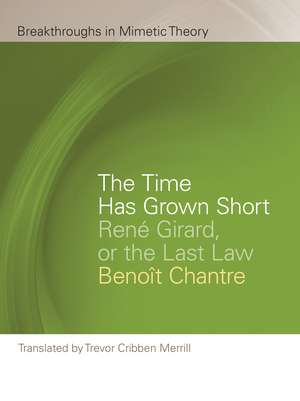
The Time Has Grown Short: René Girard, or the Last Law: Breakthroughs in Mimetic Theory
Autor Benoît Chantre Traducere de Trevor Cribben Merrillen Limba Engleză Paperback – mai 2022
Preț: 189.17 lei
Puncte Express: 284
Carte disponibilă
Livrare economică 26 octombrie-09 noiembrie
Livrare express 10-16 octombrie pentru 13.59 lei
Livrare prin curier în România Termenul estimat este afișat lângă disponibilitate.
Transport gratuit de la 400.00 lei Plată online sau ramburs, în funcție de opțiunile comenzii.
Retur gratuit în 14 zile Comandă securizată și suport în română.
Specificații
ISBN-13: 9781611864267
ISBN-10: 1611864267
Pagini: 116
Dimensiuni: 114 x 152 x 10 mm
Greutate: 0.03 kg
Ediția:First Edition
Editura: Michigan State University Press
Colecția Michigan State University Press
Seria Breakthroughs in Mimetic Theory
ISBN-10: 1611864267
Pagini: 116
Dimensiuni: 114 x 152 x 10 mm
Greutate: 0.03 kg
Ediția:First Edition
Editura: Michigan State University Press
Colecția Michigan State University Press
Seria Breakthroughs in Mimetic Theory
Notă biografică
BENOÎT CHANTRE is a French essayist and literary critic. He has authored books on the German poet Hölderlin (Le clocher de Tübingen, 2019) and René Girard (Les derniers jours de René Girard, 2016), with whom he collaborated on Battling to the End (2009).
Cuprins
Contents
Introduction
I. From Vertical Transcendence to Deviated Transcendence
II. Self-Transcendence, the Scapegoat Mechanism, and the Institution of Sacrifice
III. Messianic Transcendence
IV. A Mimetic Approach to the Letter to the Romans
Conclusion
Notes
Recenzii
Benoît Chantre has written a volume that masterfully lays out the three major syntheses of mimetic theory while also breaking important new ground. His eschatological reading of Saint Paul’s Letter to the Romans brilliantly shows the vibrant compossibilities—and the coexistence of apparent opposites—that are so central to understanding René Girard’s intellectual project.—Luke Burgis, author of Wanting: The Power of Mimetic Desire in Everyday Life
Benoît Chantre has written a beautiful and profound book. He has attempted something new in Girardian research: to reread the entirety of René Girard’s thought from a few words offered toward the end of Battling to the End on médiation intime (innermost mediation), words attributed to Augustine’s Deos interior intimo meo. Chantre sees in Saint Paul’s Letter to the Romans the culmination of Girard’s new conception of “anthropo-theology.”—Sandor Goodhart, professor of English and Jewish studies, Purdue University
Benoît Chantre has written a beautiful and profound book. He has attempted something new in Girardian research: to reread the entirety of René Girard’s thought from a few words offered toward the end of Battling to the End on médiation intime (innermost mediation), words attributed to Augustine’s Deos interior intimo meo. Chantre sees in Saint Paul’s Letter to the Romans the culmination of Girard’s new conception of “anthropo-theology.”—Sandor Goodhart, professor of English and Jewish studies, Purdue University
Descriere
The protagonist of Marcel Proust’s In Search of Lost Time observes with wonder the comings and goings of the crows that roost in the belfry of the village church in Combray, his childhood home. For René Girard, one of Proust’s great interpreters, their mysterious flight, first departing from and then returning to the vertical axis of the steeple, suggests the movement of modern history—the crisis of aristocratic models, the growing servitude of individuals possessed by mimetic desire, and the final irruption of authentic transcendence. In this rich exploration of Girard’s insights, his French editor and longtime collaborator Benoît Chantre brings Saint Paul’s Letter to the Romans into dialogue with both Proust and Girard in order to push to its logical endpoint the idea of a back-and-forth movement from chaos to order.