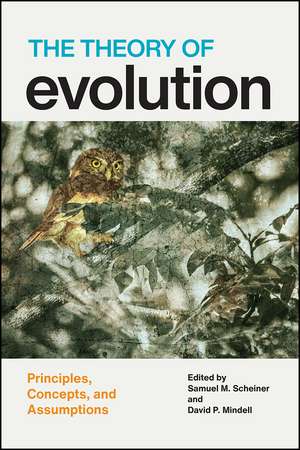
The Theory of Evolution: Principles, Concepts, and Assumptions
Editat de Samuel M. Scheiner, David P. Mindellen Limba Engleză Hardback – 7 ian 2020
Observăm în The Theory of Evolution o ambiție academică remarcabilă: aceea de a oferi o sinteză teoretică pentru secolul XXI, capabilă să integreze volumul imens de date acumulate de la „Sinteza Modernă” a mijlocului de secol XX până astăzi. Interdisciplinaritatea este pilonul central al volumului, editorii Samuel M. Scheiner și David P. Mindell facilitând un dialog riguros între biologia moleculară, biogeografie, filozofia științei și paleontologie. Această abordare permite tratarea unor fenomene complexe, precum transferul lateral de gene sau selecția pe mai multe niveluri, nu ca excepții, ci ca elemente constitutive ale unei teorii generale expandate.
Subliniem modul în care acest volum se ancorează în opera anterioară a lui Samuel M. Scheiner. Dacă în The Theory of Ecology autorul încerca să organizeze modelele disparate ale ecologiei într-un cadru coerent, iar în Phenotypic Plasticity analiza variația planurilor corporale, lucrarea de față reprezintă vârful de lance al acestui demers de sistematizare. Cartea nu se mulțumește să enumere fapte biologice, ci interoghează structura logică a biologiei evoluționiste.
Structura volumului este una progresivă, de la general la specific. Prima parte analizează fundamentele istorice și filozofice, punând sub lupă concepte precum omologia și natura speciilor. A doua parte se concentrează pe teoriile constitutive, oferind o perspectivă inductivă asupra selecției naturale. Tonul este unul academic, precis, destinat cercetătorilor și studenților avansați care caută să înțeleagă cum se raportează noile seturi de date genomice la arhitectura clasică a darwinismului. Cele 16 tabele și ilustrațiile tehnice completează un text dens, dar esențial pentru recalibrarea curriculumului de biologie teoretică.
Preț: 822.31 lei
Preț vechi: 903.64 lei
-9%
Carte disponibilă
Livrare economică 14-28 noiembrie
Livrare express 31 octombrie-06 noiembrie pentru 42.78 lei
Specificații
ISBN-10: 022667102X
Pagini: 464
Ilustrații: 14 halftones, 4 line drawings, 16 tables
Dimensiuni: 152 x 229 x 30 mm
Greutate: 0.7 kg
Ediția:First Edition
Editura: University of Chicago Press
Colecția University of Chicago Press
De ce să citești această carte
Recomandăm această carte profesioniștilor și cercetătorilor care doresc să depășească faza colectării de date și să înțeleagă structura teoretică ce le guvernează. The Theory of Evolution oferă instrumentele conceptuale necesare pentru a integra genetica modernă și biologia dezvoltării într-un model evoluționist unitar. Este o resursă fundamentală pentru oricine vrea să vadă cum arată „Sinteza Modernă” actualizată pentru provocările științifice ale prezentului.
Despre autor
Samuel M. Scheiner este un biolog teoretician de renume, cu o carieră academică desfășurată la Northern Illinois University și Arizona State University. Expertiza sa se concentrează pe organizarea formală a teoriilor biologice, fiind autorul unor lucrări de referință precum The Theory of Ecology și Phenotypic Plasticity. În colaborare cu David P. Mindell, acesta aduce în The Theory of Evolution o rigoare metodologică specifică, transformând observațiile empirice în cadre conceptuale solide. Lucrările sale sunt recunoscute pentru capacitatea de a unifica domenii aparent divergente, precum statistica aplicată, ecologia plantelor și biologia evoluționistă.
Descriere scurtă
This book gives us that framework and synthesis for the twenty-first century. The Theory of Evolution presents a series of chapters by experts seeking this integration by addressing the current state of affairs across numerous fields within evolutionary biology, ranging from biogeography to multilevel selection, speciation, and macroevolutionary theory. By presenting current syntheses of evolution’s theoretical foundations and their growth in light of new datasets and analyses, this collection will enhance future research and understanding.
Notă biografică
Cuprins
Chapter 1: The Theory of Evolution
David P. Mindell and Samuel M. Scheiner
Part 1: Overarching Issues
Chapter 2: Historicizing the Synthesis: Critical Insights and Pivotal Moments in the Long History of Evolutionary Theory
Vassiliki Betty Smocovitis
Chaper 3: Philosophy of Evolutionary Theory: Risky Inferences of Process from Pattern
Patrick Forber
Chapter 4: Modeling Evolutionary Theories
Patrick C. Phillips
Chapter 5: Traits and Homology
James O. McInerney
Chapter 6: The Nature of Species in Evolution
Marco J. Nathan and Joel Cracraft
Chapter 7: The Tree of Life and the Episodic Evolutionary Synthesis
Maureen Kearney
Chapter 8: Situating Evolutionary Developmental Biology in Evolutionary Theory
Alan C. Love
Part 2: Constitutive Theories
Chapter 9: The Inductive Theory of Natural Selection
Steven A. Frank and Gordon A. Fox
Chapter 10: The Theory of Multilevel Selection
Charles Goodnight
Chapter 11: The Demography of Fitness: Life Histories and Their Evolution
Gordon A. Fox and Samuel M. Scheiner
Chapter 12: The Theory of Ecological Specialization
Timothée Poisot
Chapter 13: The Theory of the Evolution of Phenotypic Plasticity
Samuel M. Scheiner
Chapter 14: The Evolution of Sex
Maria E. Orive
Chapter 15: Speciation
Scott V. Edwards, Robin Hopkins, and James Mallet
Chapter 16: The Theory of Evolutionary Biogeography
Rosemary G. Gillespie, Jun Y. Lim, and Andrew J. Rominger
Chapter 17: Macroevolutionary Theory
David Jablonski
List of References
Index