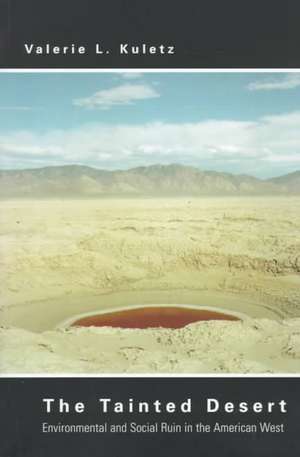
The Tainted Desert: Environmental and Social Ruin in the American West
Autor Valerie L. Kuletzen Limba Engleză Paperback – 3 apr 1998
Preț: 473.93 lei
Puncte Express: 711
Carte tipărită la comandă
Livrare economică 28 noiembrie-12 decembrie
Livrare prin curier în România Termenul estimat este afișat lângă disponibilitate.
Transport gratuit pentru acest produs Plată online sau ramburs, în funcție de opțiunile comenzii.
Retur gratuit în 14 zile Comandă securizată și suport în română.
Specificații
ISBN-13: 9780415917711
ISBN-10: 0415917719
Pagini: 360
Dimensiuni: 152 x 229 x 19 mm
Greutate: 0.68 kg
Ediția:New.
Editura: Taylor & Francis
Colecția Routledge
Locul publicării:Oxford, United Kingdom
ISBN-10: 0415917719
Pagini: 360
Dimensiuni: 152 x 229 x 19 mm
Greutate: 0.68 kg
Ediția:New.
Editura: Taylor & Francis
Colecția Routledge
Locul publicării:Oxford, United Kingdom
V-ar putea interesa
-
 -18%Preț: 1608.92 lei1962.10 lei
 -
 Exploring Environmental Issues: An Integrated ApproachDavid D. Kemp-15%Preț: 664.07 lei781.26 lei
 -
 -18%Preț: 1412.81 lei1722.93 lei
 -
 Green China: Seeking Ecological AlternativesIan G. Cook-18%Preț: 1114.85 lei1359.57 lei
 -
 -18%Preț: 1291.72 lei1575.27 lei
 -
 -18%Preț: 909.08 lei1108.63 lei
 -
 Preț: 404.23 lei
 -
 Blueprint 1: For a Green EconomyDavid PearcePreț: 403.30 lei
 -
 Environment, Energy and Climate Change IElena Jiménez-27%Preț: 1136.95 lei1558.38 lei
 -
 Advances in Watershed Science and AssessmentTamim Younos-18%Preț: 985.70 lei1202.07 lei
 -
 Environmental BiomedicineMieczyslaw Pokorski-15%Preț: 661.57 lei778.32 lei
 -
 Environment, Energy and Climate Change IIGilles Lefebvre-18%Preț: 1266.42 lei1544.41 lei
 -
 Dynamics of the Pantanal Wetland in South AmericaIvan Bergier-18%Preț: 1265.37 lei1543.13 lei
 -
 -18%Preț: 1900.83 lei2318.09 lei
 -
 Experiences from Surface Water Quality MonitoringAntoni Munné-18%Preț: 1270.02 lei1548.81 lei
 -
 -18%Preț: 1270.64 lei1549.56 lei
 -
 Indoor and Outdoor NanoparticlesMar Viana-18%Preț: 1264.94 lei1542.61 lei
 -
 From Biomolecules to ChemofossilsJan SchwarzbauerPreț: 402.05 lei
 -
 Climate Change and Water ResourcesTamim Younos-18%Preț: 1218.78 lei1486.31 lei
 -
 The Sava RiverRadmila Mila¿i¿-18%Preț: 1900.41 lei2317.57 lei
 -
 Silver Nanoparticles in the EnvironmentJingfu LiuPreț: 400.42 lei
 -
 -15%Preț: 662.58 lei779.51 lei
 -
 Environmental Photochemistry Part IIIDetlef W. Bahnemann-18%Preț: 1891.93 lei2307.22 lei
 -
 Threats to the Quality of Groundwater ResourcesAndrea Scozzari-18%Preț: 1269.15 lei1547.75 lei
 -
 Polycyclic Aromatic HydrocarbonsHuizhong Shen-15%Preț: 664.14 lei781.33 lei
 -
 -20%Preț: 645.19 lei806.48 lei
 -
 -15%Preț: 669.81 lei788.01 lei
Notă biografică
Valerie L. Kuletz, the daughter of a weapons scientist, grew up near a Department of Defense research and testing center in the Mojave Desert. She has taught at the University of California at Santa Cruz, and currently is Lecturer in American Studies at the University of Canterbury in New Zealand. Her work on this book won the American Sociological Association's 1997 Robert Boguslaw Award for Technology and Humanism.
Recenzii
"This is an important and serious book that deserves a wide audience, both in and out of the classroom." -- International Journal of Mass Emergencies and Disasters
"...present detailed understandings of the environmental and social impacts of advanced industrial society on diverse American Indian communities...they make important contributions to understanding the broader differential benefits and burdens of science and technology in the late twentieth century, particularly as it concerns environmental degradiation...will be of particular interest to students of the American West, American Indian communities, and scholars of environmental justice and of societal change in the postindustrial world." -- Environmental History
"The author's inclusion of Native-American perspectives and voices, her critique of the "objectivity" of science, and the timeliness of the topic...all make this one of the most important environmental books of our time." -- The Bloomsbury Review
"The Tainted Desert brings to mind Rachel Carson's Silent Spring as a wake-up call to Americans." -- The Bloomsbury Review
"Tainted Desert is a powerful, important, and readable explication of the nuclear devastation of the American Southwest." -- San Francisco Bay Guardian
"[Kuletz] has written a striking...portrait of the consequences of `nuclearism' in the American West, and particularly of the tragic, largely unacknowledged overlap between the domain of Native Americans and that of uranium mining, weapons testing, and nuclear waste storage... Her study invokes the richness of a landscape that has been overlaid with devestation... This is an important and, at times, eloquent book." -- Audubon
"...a moving account of the 'secret nuclear holocaust' spawned in the Southwest desert by the nuclear experimentation of the 1940s, '50s and '60s...readers will find a deeply disturbing indictment of our government's neglect and lack of responsibility to the land and its people." -- Publishers Weekly
"Offering a unique perspective on a controversial topic, this is recommended for academic environmental and sociological collections." -- Library Journal
"Kuletz does a solid job of presenting [Native American] views..." -- Kirkus Reviews
"The Tainted Desert is a powerful, important, and readable explication of the nuclear devastation of the American Southwest... In her very fine text, Valerie Kuletz explores the ways in which the deadly convergence of militarism, science, and the nuclear industry resulted in environmental havoc that threatens both the indigenous peoples of the region and the rest of us who live on the planet... She makes compelling arguments without resorting to jargon... will change the way you look at the world." -- San Francisco Bay Guardian
"The Tainted Desert vividly shows how contending constructions of nature map the earth and how these constructions--scientific, policy, Native American, tourist, sacred, and secular--collide in the management of nuclear waste. This is an important book and a deeply satisfying read." -- Donna J. Haraway, author of Modest_Witness@Second_Millennium
"Valerie Kuletz presents an astonishingly powerful indictment of the interrelated processes of genocide and ecocide that the US nuclear establishment has visited upon the western regions of our continent since 1945. Thoroughly documented and eloquently argued, this book offers one of the best overviews of America's self-imposed radioactive holocaust. It is absolutely essential reading for anyone in the least concerned with the future of the land, or of life itself." -- Ward Churchill, Coordinator of American Indian Studies, University of Colorado
"Through the powerful tools of visual and narrative mapping, Kuletz makes visible the human cost of nuclear development and testing and raises the lid on the pressing issue of waste storage. ... [A] comprehensive work that demonstrates clearly how science, once thought to be objective, arises from a cultural viewpoint." -- Booklist
"... a thorough analysis of intercultural differences." -- Choice
"A disturbing look at how the federal government has carved up the American West into gunnery ranges, army bases, testing grounds, and nuclear waste dumps, and destroyed the environment and Native American culture in the name of 'defense'." -- Sunday Record, Hackensack, N.J.
"...present detailed understandings of the environmental and social impacts of advanced industrial society on diverse American Indian communities...they make important contributions to understanding the broader differential benefits and burdens of science and technology in the late twentieth century, particularly as it concerns environmental degradiation...will be of particular interest to students of the American West, American Indian communities, and scholars of environmental justice and of societal change in the postindustrial world." -- Environmental History
"The author's inclusion of Native-American perspectives and voices, her critique of the "objectivity" of science, and the timeliness of the topic...all make this one of the most important environmental books of our time." -- The Bloomsbury Review
"The Tainted Desert brings to mind Rachel Carson's Silent Spring as a wake-up call to Americans." -- The Bloomsbury Review
"Tainted Desert is a powerful, important, and readable explication of the nuclear devastation of the American Southwest." -- San Francisco Bay Guardian
"[Kuletz] has written a striking...portrait of the consequences of `nuclearism' in the American West, and particularly of the tragic, largely unacknowledged overlap between the domain of Native Americans and that of uranium mining, weapons testing, and nuclear waste storage... Her study invokes the richness of a landscape that has been overlaid with devestation... This is an important and, at times, eloquent book." -- Audubon
"...a moving account of the 'secret nuclear holocaust' spawned in the Southwest desert by the nuclear experimentation of the 1940s, '50s and '60s...readers will find a deeply disturbing indictment of our government's neglect and lack of responsibility to the land and its people." -- Publishers Weekly
"Offering a unique perspective on a controversial topic, this is recommended for academic environmental and sociological collections." -- Library Journal
"Kuletz does a solid job of presenting [Native American] views..." -- Kirkus Reviews
"The Tainted Desert is a powerful, important, and readable explication of the nuclear devastation of the American Southwest... In her very fine text, Valerie Kuletz explores the ways in which the deadly convergence of militarism, science, and the nuclear industry resulted in environmental havoc that threatens both the indigenous peoples of the region and the rest of us who live on the planet... She makes compelling arguments without resorting to jargon... will change the way you look at the world." -- San Francisco Bay Guardian
"The Tainted Desert vividly shows how contending constructions of nature map the earth and how these constructions--scientific, policy, Native American, tourist, sacred, and secular--collide in the management of nuclear waste. This is an important book and a deeply satisfying read." -- Donna J. Haraway, author of Modest_Witness@Second_Millennium
"Valerie Kuletz presents an astonishingly powerful indictment of the interrelated processes of genocide and ecocide that the US nuclear establishment has visited upon the western regions of our continent since 1945. Thoroughly documented and eloquently argued, this book offers one of the best overviews of America's self-imposed radioactive holocaust. It is absolutely essential reading for anyone in the least concerned with the future of the land, or of life itself." -- Ward Churchill, Coordinator of American Indian Studies, University of Colorado
"Through the powerful tools of visual and narrative mapping, Kuletz makes visible the human cost of nuclear development and testing and raises the lid on the pressing issue of waste storage. ... [A] comprehensive work that demonstrates clearly how science, once thought to be objective, arises from a cultural viewpoint." -- Booklist
"... a thorough analysis of intercultural differences." -- Choice
"A disturbing look at how the federal government has carved up the American West into gunnery ranges, army bases, testing grounds, and nuclear waste dumps, and destroyed the environment and Native American culture in the name of 'defense'." -- Sunday Record, Hackensack, N.J.
Cuprins
One: Mapping the Nuclear Landscape; 1: Introduction; 2: Tragedy at the Center of the Universe; 3: Science Cities in the Desert; 4: Nuclear Wasteland; Two: Power, Representation, and Cultural Politics at Yucca Mountain; 5: The View from Yucca Mountain; 6: Cultural Politics; 7: The Country of Lost Borders; 8: Aboriginal Homeland; 9: The Experimental Landscape; 10: Conclusion