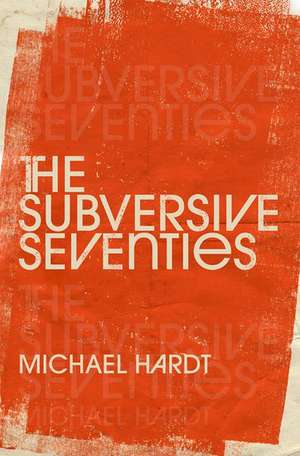
The Subversive Seventies
Autor Michael Hardten Limba Engleză Hardback – 5 sep 2023
Observăm în The Subversive Seventies o reevaluare necesară a unei decade adesea catalogate drept una a eșecului politic sau a violenței sterile. Michael Hardt propune o teză provocatoare: în timp ce mișcările anilor '60 au marcat sfârșitul unei ere, luptele anilor '70 reprezintă, de fapt, geneza contextului nostru politic actual. Găsim în această carte o cartografiere a rezistenței globale, de la armatele țărănești din Guineea-Bissau până la mișcările de eliberare din Coreea de Sud sau Italia, toate unite prin confruntarea directă cu structurile neoliberale care începuseră să prindă contur. Structura narativă nu se limitează la o cronică istorică, ci extrage lecții practice pentru activismul modern, analizând modul în care subversivitatea a atacat bazele autorității stabilite. Ca o alternativă la The Hidden 1970s pentru cursurile de științe politice și sociologie, lucrarea lui Hardt aduce avantajul unei perspective teoretice mai vaste, integrând experiențele diverse ale „subversivilor” într-un cadru conceptual unitar. Autorul continuă aici investigația începută în Multitude și Assembly, mutând însă reflectorul de pe mișcările contemporane „fără lideri” către rădăcinile lor istorice din urmă cu cinci decenii. Stilul este riguros, specific unei publicații Oxford University Press, dar păstrează o claritate care face accesibile concepte complexe de teorie politică radicală.
Preț: 163.40 lei
Preț vechi: 194.33 lei
-16%
Carte disponibilă
Livrare economică 21-26 mai
Livrare express 02-08 mai pentru 65.27 lei
Specificații
ISBN-10: 0197674658
Pagini: 320
Dimensiuni: 164 x 236 x 30 mm
Greutate: 0.59 kg
Editura: Oxford University Press
Colecția OUP USA
Locul publicării:New York, United States
De ce să citești această carte
Această carte este esențială pentru cercetătorii și activiștii care doresc să înțeleagă originile mișcărilor sociale contemporane. Cititorul câștigă o perspectivă globală asupra anilor '70, depășind clișeele istorice. Este un motiv concret de a explora cum strategiile de eliberare din trecut pot informa rezistența împotriva structurilor neoliberale de astăzi, oferind un ghid teoretic pentru noi forme de acțiune politică.
Despre autor
Michael Hardt este profesor de literatură și limba italiană la Universitatea Duke. Este recunoscut la nivel internațional pentru colaborările sale cu Antonio Negri, împreună cu care a scris lucrări fundamentale pentru teoria politică modernă, precum trilogia începută cu Empire. Opera sa se concentrează pe analiza structurilor de putere globale și pe potențialul transformator al mișcărilor sociale de masă. În The Subversive Seventies, Hardt își folosește expertiza pentru a recupera istorii uitate ale rezistenței, continuând să exploreze tema „multitudinii” și a organizării politice non-ierarhice.
Descriere
Recenzii
Hardt provides an alternative and, dare I say, hopeful, history for contemporary political struggles. Rejecting the story that we live in the shadows of the '60s, which often ends in failure, fragmentation, and cooptation, Hardt rescues the '70s with a fragmented, global story about struggles that sought to subvert existing power relations and offer their own liberatory visions. And despite the distances and differences among them, Hardt finds another kind of unity in the concepts they used to understand their struggles.
Like putting on a pair of glasses that finally has the right prescription: the edges of the world become sharper and what seemed distant is suddenly near. A dazzling achievement.
Damned or forgotten, obscured by the 'global Sixties' or by military dictatorships and incipient neoliberal hegemony, the revolutionary movements of the 1970s continue to speak to us. Michael Hardt takes readers on a breathtaking tour across those movements in different parts of the world, reactivating their political imagination for the needs of the present. A must-read book for anybody interested in a politics of liberation in its genealogy and its contemporary stakes.
In offering his generous panorama of the militant movements of the 1970s, Hardt does us a remarkable service. He lets us revisit and rethink the past in a way that explains and unsettles our present. The watchwords of autonomy, ungovernability, and revolution that reverberated during that stormy decade did not wither on the vine. They are on the lips and in the hearts of young radicals today.
In this major contribution to movement politics, Hardt deftly combines inspirational stories with strategic insights.
"The Subversive Seventies" is highly recommended.