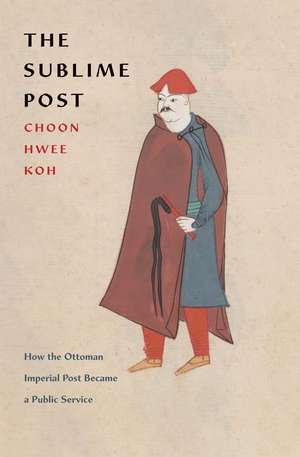
The Sublime Post: How the Ottoman Imperial Post Became a Public Service
Autor Choon Hwee Kohen Limba Engleză Hardback – 17 sep 2024
Before the advent of steamships or the telegraph, the premier technology for long-distance communication was the horse-run relay system. Every empire had one—including the Ottoman Empire. In The Sublime Post, Choon Hwee Koh examines how the vast Ottoman postal system worked across three centuries by tracking the roles of eight small-scale actors—the Courier, the Tatar, Imperial Decrees, the Bookkeeper, the Postmaster, the Villager, Money, and the Horse. There are stories of price-gouging postmasters; of murdered couriers and their bereaved widows; of moonlighting officials transporting merchandise; of neighboring villages engaged in long-running feuds; of bookkeepers calculating the annual costs of horseshoes, halters, and hay; of Tatar couriers and British travelers sharing drunken nights at post stations; of swimming with horses across rivers; and of hiding from marauding bandits in the desert.
By weaving together chronicles, sharia court records, fiscal registers, collective petitions, appointment contracts, and imperial decrees from the Ottoman archive, this study of a large-scale communications infrastructure reveals the interdependence of an empire and its diverse imperial subjects. Koh traces this evolving interdependence between 1500 and 1840 to tell the history of the Ottoman Empire and its changing social order.
Preț: 439.64 lei
Puncte Express: 659
Carte disponibilă
Livrare economică 10-24 noiembrie
Livrare express 27-31 octombrie pentru 36.34 lei
Livrare prin curier în România Termenul estimat este afișat lângă disponibilitate.
Transport gratuit pentru acest produs Plată online sau ramburs, în funcție de opțiunile comenzii.
Retur gratuit în 14 zile Comandă securizată și suport în română.
Specificații
ISBN-13: 9780300270532
ISBN-10: 0300270534
Pagini: 272
Ilustrații: 25 b-w illus.
Dimensiuni: 156 x 235 x 26 mm
Greutate: 0.48 kg
Editura: Yale University Press
Colecția Yale University Press
ISBN-10: 0300270534
Pagini: 272
Ilustrații: 25 b-w illus.
Dimensiuni: 156 x 235 x 26 mm
Greutate: 0.48 kg
Editura: Yale University Press
Colecția Yale University Press
Recenzii
“Materially rich and conceptually insightful. . . . A detailed and systematic reconstruction of the 18th-century Ottoman courier system.”—Florian Riedler, American Historical Review
“An absolute delight for scholarly readers. The author’s graceful prose balances the rich depths of Ottoman imperial archives with immersive narratives that breathe life into an evolving socio-technical infrastructure spanning continents and centuries.”—Xiaoyue Yasin Li, Technology and Culture
“An important as well as fascinating book.”—Jeremy Black, New Diplomatic History
2025 Albert Hourani Book Award winner, sponsored by the Middle East Studies Association
“Combining meticulous multilingual archival research with sophisticated social theory, what at first glance might appear as an encapsulated institutional study offers a fundamentally novel understanding of Ottoman state and social evolution during 350 years. A landmark achievement, with wide Eurasian implications.”—Victor Lieberman, University of Michigan
“This is a transformative analysis of empire, territory, and bureaucracy. The innovative focus on information infrastructures and system breakdown makes it a must-read for anyone interested in technologies of statecraft.”—Majed Akhter, King’s College London
“With meticulous research and analytical insight, Choon Hwee Koh penetrates the capillaries of the Ottoman postal system and impressively describes how the state thickened its authority by involving ordinary people.”—Cemal Çetin, author of Ulak Yol Durak (Messenger Road Station)
“Koh shows how the Ottoman central government delegated tasks to a diverse set of local intermediaries and monitored them in developing and maintaining a postal system across the large empire. This richly documented book should be required reading for those trying to better understand the growing capacity, resilience, and limitations of early modern states.”—Şevket Pamuk, Boğaziçi University
“In an exciting and innovative fashion, Dr. Koh presents the Ottoman postal system as a system, an approach rarely taken in Ottoman historiography. Generally, the system’s human and non-human components interacted quite effectively. However, breakdowns did occur; and from Dr. Koh’s ingenious analysis of such occurrences, she deduces the workings of the system.”—Suraiya Faroqhi, author of The Ottoman and Mughal Empires: Social History in the Early Modern World
“An absolute delight for scholarly readers. The author’s graceful prose balances the rich depths of Ottoman imperial archives with immersive narratives that breathe life into an evolving socio-technical infrastructure spanning continents and centuries.”—Xiaoyue Yasin Li, Technology and Culture
“An important as well as fascinating book.”—Jeremy Black, New Diplomatic History
2025 Albert Hourani Book Award winner, sponsored by the Middle East Studies Association
“Combining meticulous multilingual archival research with sophisticated social theory, what at first glance might appear as an encapsulated institutional study offers a fundamentally novel understanding of Ottoman state and social evolution during 350 years. A landmark achievement, with wide Eurasian implications.”—Victor Lieberman, University of Michigan
“This is a transformative analysis of empire, territory, and bureaucracy. The innovative focus on information infrastructures and system breakdown makes it a must-read for anyone interested in technologies of statecraft.”—Majed Akhter, King’s College London
“With meticulous research and analytical insight, Choon Hwee Koh penetrates the capillaries of the Ottoman postal system and impressively describes how the state thickened its authority by involving ordinary people.”—Cemal Çetin, author of Ulak Yol Durak (Messenger Road Station)
“Koh shows how the Ottoman central government delegated tasks to a diverse set of local intermediaries and monitored them in developing and maintaining a postal system across the large empire. This richly documented book should be required reading for those trying to better understand the growing capacity, resilience, and limitations of early modern states.”—Şevket Pamuk, Boğaziçi University
“In an exciting and innovative fashion, Dr. Koh presents the Ottoman postal system as a system, an approach rarely taken in Ottoman historiography. Generally, the system’s human and non-human components interacted quite effectively. However, breakdowns did occur; and from Dr. Koh’s ingenious analysis of such occurrences, she deduces the workings of the system.”—Suraiya Faroqhi, author of The Ottoman and Mughal Empires: Social History in the Early Modern World
Notă biografică
Choon Hwee Koh is assistant professor of history at UCLA. Born and raised in Singapore, she has lived and studied in Lebanon, Iran, India, and Türkiye.