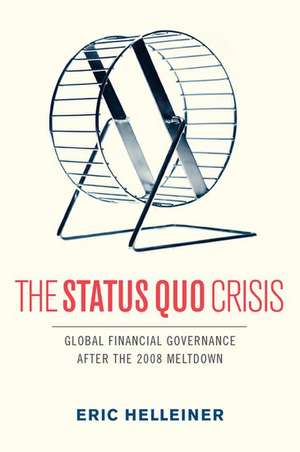
The Status Quo Crisis: Global Financial Governance After the 2008 Meltdown
Autor Eric Helleineren Limba Engleză Hardback – 7 aug 2014
În contextul instabilității economice actuale, înțelegerea mecanismelor care mențin ordinea financiară globală este vitală pentru orice decident. După colapsul din 2008, vocea colectivă a analiștilor anticipa o transformare radicală a guvernării financiare, un veritabil „moment Bretton Woods” care să rescrie regulile jocului. Ne-a atras atenția modul în care Eric Helleiner demontează această așteptare în The Status Quo Crisis, argumentând că, în locul unei revoluții, am asistat la o consolidare surprinzătoare a vechilor structuri. Merită menționat că, deși s-au creat forumuri precum G20, pârghiile de putere au rămas în mare parte neschimbate. Credem că forța acestui volum rezidă în capacitatea de a explica de ce instituțiile internaționale și reglementările de piață nu au suferit modificări de substanță. Autorul pune sub lupă rolul central al Statelor Unite și explică cum conservatorismul noilor puteri economice a contribuit la acest rezultat static. Ca și Jonathan Kirshner în American Power after the Financial Crisis, autorul distilează experiență reală în principii acționabile, însă Helleiner se concentrează mai mult pe reziliența instituțională decât pe declinul legitimității ideologice. Această lucrare continuă explorarea temelor din Global Finance in Crisis și The Future of the Dollar, oferind o perspectivă matură asupra modului în care politica internă a statelor influente dictează stabilitatea sau reforma la nivel mondial. Cititorul va găsi aici o analiză riguroasă a eșecului reformelor majore, într-un stil care evită jargonul inutil, dar păstrează precizia academică.
Preț: 311.07 lei
Preț vechi: 377.98 lei
-18%
Carte tipărită la comandă
Livrare economică 05-16 iunie
Specificații
ISBN-10: 0199973636
Pagini: 248
Dimensiuni: 272 x 160 x 18 mm
Greutate: 0.48 kg
Editura: Oxford University Press
Colecția OUP USA
Locul publicării:New York, United States
V-ar putea interesa
-
 CrashedAdam Tooze-27%Preț: 96.16 lei131.63 lei
 -
 FreefallJoseph E. StiglitzPreț: 130.13 lei
 -
 Preț: 134.68 lei
 -
 Preț: 198.36 lei
 -
 13 BankersSimon JohnsonPreț: 98.49 lei
 -
 -27%Preț: 75.76 lei103.59 lei
 -
 The Death of MoneyJames Rickards-32%Preț: 60.96 lei89.08 lei
 -
 This Time is DifferentCarmen M. ReinhartPreț: 132.98 lei
 -
 Paper PromisesPhilip Coggan-20%Preț: 60.53 lei75.58 lei
 -
 Wolf, M: Shifts and the ShocksMartin Wolf-19%Preț: 72.76 lei90.23 lei
 -
 American Power after the Financial CrisisJonathan KirshnerPreț: 146.80 lei
 -
 -26%Preț: 71.55 lei97.18 lei
 -
 The Case for a New Bretton WoodsKevin P GallagherPreț: 84.16 lei
 -
 -26%Preț: 80.67 lei109.53 lei
 -
 Paper Dragons: China and the Next CrashWalden Bello-43%Preț: 77.72 lei136.73 lei
 -
 Firefighting: The Financial Crisis and its LessonsBen S. Bernanke-21%Preț: 64.30 lei81.40 lei
 -
 The Doom LoopEswar S. PrasadPreț: 176.25 lei
 -
 The Return of Depression EconomicsPaul Krugman-21%Preț: 58.55 lei74.51 lei
 -
 In The Combat Zone of FinanceSvien Harald Øygard-11%Preț: 125.50 lei140.94 lei
De ce să citești această carte
Această carte este esențială pentru profesioniștii din economie politică și finanțe care doresc să înțeleagă de ce sistemul global nu s-a schimbat după 2008. Veți învăța cum puterea structurală a SUA și deciziile strategice ale marilor economii emergente protejează dolarul și reglementările existente. Este o lecție despre rezistența la schimbare în fața celor mai severe crize, oferind instrumente analitice pentru a evalua viitoarele șocuri economice.
Despre autor
Eric Helleiner este profesor și titular al catedrei Faculty of Arts în Economie Politică Internațională la Universitatea din Waterloo. Cu o carieră dedicată studiului sistemelor monetare și financiare, el este o autoritate recunoscută în analiza istorică a ordinii economice globale. Printre lucrările sale de referință se numără States and the Reemergence of Global Finance și The Making of National Money. Expertiza sa se concentrează pe intersecția dintre politică și finanțe, fiind unul dintre puținii cercetători care pot oferi o perspectivă de ansamblu asupra evoluției Bretton Woods și a rolului dolarului în economia modernă.
Descriere
Recenzii
The Status Quo Crisis is the first book to show how the global policy response to the first truly global financial crash since the 1930s leaves the world vulnerable to more. It should be required reading for those keen to ensure that people and capitalism are not subject to a repeat performance for a long time to come. The last chapter describes four 'what next?' scenarios, one of which has the virtue of being optimistic.
Another outstanding book from one of the stars of the field of International Political Economy -an analysis that is at once informed, articulate, and remarkably insightful. Eric Helleiner's ability to distill and explain major historical events is uncanny.
For his expertise in international monetary and financial policy, and his ability to write about such subjects cogently and insightfully, Eric Helleiner is unsurpassed. This immensely important book provides a sobering analysis of how little has been done since the global financial crisis to change the workings and regulation of the world economy and financial markets.
Few people other than Eric Helleiner have the authority to take stock on the state of global economic governance after the financial crisis of 2008. In a book that is masterfully rigorous but broadly accessible, Helleiner shows that the same system of global economic governance that failed to prevent the crisis of 2008 also failed to manage the so-called recovery. Worse still, while there have been pockets of reform that deserve merit, Helleiner demonstrates that little has been done to reform the system so as to prevent the next crisis. Not only does Helleiner confirm this lack of significant change-or the maintenance of the 'status quo'-he gives insight as to how/why significant change failed to come about. This book should be required reading for scholars of politics and economics and for policy-makers across the globe. There is still much work to be done.