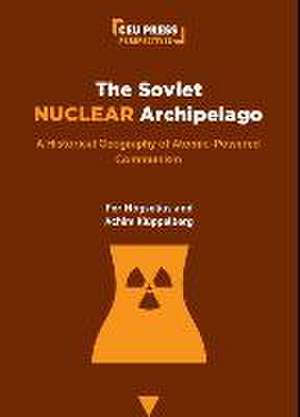
The Soviet Nuclear Archipelago: A Historical Geography of Atomic-Powered Communism: CEU Press Perspectives
Autor Achim Klüppelbergen Limba Engleză Paperback – 20 mar 2024
The two authors map the Soviet nuclear industry in a shifting historical context, making sense of a complex socio-technical and environmental history. Taking an innovative approach, this book explores the history of atomic power in the former Soviet Union using the spatial dimensions of the nuclear industry as a point of departure. The key concept is that of the archipelago – a network of nuclear facilities spread throughout the Soviet territory, but mutually reliant on each other and densely connected.
The story traces the emergence of nuclear science and technology for military and civilian purposes through to the post-Soviet Russian nuclear corporations as providers of resources and technology. The book explains how nuclear developments in the Soviet Union interacted with processes of environmental and landscape change. The spatial lens offers an analytically fruitful and pedagogically stimulating way to comprehend the nuclear histories of the Soviet Union and its successor states.


Preț: 105.36 lei
Puncte Express: 158
Carte disponibilă
Livrare economică 06-20 noiembrie
Livrare prin curier în România Termenul estimat este afișat lângă disponibilitate.
Transport gratuit de la 400.00 lei Plată online sau ramburs, în funcție de opțiunile comenzii.
Retur gratuit în 14 zile Comandă securizată și suport în română.
Specificații
ISBN-13: 9789633866474
ISBN-10: 9633866472
Pagini: 176
Ilustrații: 20 Illustrations, unspecified
Dimensiuni: 129 x 198 x 10 mm
Greutate: 0.33 kg
Ediția:1
Editura: Amsterdam University Press
Colecția Central European University Press
Seria CEU Press Perspectives
Locul publicării:Oxford, United Kingdom
ISBN-10: 9633866472
Pagini: 176
Ilustrații: 20 Illustrations, unspecified
Dimensiuni: 129 x 198 x 10 mm
Greutate: 0.33 kg
Ediția:1
Editura: Amsterdam University Press
Colecția Central European University Press
Seria CEU Press Perspectives
Locul publicării:Oxford, United Kingdom
Public țintă
AcademicNotă biografică
Achim Klüppelberg is a doctoral candidate in History of Science, Technology and Environment at KTH Royal Institute of Technology in Stockholm. He holds a BA in History and Political Science (2013) and an MA in Eastern European History (2016), both from the University of Göttingen, Germany. His studies also included a longer stay at the Russian State University for the Humanities (RGGU). His doctoral project focuses on the on the nuclear history of the Soviet Union and its successor states. He is a member of the German Society of Historians and the Society of Historians for Eastern Europe.
Per Högselius is Professor of History of Technology at KTH Royal Institute of Technology, Stockholm. He holds a MSc in Engineering Physics, a PhD in Innovation Studies and a Docent (Habilitation) degree in History of Science and Technology. He specializes in transnational studies of energy and infrastructures in historical perspective, with a particular emphasis on East-West relations.
Per Högselius is Professor of History of Technology at KTH Royal Institute of Technology, Stockholm. He holds a MSc in Engineering Physics, a PhD in Innovation Studies and a Docent (Habilitation) degree in History of Science and Technology. He specializes in transnational studies of energy and infrastructures in historical perspective, with a particular emphasis on East-West relations.
Cuprins
1. Introduction 2. Cultural Preparation 3. Bomb Geographies 4. Incepting Peaceful Atoms 5. The First Boom Phase 6. Winning New Territories 7. Evolving Macro-Entanglements 8. The Second Boom Phase 9. Towards Energy Complexes 10. Macro-Entanglements during the Second Boom Phase 11. The Post-Chernobyl Stagnation - and the Third Boom Phase 12. ConclusionAcknowledgements, Notes, Bibliography, Index.
Descriere
Explores the history of atomic power in the former Soviet Union through an innovative spatial approach, using the concept of an archipelago to map the nuclear industry's complex socio-technical and environmental history from military and civilian origins to post-Soviet Russian nuclear corporations.