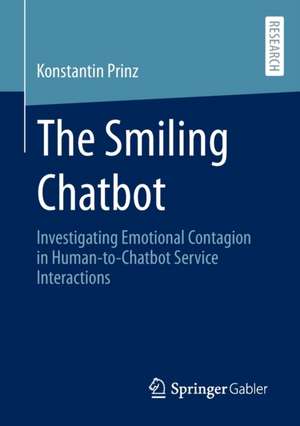
The Smiling Chatbot
Autor Konstantin Prinzen Limba Engleză Paperback – 2 dec 2022
Preț: 638.90 lei
Preț vechi: 751.66 lei
-15%
Puncte Express: 958
Carte tipărită la comandă
Livrare economică 16-30 noiembrie
Livrare prin curier în România Termenul estimat este afișat lângă disponibilitate.
Transport gratuit pentru acest produs Plată online sau ramburs, în funcție de opțiunile comenzii.
Retur gratuit în 14 zile Comandă securizată și suport în română.
Specificații
ISBN-13: 9783658400279
ISBN-10: 3658400277
Pagini: 244
Ilustrații: XVIII, 223 p. 10 illus. Textbook for German language market.
Dimensiuni: 148 x 210 x 14 mm
Greutate: 0.32 kg
Ediția:1st edition 2022
Editura: SPRINGER VIEWEG
Locul publicării:Wiesbaden, Germany
ISBN-10: 3658400277
Pagini: 244
Ilustrații: XVIII, 223 p. 10 illus. Textbook for German language market.
Dimensiuni: 148 x 210 x 14 mm
Greutate: 0.32 kg
Ediția:1st edition 2022
Editura: SPRINGER VIEWEG
Locul publicării:Wiesbaden, Germany
Cuprins
Introduction.- Foundations of Artificial Intelligence and Conversational Agents.- Emotions and Their Relevance for Service Research.- Overview of Current Literature.- Conceptual Developments and Empirical Investigations.- General Discussion.- Implications and Limitations.- References.
Textul de pe ultima copertă
Significant advances in the field of artificial intelligence have given a strong tailwind to the spread of technologies based on it. AI technologies are increasingly influencing private contexts but also the service sector where more and more service encounters are handled by chatbots. In part, however, the spread of chatbots and the associated focus on their functional advantages seem to contradict extant research findings that service interactions are also driven by emotional components. A central role is played here by so-called emotional contagion (i.e., the unconscious transfer of emotions from employees to customers). Against the background that this contagion with positive emotions can lead to a better evaluation of the service transaction in the further course, it is the goal of this book to investigate the effects of positive displayed emotions of a chatbot. For this purpose, six consecutive studies were conducted. The results show that the expression of positive emotions by achatbot enriches the service interactions by transmitting positive emotions that, in the further course, do also lead to a better evaluation of the service experienced. Moreover, it is shown that these emotional reactions are dependent on the customer’s personality and the chatbot’s appearance, expressed through an avatar.
About the author
Dr. Konstantin Prinz joined the research group Media and Service Management at the University of Koblenz-Landau in 2018. In his research, he dealt with customer-related reactions to emotions in the context of artificial intelligence. Further research interests relate to brand management and corporate communication. After receiving his PhD in 2022, he worked as a deputy professor at different universities.
Dr. Konstantin Prinz joined the research group Media and Service Management at the University of Koblenz-Landau in 2018. In his research, he dealt with customer-related reactions to emotions in the context of artificial intelligence. Further research interests relate to brand management and corporate communication. After receiving his PhD in 2022, he worked as a deputy professor at different universities.