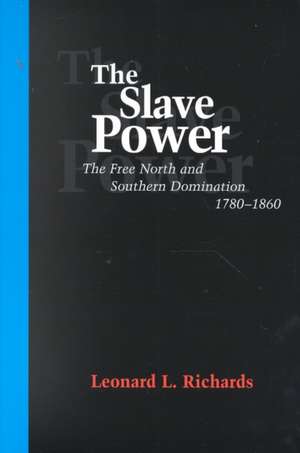
The Slave Power: The Free North and Southern Domination, 1780--1860
Autor Leonard L. Richardsen Limba Engleză Paperback – 31 iul 2000
În această lucrare publicată de Lsu Press, Leonard L. Richards reia o dezbatere istoriografică ce părea închisă încă din anii 1920: influența reală a puterii sclavagiste asupra guvernării federale americane. Notăm cu interes modul în care autorul validează teoria „Slave Power”, demonstrând că aceasta nu a fost doar o reacție paranoică a aboliționiștilor, ci o realitate politică recunoscută de figuri precum Abraham Lincoln sau editorii de la The Atlantic Monthly. Subliniem rigoarea cu care Richards documentează evoluția acestui argument, de la semnarea Constituției până în pragul Războiului Civil, oferind o perspectivă nouă asupra modului în care o minoritate sudică a reușit să își impună agenda la nivel național.
Prin intermediul unor vignete narative și portrete biografice incisive, volumul urmărește momentele critice ale expansiunii sclaviei, inclusiv Legea Sclavilor Fugari din 1850 și Compromisul Missouri. Credem că această analiză completează perspectiva oferită de A Slaveholders' Union de George William Van Cleve. În timp ce George William Van Cleve se concentrează pe fundamentele constituționale care au protejat sclavia, The Slave Power adaugă o dimensiune politică și electorală esențială, explicând strategiile de partid și modul în care alegătorii din Nord au fost mobilizați împotriva „aristocrației sclavagiste”. De asemenea, lucrarea oferă un contrast util față de Deliver Us from Evil de Lacy K. Ford, care explorează justificările ideologice ale Sudului, în timp ce Richards se concentrează strict pe exercitarea puterii administrative și legislative.
Preț: 204.91 lei
Carte tipărită la comandă
Livrare economică 02-16 decembrie
Specificații
ISBN-10: 0807126004
Pagini: 208
Dimensiuni: 153 x 230 x 13 mm
Greutate: 0.33 kg
Ediția:New.
Editura: Lsu Press
V-ar putea interesa
-
 The Life and Times of Congressman John Quincy AdamsLeonard L. Richards-16%Preț: 143.56 lei171.61 lei
 -
 The California Gold Rush and the Coming of the Civil WarLeonard L. RichardsPreț: 112.09 lei
 -
 An A-Z of Modern AmericaAlicia DuchakPreț: 247.60 lei
 -
 Preț: 412.58 lei
 -
 SaratogaRichard KetchumPreț: 247.20 lei
 -
 The Stonewall BrigadeJames I. RobertsonPreț: 141.41 lei
 -
 Antebellum Homes of GeorgiaDavid King GleasonPreț: 343.63 lei
 -
 The Decisive Battle of NashvilleStanley F. HornPreț: 147.99 lei
 -
 Civil War in LouisianaJohn D WintersPreț: 216.27 lei
 -
 AtlantaDavid King GleasonPreț: 307.37 lei
 -
 God and General Longstreet: The Lost Cause and the Southern MindThomas L. ConnellyPreț: 122.83 lei
 -
 The Shattering of Texas UnionismDale BaumPreț: 377.49 lei
 -
 Preț: 246.22 lei
 -
 Shays's RebellionLeonard L RichardsPreț: 214.81 lei
 -
 The Noblest Minds: Fame, Honor, and the American FoundingPeter McNamara-21%Preț: 365.61 lei463.74 lei
 -
 Preț: 136.46 lei
 -
 The San Saba MissionRobert S. WeddlePreț: 196.37 lei
 -
 The Dawes CommissionKent CarterPreț: 200.93 lei
 -
 A Return to His Native TownLeonard L. RichardsPreț: 135.26 lei
 -
 Rochester's Lakeside Resorts and Amusement ParksDonovan A. ShillingPreț: 223.19 lei
 -
 Block IslandDonald a. D'AmatoPreț: 213.63 lei
 -
 Death of a LegendBill GronemanPreț: 151.33 lei
 -
 Louisiana LegacyEvans J CassoPreț: 253.08 lei
 -
 100 Jahre Waldheimverein-Hedelfingen e.V.1912Brigitte MeissnerPreț: 190.27 lei
De ce să citești această carte
Această carte este esențială pentru cercetătorii istoriei politice americane și pentru cei interesați de mecanismele prin care structurile de putere pot fi capturate de grupuri de interese. Cititorul va înțelege cum sclavia nu a fost doar o problemă socială, ci pilonul central al politicii federale antebelice, oferind o explicație documentată pentru radicalizarea care a dus la conflictul civil.