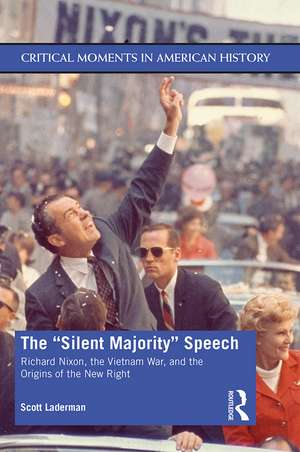
The "Silent Majority" Speech: Richard Nixon, the Vietnam War, and the Origins of the New Right: Critical Moments in American History
Autor Scott Ladermanen Limba Engleză Hardback – 19 aug 2019
The book uses Nixon’s speech – which introduced the policy of "Vietnamization" and cited the so-called bloodbath theory as a justification for continued U.S. involvement in Southeast Asia – as a fascinating moment around which to build an analysis of the last years of the war. For Nixon’s strategy to be successful, he requested the support of what he called the "great silent majority," a term that continues to resonate in American political culture. Scott Laderman moves beyond the war’s final years to address the administration’s hypocritical exploitation of moral rhetoric and its stoking of social divisiveness to achieve policy aims. Laderman explores the antiwar and pro-war movements, the shattering of the liberal consensus, and the stirrings of the right-wing resurgence that would come to define American politics.
Supplemental primary sources make this book an ideal tool for introducing students to historical research. The "Silent Majority" Speech is critical reading for those studying American political history and U.S.–Asian/Southeast Asian relations.
Din seria Critical Moments in American History
-
 Preț: 389.20 lei
 -
 Preț: 406.18 lei
 -
 Preț: 418.66 lei
 -
 Preț: 420.65 lei
 -
 Preț: 406.18 lei
 -
 Preț: 389.12 lei
 -
 Preț: 408.36 lei
 -
 Preț: 381.97 lei
 -
 Preț: 392.87 lei
 -
 Preț: 403.20 lei
 -
 Preț: 408.98 lei
 -
 Preț: 391.90 lei
 -
 Preț: 410.01 lei
 -
 Preț: 410.99 lei
 -
 Preț: 425.09 lei
 -
 Preț: 355.93 lei
 -
 Preț: 391.90 lei
 -
 Preț: 403.30 lei
 -
 Preț: 404.23 lei
 -
 Preț: 391.90 lei
 -
 Preț: 405.59 lei
 -
 Preț: 450.40 lei
 - 18%
 Preț: 1121.46 lei
 -
 Preț: 391.90 lei
 -
 Preț: 404.22 lei
 -
 Preț: 392.87 lei
 - 18%
 Preț: 1113.27 lei
 - 18%
 Preț: 1115.51 lei
Preț: 1114.82 lei
Preț vechi: 1359.54 lei
-18%
Puncte Express: 1672
Carte tipărită la comandă
Livrare economică 01-15 decembrie
Livrare prin curier în România Termenul estimat este afișat lângă disponibilitate.
Transport gratuit pentru acest produs Plată online sau ramburs, în funcție de opțiunile comenzii.
Retur gratuit în 14 zile Comandă securizată și suport în română.
Specificații
ISBN-13: 9780415347464
ISBN-10: 0415347467
Pagini: 194
Ilustrații: 5 Halftones, black and white
Dimensiuni: 152 x 229 mm
Greutate: 0.52 kg
Ediția:1
Editura: Taylor & Francis
Colecția Routledge
Seria Critical Moments in American History
Locul publicării:Oxford, United Kingdom
ISBN-10: 0415347467
Pagini: 194
Ilustrații: 5 Halftones, black and white
Dimensiuni: 152 x 229 mm
Greutate: 0.52 kg
Ediția:1
Editura: Taylor & Francis
Colecția Routledge
Seria Critical Moments in American History
Locul publicării:Oxford, United Kingdom
Public țintă
Postgraduate and UndergraduateCuprins
Series Introduction
List of Figures
Acknowledgments
A Brief Note on Language
Timeline
Part One:
Introduction. Toward "Peace"
1. Richard Nixon, the Cold War, and Southeast Asia
2. Vietnamization and the Illusion of Peace
3. Nixon and the Bloodbath Theory
4. The "Great Silent Majority" and Right-Wing Revanchism
Epilogue. Conjuring Nixon in the Twenty-First Century
Part Two: Documents
1. Richard Nixon, "Address to the Nation on the War in Vietnam," November 3, 1969
2. Mrs. Dennis W. Harrison to Richard Nixon, November 4, 1969
3. Commentary by George Salem, KWGN Television, November 5, 1969
4. Editors, "President on Solid Ground in Search for Vietnam Peace," Orlando
Sentinel, November 5, 1969
5. Robert T. Park, et al., to Richard M. Nixon, November 17, 1969
6. Excerpt from Colonel Robert D. Heinl, Jr., "The Collapse of the Armed
Forces," Armed Forces Journal (June 7, 1971)
7. Excerpt from George McT. Kahin, "History and the Bloodbath Theory in Vietnam," New
York Times, December 6, 1969
8. Richard Nixon, "Address to the Nation on the Situation in Southeast
Asia," April 30, 1970
Index
List of Figures
Acknowledgments
A Brief Note on Language
Timeline
Part One:
Introduction. Toward "Peace"
1. Richard Nixon, the Cold War, and Southeast Asia
2. Vietnamization and the Illusion of Peace
3. Nixon and the Bloodbath Theory
4. The "Great Silent Majority" and Right-Wing Revanchism
Epilogue. Conjuring Nixon in the Twenty-First Century
Part Two: Documents
1. Richard Nixon, "Address to the Nation on the War in Vietnam," November 3, 1969
2. Mrs. Dennis W. Harrison to Richard Nixon, November 4, 1969
3. Commentary by George Salem, KWGN Television, November 5, 1969
4. Editors, "President on Solid Ground in Search for Vietnam Peace," Orlando
Sentinel, November 5, 1969
5. Robert T. Park, et al., to Richard M. Nixon, November 17, 1969
6. Excerpt from Colonel Robert D. Heinl, Jr., "The Collapse of the Armed
Forces," Armed Forces Journal (June 7, 1971)
7. Excerpt from George McT. Kahin, "History and the Bloodbath Theory in Vietnam," New
York Times, December 6, 1969
8. Richard Nixon, "Address to the Nation on the Situation in Southeast
Asia," April 30, 1970
Index
Notă biografică
Scott Laderman is a professor of history at the University of Minnesota, Duluth. His previous books include Tours of Vietnam: War, Travel Guides, and Memory (2009) and Empire in Waves: A Political History of Surfing (2014).
Recenzii
"In his concise analysis of President Richard Nixon’s 'Silent Majority' speech, Scott Laderman elucidates how Nixon used his policy of 'positive polarization' to pursue his effort toward victory in Vietnam, and demonstrates how President Nixon’s speech helped bring forth the rise of the political right. An excellent examination of the beginnings of the political discourse that have shaped post-Vietnam War America."
David F. Schmitz, Robert Allen Skotheim Chair of History, Whitman College, USA
David F. Schmitz, Robert Allen Skotheim Chair of History, Whitman College, USA
Descriere
The "Silent Majority" Speech treats Richard Nixon’s address of November 3, 1969, as a lens through which to examine the latter years of the Vietnam War and their significance to US global power and domestic life. This book is critical reading for students of American political history and U.S.-Asian/Southeast Asian relations.