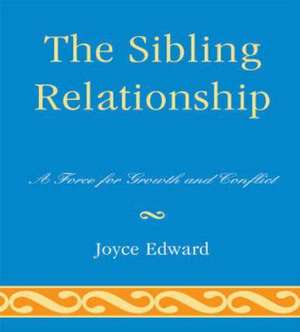
The Sibling Relationship: A Force for Growth and Conflict
Autor Joyce Edwarden Limba Engleză Paperback – 19 ian 2012
| Toate formatele și edițiile | Preț | Express |
|---|---|---|
| Paperback (1) | 299.13 lei 6-8 săpt. | |
| Bloomsbury Publishing – 19 ian 2012 | 299.13 lei 6-8 săpt. | |
| Hardback (1) | 541.89 lei 6-8 săpt. | |
| Bloomsbury Publishing – 29 dec 2010 | 541.89 lei 6-8 săpt. |
Preț: 299.13 lei
Preț vechi: 368.30 lei
-19%
Puncte Express: 449
Preț estimativ în valută:
52.97€ • 61.87$ • 46.02£
52.97€ • 61.87$ • 46.02£
Carte tipărită la comandă
Livrare economică 21 februarie-07 martie
Preluare comenzi: 021 569.72.76
Specificații
ISBN-13: 9780765707338
ISBN-10: 0765707330
Pagini: 215
Dimensiuni: 155 x 234 x 13 mm
Greutate: 0.36 kg
Editura: Bloomsbury Publishing
Colecția Jason Aronson Inc
Locul publicării:New York, United States
ISBN-10: 0765707330
Pagini: 215
Dimensiuni: 155 x 234 x 13 mm
Greutate: 0.36 kg
Editura: Bloomsbury Publishing
Colecția Jason Aronson Inc
Locul publicării:New York, United States
V-ar putea interesa
-
 Working with Emotions in PsychotherapyLeslie S. Greenberg-5%Preț: 335.34 lei352.99 lei
 -
 Preț: 293.11 lei
 -
 -30%Preț: 163.21 lei233.93 lei
 -
 -22%Preț: 116.98 lei149.22 lei
 -
 -26%Preț: 233.13 lei313.59 lei
 -
 Art Therapy and AngerAnnette Coulter-31%Preț: 194.09 lei279.50 lei
 -
 Preț: 407.85 lei
 -
 -31%Preț: 193.52 lei279.12 lei
 -
 Working with Anger and Young PeopleNick Luxmoore-26%Preț: 134.94 lei182.83 lei
 -
 Trauma, Tragedy, Therapy: The Arts and Human SufferingStephen K. Levine-30%Preț: 218.07 lei311.32 lei
 -
 Counselling People on the Autism Spectrum: A Practical ManualKatherine Paxton-27%Preț: 170.01 lei232.79 lei
 -
 -30%Preț: 181.64 lei261.22 lei
 -
 -25%Preț: 292.61 lei390.38 lei
 -
 On Becoming a PersonCarl Rogers-31%Preț: 71.40 lei103.45 lei
 -
 Focus on Psychodrama: The Therapeutic Aspects of PsychodramaPeter Felix Kellermann-30%Preț: 230.76 lei329.55 lei
 -
 -31%Preț: 193.31 lei278.98 lei
 -
 -22%Preț: 114.56 lei147.75 lei
Cuprins
1 Acknowledgments
2 Introduction
Chapter 3 1. Siblings as Developmental Partners
Chapter 4 2. The Impact of Culture on Sibling Relationships
Chapter 5 3. Siblings in the Families of Today
Chapter 6 4. Foster Care, Adoption, and the New Reproductive Technologies
Chapter 7 5. Sibling Discord
Chapter 8 6. Sibling Sexuality
Chapter 9 7. Siblings with Special Needs
Chapter 10 8. The Death of a Sibling
11 Afterword
12 Bibliography
13 Index
14 About the Author
2 Introduction
Chapter 3 1. Siblings as Developmental Partners
Chapter 4 2. The Impact of Culture on Sibling Relationships
Chapter 5 3. Siblings in the Families of Today
Chapter 6 4. Foster Care, Adoption, and the New Reproductive Technologies
Chapter 7 5. Sibling Discord
Chapter 8 6. Sibling Sexuality
Chapter 9 7. Siblings with Special Needs
Chapter 10 8. The Death of a Sibling
11 Afterword
12 Bibliography
13 Index
14 About the Author
Recenzii
With strong scholarship, an astute, well-exercised clinical eye, and an even hand, Joyce Edward opens more richly and widely than I have seen to date the multiple functions, both negative and positive, siblings serve in our lives. She rightly observes that in our clinical and theoretical universe, the topic has too long been marginalized by constructs we have perhaps centered too exclusively, failing to take stock of how siblings enrich or burden us and our patients as they help mold who we and they become. Edward, with much clarity, makes a strong case and contribution to what, in our clinical work, we all need to better take into account. A decidedly worth to have book.
There is a special warmth about this book perhaps because of the author's style and clarity, perhaps because of the subject matter which is so welcome because of long neglect, perhaps it is because most of us will bring personal recollections to the reading of the volume. In any case this is a most welcome and important book for all who work with people. Relationships between siblings are studied from many perspectives both normal and pathological. The lingering influence of death of a sibling, illness or developmental problems is discussed and case studies are presented to demonstrate treatment implications. This is an important book that belongs in the library of all practitioners and in the reference materials in schools of social work. It is even interesting enough to be read by anyone who has a sibling, as well as those who wish they did.
The sibling relationship deserves a more prominent place in psychoanalytic treatment. Joyce Edward's book is an invaluable contribution, illuminating the complexity of the sibling attachment and its significance as a force for individual development. Encyclopaedic in its scope, this book is broad as well as deep. The reader can read it as if it were a smorgasbord, selecting chapters on cultural considerations, changing family structure, foster care, adoption, new reproductive technologies, sibling rivalry, sibling sexuality, siblings with special needs. All have numerous clinical vignettes. I would urge all clinicians who care about their work to have this book in their professional library.
A clinical social worker who has practiced psychotherapy with a psychoanalytic orientation for more than 25 years, Edward here focuses on the role siblings play in each other's development in order to demonstrate the necessity for therapists to give siblings a place in the therapeutic context. She begins by focusing on sibling attachments, which provide not only security but also an internalization of interpersonal exchanges that influences how they relate to others throughout the life span. Subsequent chapters address such issues as the impact of the wider culture on sibling relationships; the impact of envy, rivalry, and hatred, which can lead to pathology; sexual activity between siblings; and the influence of a developmental disability or serious illness on the sibling relationship. A chapter addressing the effect of the death of a sibling on surviving brothers and sisters was especially interesting. Blending findings from case studies with results from quantitative research and information revealed in memoirs, biographies, and even fiction, Edward builds the case that therapists ought to give their patients' siblings a place in their treatment efforts. Summing Up: Recommended. Lower- and upper-division undergraduates, graduate students, professionals, general readers.
A comprehensive review of the literature on siblings, such as Edward has laboriously amassed, provides the perfect foundation for engaging in the kind of integrative thinking about siblings that has been largely missing from our literature, and thereby contributes a theory of sibling relationships that is broad, psychological and clinically useful.... This is a worthwhile contribution. Moreover, the many intriguing examples across the volume, the clinical focus and the select strong chapters make this book worth reading for those who want a sample of the range of clinically relevant ideas on siblings. For those who want more than a sample, this book provides a good place from which to launch an in-depth investigation of the wide-ranging literature on the sibling relationship.
There is a special warmth about this book perhaps because of the author's style and clarity, perhaps because of the subject matter which is so welcome because of long neglect, perhaps it is because most of us will bring personal recollections to the reading of the volume. In any case this is a most welcome and important book for all who work with people. Relationships between siblings are studied from many perspectives both normal and pathological. The lingering influence of death of a sibling, illness or developmental problems is discussed and case studies are presented to demonstrate treatment implications. This is an important book that belongs in the library of all practitioners and in the reference materials in schools of social work. It is even interesting enough to be read by anyone who has a sibling, as well as those who wish they did.
The sibling relationship deserves a more prominent place in psychoanalytic treatment. Joyce Edward's book is an invaluable contribution, illuminating the complexity of the sibling attachment and its significance as a force for individual development. Encyclopaedic in its scope, this book is broad as well as deep. The reader can read it as if it were a smorgasbord, selecting chapters on cultural considerations, changing family structure, foster care, adoption, new reproductive technologies, sibling rivalry, sibling sexuality, siblings with special needs. All have numerous clinical vignettes. I would urge all clinicians who care about their work to have this book in their professional library.
A clinical social worker who has practiced psychotherapy with a psychoanalytic orientation for more than 25 years, Edward here focuses on the role siblings play in each other's development in order to demonstrate the necessity for therapists to give siblings a place in the therapeutic context. She begins by focusing on sibling attachments, which provide not only security but also an internalization of interpersonal exchanges that influences how they relate to others throughout the life span. Subsequent chapters address such issues as the impact of the wider culture on sibling relationships; the impact of envy, rivalry, and hatred, which can lead to pathology; sexual activity between siblings; and the influence of a developmental disability or serious illness on the sibling relationship. A chapter addressing the effect of the death of a sibling on surviving brothers and sisters was especially interesting. Blending findings from case studies with results from quantitative research and information revealed in memoirs, biographies, and even fiction, Edward builds the case that therapists ought to give their patients' siblings a place in their treatment efforts. Summing Up: Recommended. Lower- and upper-division undergraduates, graduate students, professionals, general readers.
A comprehensive review of the literature on siblings, such as Edward has laboriously amassed, provides the perfect foundation for engaging in the kind of integrative thinking about siblings that has been largely missing from our literature, and thereby contributes a theory of sibling relationships that is broad, psychological and clinically useful.... This is a worthwhile contribution. Moreover, the many intriguing examples across the volume, the clinical focus and the select strong chapters make this book worth reading for those who want a sample of the range of clinically relevant ideas on siblings. For those who want more than a sample, this book provides a good place from which to launch an in-depth investigation of the wide-ranging literature on the sibling relationship.