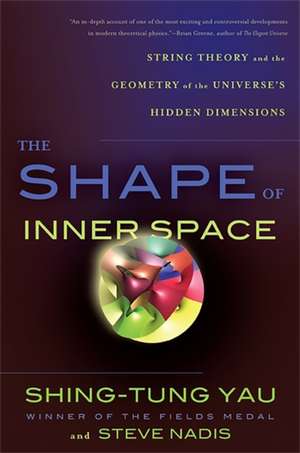
The Shape of Inner Space
Autor Shing-Tung Yau, Steve Nadisen Limba Engleză Paperback – mar 2012
Bazându-ne pe datele furnizate de BASIC BOOKS și pe profilul academic al autorului, reținem The Shape of Inner Space ca fiind o incursiune de referință în arhitectura matematică a universului. Shing-Tung Yau, laureat al Medaliei Fields, colaborează cu Steve Nadis pentru a traduce concepte de geometrie diferențială avansată într-un limbaj accesibil, fără a sacrifica rigoarea științifică. Găsim în această carte argumentul central conform căruia spațiul nostru nu are doar cele patru dimensiuni perceptibile, ci încă șase, ascunse în structuri complexe numite varietăți Calabi-Yau.
Ne-a atras atenția modul în care Yau poziționează geometria nu ca pe un simplu instrument, ci ca pe însăși substanța realității. Această perspectivă completează viziunea oferită de Imagining the Tenth Dimension de Rob Bryanton; în timp ce Bryanton folosește analogii filozofice și geometrie simplă pentru a vizualiza dimensiunile superioare, Yau oferă fundamentul matematic concret care a validat aceste teorii în fizica modernă. De asemenea, lucrarea servește ca o punte conceptuală către texte tehnice precum Calabi-Yau Manifolds de Tristan Heubsch, oferind contextul narativ și istoric pe care un manual de specialitate îl omite.
În contextul operei sale, această carte reprezintă pilonul de popularizare al cercetărilor sale fundamentale. Dacă în publicații precum Notices of the International Congress of Chinese Mathematicians Yau coordonează schimbul de date între experți, aici el își asumă rolul de ghid pentru publicul larg. Stilul este unul analitic, dar marcat de entuziasmul descoperirii, oferind o perspectivă rară asupra modului în care o demonstrație matematică pură ajunge să dicteze direcția de dezvoltare în fizica teoretică și cosmologie.
Preț: 205.48 lei
Carte tipărită la comandă
Livrare economică 08-22 iunie
Specificații
ISBN-10: 0465028373
Pagini: 400
Ilustrații: 20 b/w figures
Dimensiuni: 156 x 234 x 23 mm
Greutate: 0.68 kg
Ediția:First Trade Paper ed.
Editura: BASIC BOOKS
V-ar putea interesa
-
 The Physics of Star TrekLawrence M. KraussPreț: 98.55 lei
 -
 -29%Preț: 71.73 lei100.33 lei
 -
 The Theory of Linear AntennasRonold W. P. KingPreț: 518.10 lei
 -
 Theoretical ElasticityCarl E. PearsonPreț: 463.72 lei
 -
 Nonequilibrium Thermodynamics in BiophysicsA. KatchalskyPreț: 465.60 lei
 -
 -8%Preț: 398.33 lei432.97 lei
 -
 Lehrbuch der PhysikPeter MünchPreț: 366.69 lei
 -
 -19%Preț: 414.83 lei512.13 lei
 -
 Relativitätstheorie kompaktRobert DenschlagPreț: 66.66 lei
 -
 Das geheimnisvolle Higgs-BosonNathan Lamour-9%Preț: 616.61 lei677.59 lei
De ce să citești această carte
Această carte este esențială pentru cei care doresc să înțeleagă teoria șirurilor direct de la sursă. Cititorul câștigă o perspectivă clară asupra modului în care formele geometrice invizibile modelează forțele fundamentale. Este un titlu recomandat pasionaților de fizică teoretică și matematică, oferind un argument solid pentru ideea că universul este, în esență, geometrie pură.
Despre autor
Shing-Tung Yau este un matematician de talie mondială, laureat al Medaliei Fields și profesor la Universitatea Harvard. Este recunoscut la nivel global pentru contribuțiile sale în geometria diferențială și fizica teoretică, fiind cel care a demonstrat ipoteza Calabi, oferind astfel baza matematică pentru teoria șirurilor. Activitatea sa academică este vastă, incluzând editarea Notices of the International Congress of Chinese Mathematicians, unde promovează dezvoltarea cercetării matematice. În lucrările sale, Yau explorează constant intersecția dintre topologie și structura spațiu-timpului, fiind o figură centrală în știința contemporană.
Descriere scurtă
Notă biografică
Steve Nadis is a Contributing Editor to Astronomy Magazine. He has published articles in Nature, Science, Scientific American, New Scientist, Sky&Telescope, The Atlantic Monthly, and other journals. He has written or contributed to more than two dozen books. A former staff researcher for the Union of Concerned Scientists, Nadis has also been a research fellow at MIT and a consultant to the World Resources Institute, the Woods Hole Oceanographic Institution, and WGBH/NOVA. He lives in Cambridge, Massachusetts.
Recenzii
“Einstein’s vision of physical laws emerging from the shape of space has been expanded by the higher dimensions of string theory. This vision has transformed not only modern physics, but also modern mathematics. Shing-Tung Yau has been at the center of these developments. In this ambitious book, written
Of course, none of this could have been foretold more than a half century ago when a man named Eugenio Calabi — the first half of the Calabi-Yau duo — proposed that there could be multidimensional spaces with properties so special that many mathematicians, including one of this book's authors, considered them "too good to be true." Calabi had not been thinking about physics at the time, in the early 1950s, when he advanced the famous conjecture named after him. Following the proof of the Calabi conjecture, we have learned many new and wonderful things in both physics and mathematics — all of which suggest that Calabi-Yau spaces are not only too good to be true, as the skeptics used to say, but that they may be even better.
Brian Greene, Professor of Mathematics & Physics, Columbia University; author of The Fabric of the Cosmos and The Elegant Universe
“The Shape of Inner Space provides a vibrant tour through the strange and wondrous possibility that the three spatial dimensions we see may not be the only ones that exist. Told by one of the masters of the subject, the book gives an in-depth account of one of the most exciting and controversial developments in modern theoretical physics.”
“The Shape of Inner Space is a portrait of a beautiful branch of geometric analysis as seen through the eyes of one of its pioneers, Fields medal winner Shing-Tung Yau… After describing the sequence of events that led him to the United States and to his enamoration with geometry, Yau explains as only a master could the conjecture by Calabi and the subsequent discovery of Calabi-Yau manifolds that are the centerpiece of this book. The reader is thrown into a world of complex manifolds, geometric analysis, and differential equations, yet the book is written so that the persistent layperson could follow all of the main ideas.”
“In the fascinating book, The Shape of Inner Space… Shing-Tung Yau, along with coauthor Steve Nadis, describes the exciting development of the theory of what are now called Calabi-Yau manifolds and their relationship to the structure of the universe.”
“A journey into the mind of a brilliant mathematician, The Shape of Inner Space will delight readers who are not afraid to use their minds.”
There is a certain irony running through this book that one of the smallest things you can possibly imagine — six-dimensional geometric spaces that may be more than a trillion times smaller than an electron — could, nevertheless, be one of the defining features of our universe, exerting a profound influence that extends to every single point in the cosmos. This book is, in many ways, the story of those spaces, which physicists have dubbed "Calabi-Yau manifolds." It tells how one of us, Yau, managed to prove the existence, mathematically, of those spaces, despite the fact that he had originally set out to prove that such spaces could not possibly exist. It then goes on to explain how this mathematical proof, which had initially been ignored by physicists (partly because it was steeped in difficult, nonlinear arguments), nevertheless made its way into the center of string theory, which now stands as the leading theory of the universe and our best hope yet of unifying all the particles and forces observed — and yet to be observed--in nature.