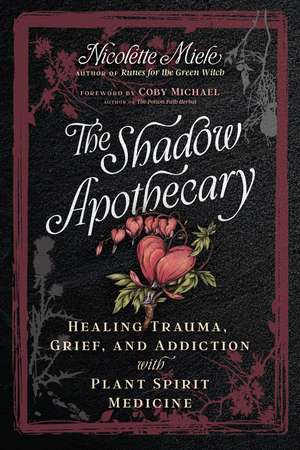
The Shadow Apothecary: Healing Trauma, Grief, and Addiction with Plant Spirit Medicine
Autor Nicolette Miele Cuvânt înainte de Coby Michaelen Limba Engleză Paperback – 13 aug 2026
• Introduces herbs that can help us explore our hidden depths, release trauma, grief, and shame, ease stress and anxiety, and support addiction recovery
• Looks at the healing abilities of plants associated with the Divine Feminine, the powers of poisonous and entheogenic plants, and how to use them safely
• Provides a detailed formulary for incorporating shadow work herbs into daily life, including recipes for teas, tinctures, oils, and ritual baths
Through their holistic healing abilities, plants are ideal allies for those seeking to embrace their shadow self and experience spiritual rebirth. Clinical herbalist and pagan Nicolette Miele introduces plants that can help us explore our hidden depths, release trauma and grief, support recovery from addiction, and heal our psyche.
Miele examines what shadow work is and the importance of accepting our shadow. She explores the use of nervines and adaptogens—herbs that calm stress and stabilize the nervous system, showing how when the nervous system is balanced, you can more easily connect with your intuition and your higher self. She also provides a detailed formulary for incorporating herbs into daily life, including recipes for teas, tinctures, oils, and ritual baths.
Presenting plants with poisonous or entheogenic qualities, Miele reveals how these plants are profoundly connected to shadow work. She explains how to work with them safely as plant spirit allies without direct contact or consumption. She also looks at plants associated with the Divine Feminine and how they can aid in integrating the hidden aspects of ourselves, and she provides practical advice on using herbs and ritual for healing trauma, depression, anxiety, heartbreak, and sexual shame.
This guide to shadow work with plants not only reveals new paths to healing, it also reminds us that darkness holds beauty and is an essential counterpart to light.
Preț: 104.97 lei
Preț vechi: 138.55 lei
-24% Nou
Puncte Express: 157
Carte disponibilă
Livrare economică 20 noiembrie-02 decembrie
Livrare express 03-07 noiembrie pentru 59.49 lei
Livrare prin curier în România Termenul estimat este afișat lângă disponibilitate.
Transport gratuit de la 400.00 lei Plată online sau ramburs, în funcție de opțiunile comenzii.
Retur gratuit în 14 zile Comandă securizată și suport în română.
Specificații
ISBN-13: 9798888503218
Pagini: 288
Ilustrații: 9 b&w illustrations
Dimensiuni: 152 x 229 x 20 mm
Greutate: 0.34 kg
Editura: Inner Traditions/Bear & Company
Colecția Destiny Books
Pagini: 288
Ilustrații: 9 b&w illustrations
Dimensiuni: 152 x 229 x 20 mm
Greutate: 0.34 kg
Editura: Inner Traditions/Bear & Company
Colecția Destiny Books
Notă biografică
Nicolette Miele is a pagan, writer, rune worker, and herbalist. She has practiced witchcraft for more than 20 years with focuses on runes, folk herbalism, alchemy, and trance meditation. She is the owner and operator of Handfuls of Dust Apothecary LLC, offering rune readings and handmade ritual products. She lives in Pittsburgh, Pennsylvania.
Extras
1
Hello Shadow
One need not be a chamber to be haunted. One need
not be a house. The brain has corridors . . .
EMILY DICKINSON
I hope I don’t sound too cynical, but I’ve never been a fan of the whole “love and light” and “good vibes only” culture. Don’t get me wrong—love, light, and positivity are wonderful; but they are only part of what it means to exist, to be a person. When I hear “good vibes only” what I’m really hearing is that my whole, complex self and complicated emotions are not acknowledged. Of course, there are situations where we must set aside our personal challenges—work being one example. We also would never want to go to a friend’s birthday party or a relative’s wedding, for instance, and disrupt the festive atmosphere with our personal tales of woe. But maybe before we put on our game face at work, we approach a manager or a trusted coworker and say, I’m struggling a bit right now, please bear with me. Maybe at the wedding we take a moment to confide in Nana and seek comfort in a hug.
There will inevitably be times when we are fresh out of good vibes and all we can muster is a half-assed fake smile. There will be days when we’re walking embodiments of sadness, cynicism, and darkness, especially if we’re suffering with things like loss, addiction, chronic illness, mental illness, or depression. As someone who has dabbled in four out of the five (I know, now I’m just bragging), I can tell you that a phrase like “good vibes only” earns itself the label of toxic positivity for a reason. Toxic positivity is when positive thinking and happy emotions are overly promoted and encouraged, even when they are not suitable or can be detrimental. Picture it: It’s two o’clock in the afternoon. You’ve been in bed all day, un-showered, still in your pajamas, and riddled with heavy depression. A friend stops by to kindly bring you lunch, sits down next to you on the bed and says, “Just try to think happy thoughts.” Despite their good intentions, you can’t help but feel irritated and think, Oh gee, why didn’t I think of that?! Thank you! All better now! Unless their advice comes with a puppy, it probably won’t have any positive effect on the situation.
In the pursuit of spiritual growth and overall wellness, it is vital to acknowledge that light and dark coexist within us and in the world around us. By solely focusing on the light and avoiding the dark, we limit our potential for growth and self-discovery and deny ourselves wholeness. Darkness and light share equal value. They depend on each other to exist. In today’s world, the word darkness is often associated with evil, fear, and negativity, but I believe the truth is far more neutral than that. In his book The Philosophy of Dark Paganism, author Frater Tenebris writes, “Dark and light are metaphors for internal and External” (2022, 24), which I find to be a perfectly succinct description. Within this book, I aim to help dismantle the overly simplistic notion that dark = bad. Embracing the darkness involves acknowledging and integrating the hidden aspects of ourselves that we may find uncomfortable or challenging in order to attain spiritual liberation.
This acknowledgement and integration are what we call shadow work. Within shadow work we strive to understand and accept our dark aspects, rather than trying to eradicate them. After all, just like the dark is not bad, neither is the shadow. They develop within each of us as mechanisms for survival. The ego mind safeguards its well-being by refusing to acknowledge thoughts or events that it finds intolerable. This ego function can be particularly helpful for individuals who have experienced abuse, as an example. In order to cope with the harshness of reality, they may employ one or more defense mechanisms, and we will delve into these shortly. As life goes on and such traumas remain unresolved, they silently influence one’s perspectives, beliefs, and intentions.
So how do we befriend the darkness within? First it is important to bear in mind that the behaviors that arise from the shadow reflect deeper, underlying problems. For example, if Jane steals her best friend Julia’s debit card and drains her checking account, Jane should not accept and befriend her thieving tendencies! This is not what befriending your darkness means. What Jane can do is make an honest effort to explore and understand the repressed feelings that cause her to want to steal in the first place. Maybe Jane envies Julia’s wealth or has been harboring resentment from a past argument between them. Maybe it has nothing to do with Julia, and Jane feels like the world owes her something or has an insatiable sense of greed. Once Jane understands what causes her to act out in such a way, she can dig even deeper into the “hows and whys.” Let’s say that the reason she stole the money is because she envies Julia’s wealth. Through shadow work, Jane comes to realize that her friend’s wealth invokes feelings of inferiority within her. Now Jane wants to understand why she feels inferior. As she continues her shadow work, she recalls that her father has always equated money and success with a person’s worth. On an unconscious level, Jane believes that if she can obtain more and more money, she will be a worthy individual in the eyes of others. With every realization, Jane can dig a little deeper until she gets to the very root of the issue, and once at the root, healing can begin. When we talk about embracing our dark aspects in shadow work, we are essentially exploring and acknowledging root causes, not accepting or justifying bad behaviors.
The term shadow, coined by psychologist Carl Jung, refers to the unconscious psyche where we store repressed and rejected elements of ourselves. As mentioned before, when the ego is unable to accept a conscious impulse, quality, or memory, it is renounced to the shadow where it will impact our lives indirectly and likely negatively, until we choose to address it. While many such shadow components are born of trauma, the shadow can also hide seemingly innocuous aspects of the self. For example, ten-year-old Maggie is riding along in her older brother’s car flipping through the radio stations, when she happens upon a song she likes. She turns up the volume and begins to joyfully sing along. At that moment her brother looks over at her and with a laugh, says “Eek, your singing sounds like fighting cats!” Maggie’s brother may have thought it was a harmless joke, but at that moment, she made the silent agreement that she has an unpleasant voice and should never sing in front of anyone again, and so she doesn’t. Singing now belongs to Maggie’s shadow. There is no villain or victim in this example, it’s simply one of the ways that aspects of the self are renounced to the shadow.
Another example is suppressed natural talent. A person who is inherently gifted in the arts may suppress their abilities during their formative years if their parents steer them toward the sciences and belittle the value of artistic pursuits. Imagine all the talents that women had to reject in themselves during the witch trial times! Traits like strong intuition, creativity, eccentricity, intellect, and knowledge of healing could condemn a woman as a witch and result in imprisonment, torture, death, or all three!
When something is perceived as undesirable, whether through explicit or implicit suggestion, it tends to scurry off into the deep dark depths of the psyche as we instinctively conceal it; especially when implied by someone we look up to or fear. This is a survival mechanism. We recognize, from a very young age, that to be accepted we must be agreeable. When we are children, we want to please our immediate caregivers. They are our models for how people should operate at home and out in the world. In adolescence we begin to pull away from caregivers and place more value on our peers. What we learn in these formative years, positive, negative, and neutral, has an inevitable impact on our adult lives. During these years our shadows grow larger, filling with all the parts of ourselves that we deem unworthy. This is necessary while growing up as we need to establish our egos. Into adulthood, however, the shadow tends to transform from helpful defense mechanisms to neuroses and unhealthy patterns. Ironically, the more we ignore and reject the shadow, the harder it pushes to make itself known. Carl Jung said a mere suppression of the shadow is just as little of a remedy as beheading in response to a headache (Pascal 1992, 126).
Hello Shadow
One need not be a chamber to be haunted. One need
not be a house. The brain has corridors . . .
EMILY DICKINSON
I hope I don’t sound too cynical, but I’ve never been a fan of the whole “love and light” and “good vibes only” culture. Don’t get me wrong—love, light, and positivity are wonderful; but they are only part of what it means to exist, to be a person. When I hear “good vibes only” what I’m really hearing is that my whole, complex self and complicated emotions are not acknowledged. Of course, there are situations where we must set aside our personal challenges—work being one example. We also would never want to go to a friend’s birthday party or a relative’s wedding, for instance, and disrupt the festive atmosphere with our personal tales of woe. But maybe before we put on our game face at work, we approach a manager or a trusted coworker and say, I’m struggling a bit right now, please bear with me. Maybe at the wedding we take a moment to confide in Nana and seek comfort in a hug.
There will inevitably be times when we are fresh out of good vibes and all we can muster is a half-assed fake smile. There will be days when we’re walking embodiments of sadness, cynicism, and darkness, especially if we’re suffering with things like loss, addiction, chronic illness, mental illness, or depression. As someone who has dabbled in four out of the five (I know, now I’m just bragging), I can tell you that a phrase like “good vibes only” earns itself the label of toxic positivity for a reason. Toxic positivity is when positive thinking and happy emotions are overly promoted and encouraged, even when they are not suitable or can be detrimental. Picture it: It’s two o’clock in the afternoon. You’ve been in bed all day, un-showered, still in your pajamas, and riddled with heavy depression. A friend stops by to kindly bring you lunch, sits down next to you on the bed and says, “Just try to think happy thoughts.” Despite their good intentions, you can’t help but feel irritated and think, Oh gee, why didn’t I think of that?! Thank you! All better now! Unless their advice comes with a puppy, it probably won’t have any positive effect on the situation.
In the pursuit of spiritual growth and overall wellness, it is vital to acknowledge that light and dark coexist within us and in the world around us. By solely focusing on the light and avoiding the dark, we limit our potential for growth and self-discovery and deny ourselves wholeness. Darkness and light share equal value. They depend on each other to exist. In today’s world, the word darkness is often associated with evil, fear, and negativity, but I believe the truth is far more neutral than that. In his book The Philosophy of Dark Paganism, author Frater Tenebris writes, “Dark and light are metaphors for internal and External” (2022, 24), which I find to be a perfectly succinct description. Within this book, I aim to help dismantle the overly simplistic notion that dark = bad. Embracing the darkness involves acknowledging and integrating the hidden aspects of ourselves that we may find uncomfortable or challenging in order to attain spiritual liberation.
This acknowledgement and integration are what we call shadow work. Within shadow work we strive to understand and accept our dark aspects, rather than trying to eradicate them. After all, just like the dark is not bad, neither is the shadow. They develop within each of us as mechanisms for survival. The ego mind safeguards its well-being by refusing to acknowledge thoughts or events that it finds intolerable. This ego function can be particularly helpful for individuals who have experienced abuse, as an example. In order to cope with the harshness of reality, they may employ one or more defense mechanisms, and we will delve into these shortly. As life goes on and such traumas remain unresolved, they silently influence one’s perspectives, beliefs, and intentions.
So how do we befriend the darkness within? First it is important to bear in mind that the behaviors that arise from the shadow reflect deeper, underlying problems. For example, if Jane steals her best friend Julia’s debit card and drains her checking account, Jane should not accept and befriend her thieving tendencies! This is not what befriending your darkness means. What Jane can do is make an honest effort to explore and understand the repressed feelings that cause her to want to steal in the first place. Maybe Jane envies Julia’s wealth or has been harboring resentment from a past argument between them. Maybe it has nothing to do with Julia, and Jane feels like the world owes her something or has an insatiable sense of greed. Once Jane understands what causes her to act out in such a way, she can dig even deeper into the “hows and whys.” Let’s say that the reason she stole the money is because she envies Julia’s wealth. Through shadow work, Jane comes to realize that her friend’s wealth invokes feelings of inferiority within her. Now Jane wants to understand why she feels inferior. As she continues her shadow work, she recalls that her father has always equated money and success with a person’s worth. On an unconscious level, Jane believes that if she can obtain more and more money, she will be a worthy individual in the eyes of others. With every realization, Jane can dig a little deeper until she gets to the very root of the issue, and once at the root, healing can begin. When we talk about embracing our dark aspects in shadow work, we are essentially exploring and acknowledging root causes, not accepting or justifying bad behaviors.
The term shadow, coined by psychologist Carl Jung, refers to the unconscious psyche where we store repressed and rejected elements of ourselves. As mentioned before, when the ego is unable to accept a conscious impulse, quality, or memory, it is renounced to the shadow where it will impact our lives indirectly and likely negatively, until we choose to address it. While many such shadow components are born of trauma, the shadow can also hide seemingly innocuous aspects of the self. For example, ten-year-old Maggie is riding along in her older brother’s car flipping through the radio stations, when she happens upon a song she likes. She turns up the volume and begins to joyfully sing along. At that moment her brother looks over at her and with a laugh, says “Eek, your singing sounds like fighting cats!” Maggie’s brother may have thought it was a harmless joke, but at that moment, she made the silent agreement that she has an unpleasant voice and should never sing in front of anyone again, and so she doesn’t. Singing now belongs to Maggie’s shadow. There is no villain or victim in this example, it’s simply one of the ways that aspects of the self are renounced to the shadow.
Another example is suppressed natural talent. A person who is inherently gifted in the arts may suppress their abilities during their formative years if their parents steer them toward the sciences and belittle the value of artistic pursuits. Imagine all the talents that women had to reject in themselves during the witch trial times! Traits like strong intuition, creativity, eccentricity, intellect, and knowledge of healing could condemn a woman as a witch and result in imprisonment, torture, death, or all three!
When something is perceived as undesirable, whether through explicit or implicit suggestion, it tends to scurry off into the deep dark depths of the psyche as we instinctively conceal it; especially when implied by someone we look up to or fear. This is a survival mechanism. We recognize, from a very young age, that to be accepted we must be agreeable. When we are children, we want to please our immediate caregivers. They are our models for how people should operate at home and out in the world. In adolescence we begin to pull away from caregivers and place more value on our peers. What we learn in these formative years, positive, negative, and neutral, has an inevitable impact on our adult lives. During these years our shadows grow larger, filling with all the parts of ourselves that we deem unworthy. This is necessary while growing up as we need to establish our egos. Into adulthood, however, the shadow tends to transform from helpful defense mechanisms to neuroses and unhealthy patterns. Ironically, the more we ignore and reject the shadow, the harder it pushes to make itself known. Carl Jung said a mere suppression of the shadow is just as little of a remedy as beheading in response to a headache (Pascal 1992, 126).
Cuprins
Foreword by Coby Michael
Acknowledgments
Introduction
Birth, Death, and Rebirth
1
Hello Shadow
2
Plant Spirit Allies for the Rebel Heart
3
Take a Chill Pill Plant
4
Accept the Things I Cannot Change
5
Courage to Change the Things I Can
6
Spirit Medicine from the Underworld
7
Spirit Medicine from the Divine Feminine
8
Dismantling the Cage
9
New Beginnings Conclusion
Where Do We Go from Here?
Appendix A
Putting the “Work” in Shadow Work
Appendix B
Additional Tools for Healing
Appendix C
Shadow Formulary
Appendix D
Potential Plant Allies for the . . .
Appendix E
Herbal Actions, Affinities, and Uses
Bibliography
Index
Acknowledgments
Introduction
Birth, Death, and Rebirth
1
Hello Shadow
2
Plant Spirit Allies for the Rebel Heart
3
Take a Chill Pill Plant
4
Accept the Things I Cannot Change
5
Courage to Change the Things I Can
6
Spirit Medicine from the Underworld
7
Spirit Medicine from the Divine Feminine
8
Dismantling the Cage
9
New Beginnings Conclusion
Where Do We Go from Here?
Appendix A
Putting the “Work” in Shadow Work
Appendix B
Additional Tools for Healing
Appendix C
Shadow Formulary
Appendix D
Potential Plant Allies for the . . .
Appendix E
Herbal Actions, Affinities, and Uses
Bibliography
Index
Recenzii
“A treasure for chaotic times, offering herbal support, folk magic, and common-sense advice for working with both our personal shadow and the collective shadow. It’s valuable information worth coming back to again and again. The author truly says it best, ‘The Shadow Apothecary provides information on the medicinal and spiritual properties of herbs that can offer support for all stages of healing.’”
“As we navigate the peaks and valleys of our lives upon this earth, we may notice that we are often surrounded by a garden. Miele has created a sincere and authentic shadow journey guide with plants, based on both personal and professional experience, offering valuable insight into the use of plant allies to assist humanity through the dark nights of the soul that we will all experience from time to time.”
“We bear witness to a wisdom born of lived experience, making this book a radiant torch of hope for those walking their inner underworld. I honor Nicolette’s brave vulnerability and feel her generous, motherly medicine woven through every word. This book awakens consciousness, self-love, and invokes the healing embrace of Green Wisdom—an offering available to all.”
“As we navigate the peaks and valleys of our lives upon this earth, we may notice that we are often surrounded by a garden. Miele has created a sincere and authentic shadow journey guide with plants, based on both personal and professional experience, offering valuable insight into the use of plant allies to assist humanity through the dark nights of the soul that we will all experience from time to time.”
“We bear witness to a wisdom born of lived experience, making this book a radiant torch of hope for those walking their inner underworld. I honor Nicolette’s brave vulnerability and feel her generous, motherly medicine woven through every word. This book awakens consciousness, self-love, and invokes the healing embrace of Green Wisdom—an offering available to all.”