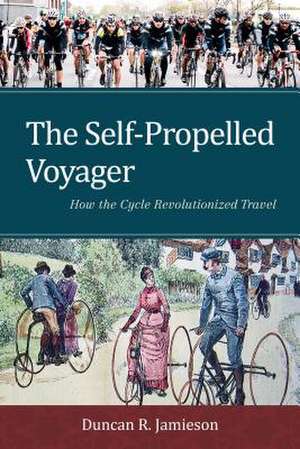
The Self-Propelled Voyager: How the Cycle Revolutionized Travel
Autor Duncan R. Jamiesonen Limba Engleză Hardback – 3 sep 2015
Preț: 582.81 lei
Preț vechi: 863.75 lei
-33%
Puncte Express: 874
Carte tipărită la comandă
Livrare economică 04-18 decembrie
Livrare prin curier în România Termenul estimat este afișat lângă disponibilitate.
Transport gratuit pentru acest produs Plată online sau ramburs, în funcție de opțiunile comenzii.
Retur gratuit în 14 zile Comandă securizată și suport în română.
Specificații
ISBN-13: 9781442253704
ISBN-10: 1442253703
Pagini: 232
Ilustrații: 15 BW Photos
Dimensiuni: 150 x 232 x 20 mm
Greutate: 0.5 kg
Editura: Bloomsbury Publishing
Colecția Rowman & Littlefield
Locul publicării:New York, United States
ISBN-10: 1442253703
Pagini: 232
Ilustrații: 15 BW Photos
Dimensiuni: 150 x 232 x 20 mm
Greutate: 0.5 kg
Editura: Bloomsbury Publishing
Colecția Rowman & Littlefield
Locul publicării:New York, United States
V-ar putea interesa
-
 The Bolt SupremacyRichard Moore-51%Preț: 58.21 lei119.07 lei
 -
 Football: A Short HistoryMatthew Taylor-31%Preț: 47.61 lei69.26 lei
 -
 Le Mans 1990-99Quentin SpurringPreț: 403.22 lei
 -
 100 Years of the Isle of Man TTDavid WrightPreț: 236.16 lei
 -
 Cricket On Three ContinentsHenry BlofeldPreț: 171.37 lei
Descriere
Before the last quarter of the nineteenth century, people who wanted to travel independently either walked or rode horses. Then a newly invented machine changed forever the nature of personal transportation. The cycle-self-propelled bicycles, tricycles, and tandems-allowed almost anyone to travel around town, around their region, and around the world. While dramatic developments in equipment, clothing, road surfaces, and amenities make the physicality of cycling much different from the earlier era, the experience of cycling has seen little change.
The Self-Propelled Voyager: How the Cycle Revolutionized Travel recounts how a transportation innovation opened the world for not only those who made the journey but also for the armchair travelers who read with interest the cyclists' accounts of faraway places. Following a brief history of the development of the cycle, this book describes the exploits of long-distance riders who wrote of their experiences, their triumphs, and their tragedies. Duncan R. Jamieson chronicles their journeys, their personal stories, and the times in which they lived, revealing that, despite the continuing rise and fall of cycling interest, people continue to enjoy traveling in the slow lane.
Drawing on books and articles by the women and men who rode and wrote of their travels, The Self-Propelled Voyager also features photographs from the 1880s up to the modern day, illustrating the development of the cycle through history. Accessibly written yet comprehensive in its coverage, this book will interest not only the cycling enthusiast but historians focusing on sport and sport tourism as well.
The Self-Propelled Voyager: How the Cycle Revolutionized Travel recounts how a transportation innovation opened the world for not only those who made the journey but also for the armchair travelers who read with interest the cyclists' accounts of faraway places. Following a brief history of the development of the cycle, this book describes the exploits of long-distance riders who wrote of their experiences, their triumphs, and their tragedies. Duncan R. Jamieson chronicles their journeys, their personal stories, and the times in which they lived, revealing that, despite the continuing rise and fall of cycling interest, people continue to enjoy traveling in the slow lane.
Drawing on books and articles by the women and men who rode and wrote of their travels, The Self-Propelled Voyager also features photographs from the 1880s up to the modern day, illustrating the development of the cycle through history. Accessibly written yet comprehensive in its coverage, this book will interest not only the cycling enthusiast but historians focusing on sport and sport tourism as well.
Cuprins
Acknowledgments
Preface
Introduction
Chapter One: Beginnings
Chapter Two: The Pioneers: 1878-1887
Chapter Three: The Early Years: 1888-1894
Chapter Four: The Golden Age: 1895-1900
Chapter Five: Sharing the Road: 1901-1960
Chapter Six: Renaissance: 1961-
Conclusion
Notes
Bibliography
Index
About the Author
Preface
Introduction
Chapter One: Beginnings
Chapter Two: The Pioneers: 1878-1887
Chapter Three: The Early Years: 1888-1894
Chapter Four: The Golden Age: 1895-1900
Chapter Five: Sharing the Road: 1901-1960
Chapter Six: Renaissance: 1961-
Conclusion
Notes
Bibliography
Index
About the Author
Recenzii
Before the automobile captured and consumed attention at the turn of the 20th century, there was the bicycle. Jamieson provides a social history of the bicycle, the popularity of which peaked in 1899. Such a machine provided nearly anyone with the opportunity to move about and travel great distances with relative ease. Clubs and groups sprang up; lengthy national and international journeys were made and written up in serials. The author devotes the bulk of the book to recounting travels by intrepid cyclists of old-Thomas Stevens, Elizabeth Robins Pennell and her husband Joseph Pennell, Frank Lenz, Bernard Newman-and by examining their influence. Those who are familiar with bicycle touring and travel will note that many things have not changed one bit since the late 1800s, witness tour groups, the mental challenge of long distances, camaraderie, public scorn or curiosity, and SAG wagons (i.e., support vehicles accompanying the riders). The author mentions changes in technology, equipment, and the Good Roads Movement only in passing. Reflecting Jamieson's personal interest in cycling, the book is interspersed with his own experiences, which adds to his credibility as an authority on the subject.
Summing Up:Highly recommended. Lower- and upper-division undergraduates; graduate students; general readers.
Professor Jamieson himself is obviously an avid long distance cyclist and he has covered vast stretches, such as across the United States. He is thus well suited to analyze and understand all these stories about bicycle trips written by other intellectuals over the years. He emphasizes the importance of cycling for children and young people, but adds that there has been some criticism of cycling in the United States, where the car is often a priority. He believes that motoring gives freedom, but also a certain social isolation when traveling far - as opposed to cycling, which is a much more social activity given the open air and slow speed mode of traveling, so that cyclists meet other riders and all sorts of people on their journeys.
Jamieson's personal experiences churning out mile after metronomic mile in the saddle translate throughout this well-researched and enthusiastic look at the history of bicycle touring.... Jamieson's book provides lasting value for scholars focused on cycling history as those with more casual interest in the subject. It is at once a history of cycle touring and of cycle touring literature, providing several layers of relevant cultural analysis. The Self-Propelled Voyager will resonate with anyone who has ever began pedaling with a destination in mind and quickly become lost in the journey.
The book provides a fascinating history of the role of the cycle in touring and adventure.... We read about journeys that are so varied, eventful, challenging, and simply interesting, that the 'armchair travellers' amongst us are spoilt for choice.... There is no doubt that this is a well-researched and informative book on a fascinating subject.
Summing Up:Highly recommended. Lower- and upper-division undergraduates; graduate students; general readers.
Professor Jamieson himself is obviously an avid long distance cyclist and he has covered vast stretches, such as across the United States. He is thus well suited to analyze and understand all these stories about bicycle trips written by other intellectuals over the years. He emphasizes the importance of cycling for children and young people, but adds that there has been some criticism of cycling in the United States, where the car is often a priority. He believes that motoring gives freedom, but also a certain social isolation when traveling far - as opposed to cycling, which is a much more social activity given the open air and slow speed mode of traveling, so that cyclists meet other riders and all sorts of people on their journeys.
Jamieson's personal experiences churning out mile after metronomic mile in the saddle translate throughout this well-researched and enthusiastic look at the history of bicycle touring.... Jamieson's book provides lasting value for scholars focused on cycling history as those with more casual interest in the subject. It is at once a history of cycle touring and of cycle touring literature, providing several layers of relevant cultural analysis. The Self-Propelled Voyager will resonate with anyone who has ever began pedaling with a destination in mind and quickly become lost in the journey.
The book provides a fascinating history of the role of the cycle in touring and adventure.... We read about journeys that are so varied, eventful, challenging, and simply interesting, that the 'armchair travellers' amongst us are spoilt for choice.... There is no doubt that this is a well-researched and informative book on a fascinating subject.