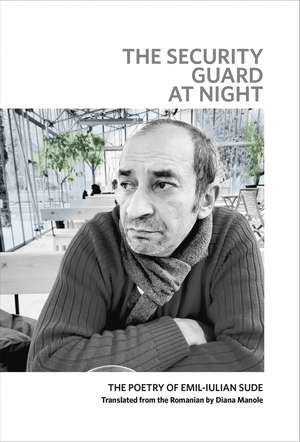
The Security Guard at Night: The Poetry of Emil-Iulian Sude
Autor Emil-Iulian Sude Traducere și comentarii de Diana Manoleen Limba Engleză Paperback – apr 2027
Preț: 129.75 lei
Precomandă
Puncte Express: 195
Carte nepublicată încă
Livrare prin curier în România Precomanda se expediază când titlul devine disponibil.
Transport gratuit de la 400.00 lei Plată online sau ramburs, în funcție de opțiunile comenzii.
Retur gratuit în 14 zile Comandă securizată și suport în română.
Doresc să fiu notificat când acest titlu va fi disponibil:
Se trimite...
Specificații
ISBN-13: 9781942281399
ISBN-10: 1942281390
Pagini: 102
Dimensiuni: 152 x 216 x 8 mm
Greutate: 0.36 kg
Editura: Laertes
Colecția Egret
Locul publicării:United States
Recenzii
Emil-Iulian Sude connects the heavens to the light and becomes himself the rope through which he intertwines the world below with the world above, in a continuous need for knowledge, for finding meanings, in a state of unforced vigilance. The poetry of Emil-Iulian Sude is a portal that makes the transition from one (terrestrial) world to another (celestial) . . . The fear of dying "so foolishly unwashed" and of being judged by those who "bathe the dead" reveals an anxiety about purity and hygiene not so much of the body but especially of the self . . . The author's identity is seen as an anomaly, an absurdity in life, which only makes sense after death, when corporeality and genders are abolished in favor of a pure spiritual existence.
Children, teachers, colleagues, supervisors, security guards at Mega Image supermarkets, fellow citizens caught in their everyday gestures, and even God Himself imagined as a Guard, “the best one,” become subjects of a poetry that captures and analyzes them from characterological angles that are almost always surprising. Life and death, too, are confronted head-on in a lyric voice that is daring both in its themes and in its imagery.
I notice a recurrence of the theme of death, seen as a kind of zone that opens up at any time, asserting its presence in the simplest places—a theme that becomes a metaphor for exiting quotidian time and space . . . Freedom translates into a certain form of love, of tenderness—a state it is possible to reach, if only intermittently.