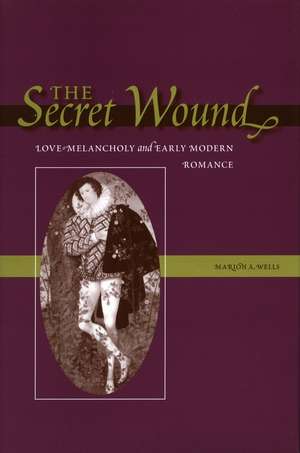
The Secret Wound: Love-Melancholy and Early Modern Romance
Autor Marion Wellsen Limba Engleză Hardback – 3 ian 2007
Evoluția studiilor literare contemporane reflectă o tendință tot mai accentuată de a integra istoria medicinei în analiza textelor de ficțiune, transformând diagnosticele arhaice în instrumente de critică narativă. În The Secret Wound, Marion Wells demonstrează cum patologia medicală a „bolii din dragoste” (amor hereos) nu a fost doar o temă literară, ci un fundament structural pentru genul romance în perioada modernă timpurie. Remarcăm modul în care autoarea trasează genealogia acestui concept, pornind de la sursele grecești și arabe până la receptarea sa în vestul latin, oferind o bază istorică riguroasă pentru analiza subiectivității.
Subliniem că lucrarea nu se limitează la o inventariere a simptomelor, ci explică mecanismele narative specifice — precum rătăcirea continuă sau căutarea unei iubiri cvasi-fantasmatice — ca proiecții ale stării melancolice. Analiza se concentrează pe operele lui Ariosto, Tasso și Spenser, oferind o perspectivă nouă asupra modului în care incertitudinea epistemologică a personajelor este ancorată în teoriile medicale ale epocii despre minte și corp. Reținem, de asemenea, capitolul final care face puntea către Romantism, sugerând persistența acestei moșteniri medicale în literatura ulterioară.
Această cercetare acoperă aceeași arie tematică precum Lovesickness and Gender in Early Modern English Literature de Lesel Dawson, dar cu o abordare mai axată pe structura narativă și pe evoluția istorică a tratatelor medicale, spre deosebire de accentul pus de Dawson pe identitatea de gen. De asemenea, lucrarea completează perspectiva oferită de Lovesickness in the Middle Ages de Mary Frances Wack, extinzând analiza dincolo de perioada medievală către complexitatea Renașterii și a zorilor modernității.
Preț: 539.07 lei
Preț vechi: 665.52 lei
-19%
Carte tipărită la comandă
Livrare economică 17 noiembrie-01 decembrie
Specificații
ISBN-10: 0804750467
Pagini: 384
Dimensiuni: 152 x 229 x 25 mm
Greutate: 0.63 kg
Ediția:Adnotată
Editura: Stanford University Press
Colecția Stanford University Press
V-ar putea interesa
-
 Stop What Youre Doing And Read This!Mark HaddonPreț: 71.99 lei
 -
 Music at MidnightJohn DruryPreț: 106.37 lei
 -
 New Maps of HellKingsley Amis-35%Preț: 50.86 lei77.68 lei
 -
 Housman's PoemsJohn Bayley-33%Preț: 785.71 lei1170.16 lei
 -
 -22%Preț: 296.15 lei379.95 lei
 -
 -18%Preț: 113.14 lei137.51 lei
 -
 American Authorship and Autobiographical NarrativeJonathan D'AmorePreț: 385.78 lei
 -
 Preț: 91.35 lei
 -
 Shakespeare's Original PronunciationBritish Library-18%Preț: 56.99 lei69.60 lei
 -
 The Material Image: Art and the Real in FilmBrigitte PeuckerPreț: 196.07 lei
 -
 A Question of Tradition: Women Poets in Yiddish, 1586-1987Kathryn Hellerstein-19%Preț: 490.10 lei605.06 lei
 -
 Semites: Race, Religion, LiteratureGil AnidjarPreț: 143.12 lei
 -
 Warped Mourning: Stories of the Undead in the Land of the UnburiedAlexander EtkindPreț: 199.66 lei
 -
 Preț: 201.84 lei
 -
 Gather at the RiverHal CrowtherPreț: 195.77 lei
 -
 Preț: 374.01 lei
 -
 Preț: 333.08 lei
De ce să citești această carte
Recomandăm această lucrare cercetătorilor și studenților interesați de intersecția dintre literatură și istoria medicinei. Cititorul va obține o înțelegere profundă a modului în care teoriile medicale despre melancolie au modelat marile epopei ale Renașterii. Este un instrument esențial pentru a descifra comportamentul personajelor lui Spenser sau Tasso dintr-o perspectivă istorică autentică, depășind interpretările psihologice anacronice.
Despre autor
Marion Wells este un specialist recunoscut în literatura perioadei moderne timpurii, cu un interes academic profund pentru istoria ideilor și studiile interdisciplinare. Expertiza sa acoperă evoluția conceptelor medicale antice și medievale și modul în care acestea au fost asimilate în cultura europeană a secolelor XVI și XVII. Prin publicațiile sale, Wells explorează legăturile subtile dintre stările psihopatologice descrise în tratatele de epocă și reprezentările lor artistice, fiind apreciată în mediul academic pentru rigoarea documentării și originalitatea interpretărilor critice.
Descriere scurtă
Recenzii
"This book is a significant and valuable addition to the study of early modern romance and should soon be adopted by fellow researchers as well as in courses dedicated to the genre."—Consciousness, Literature, and the Arts
"In this unusual and fruitful study, Wells offers a new reading of early modern romance in the light of historically contemporary accounts of the medical perception of love-melancholy."—Book News, INC.
"This well-argued book explores the malady of love, that is, the moment when love becomes psychologically unmanageable and turns into delusional disease...This is an ambitious and sharply reasoned book and Marion Wells gives fascinating insights into the courtly and Petrarchan tradition of lovesickness."—Renaissance Quarterly
Notă biografică
Textul de pe ultima copertă
“This is a strong book, which will make a central contribution to the study of early modern literature and to the history of ideas. Wells presents a bold argument, and is a master of classical tradition, allowing her to make novel and impressive claims.”—Mary Wack, Washington State University