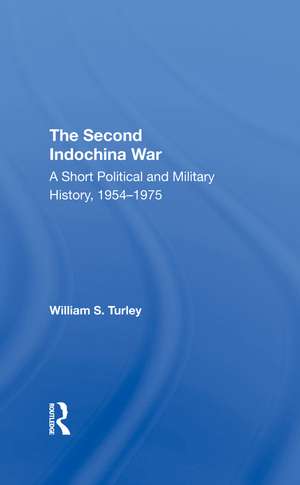
The Second Indochina War: A Short Political And Military History, 19541975
Autor William S. Turleyen Limba Engleză Hardback – 13 sep 2019
Preț: 983.07 lei
Preț vechi: 1320.16 lei
-26%
Puncte Express: 1475
Carte indisponibilă temporar
Doresc să fiu notificat când acest titlu va fi disponibil:
Se trimite...
Specificații
ISBN-13: 9780367295714
ISBN-10: 0367295717
Pagini: 238
Dimensiuni: 144 x 229 mm
Greutate: 0.63 kg
Ediția:1
Editura: Taylor & Francis
Colecția Routledge
Locul publicării:Oxford, United Kingdom
ISBN-10: 0367295717
Pagini: 238
Dimensiuni: 144 x 229 mm
Greutate: 0.63 kg
Ediția:1
Editura: Taylor & Francis
Colecția Routledge
Locul publicării:Oxford, United Kingdom
V-ar putea interesa
-
 Steaming as BeforeRichard V. Bovbjerg-24%Preț: 333.78 lei436.64 lei
 -
 Down In TennesseeEdmund KirkePreț: 153.81 lei
 -
 The SouthernersCyrus Townsend BradyPreț: 209.70 lei
 -
 Chaplain FullerRobert F. FullerPreț: 188.56 lei
 -
 Address Given at a Meeting of the Colorado CommanderyHarrison HannahsPreț: 87.21 lei
 -
 War LyricsHenry Howard BrownellPreț: 141.74 lei
 -
 Korean American Pioneer Aviators: The Willows AirmenEdward T. Chang-33%Preț: 576.46 lei863.98 lei
 -
 InfernoEdwin P. HoytPreț: 197.95 lei
 -
 How Botha and Smuts Conquered German South WestW. S. RaynerPreț: 155.14 lei
 -
 Preț: 98.52 lei
 -
 RECOLLECTIONS OF A PENINSULAR VETERANLt-Colonel Joseph AndersonPreț: 136.80 lei
 -
 AN OUTLINE OF THE RUMANIAN CAMPAIGN 1916-1918Major-General W. M. St. KirkePreț: 119.90 lei
 -
 Murmansk VentureMajor-General C MaynardPreț: 139.50 lei
 -
 Journal of a Cavalry OfficerW. W. W. HumbleyPreț: 119.85 lei
 -
 The Zouave OfficerJean Joseph Gustave ClerPreț: 118.50 lei
 -
 Napoleon's Campaign in Poland 1806-1807F. Loraine PetrePreț: 133.22 lei
 -
 Sea BattlesJohn Richard HalePreț: 147.25 lei
Cuprins
Preface -- Legacies of Time -- Vietnam Between Two Wars -- Fateful Decisions -- Americanization -- Air War -- Tet -- The Road to Paris -- Vietnam Without the United States -- Of Lessons and Their Price -- Suggested Readings
Notă biografică
William S. Turley, associate professor of political science at Southern Illinois University, has been researching Vietnamese communism since 1970, including extensive work in Vietnam. He has spent time in Southeast Asia as a Ford Foundation Research Associate at Saigon University (1972-1973) and a Fulbright Professor at Chulalongkorn University, Bangkok (1982-1984); his numerous publications include Vietnamese Communism in Comparative Perspective (Westview 1980).
Descriere
This book emphasizes the Vietnamese dimensions of a conflict in which all of Indochina—Vietnam, Laos, and Cambodia—was treated as a single strategic unit. It focuses on the experience, strategies, leadership, and internal politics of the revolutionary side.
Recenzii
Turley is a leading scholar on Vietnamese politics, and he has updated his classic account of the Second Indochina War to reflect not only the latest scholarship and memoirs but also the perspective gained from more than thirty years of peace. There is never a 'last word' on a complex event, but for scholars, veterans, and anyone else who wants to understand the war in its context, this excellent and judicious book is the place to start. I look forward to using it in class.
By viewing events almost as closely from Hanoi and Saigon as from Washington, Professor Turley spares us the rampant self-absorption so characteristic of most American accounts of the war. For younger generations wondering 'Why Vietnam?' this book is the best place to start seeking answers.
This new edition, buttressed by twenty years of new scholarship, is even more satisfying than the original impressive book. The author's lucid prose and keen analytic bent give the work a distinctive tone and penetration, and his mastery of Vietnamese-language material allows for a balance and depth not found in other surveys.
Mandatory reading for everyone concerned with any of the Indochina states. Turley elegantly and vividly provides a comprehensive overview of the war, perceptive analysis of calculations at the top in Hanoi and Washington leading to the war's end, and compelling details of the prolonged and complex disputes within the Vietnamese communist leadership and followers and among Vietnamese, Chinese, Lao, and Cambodian actors.
An admirable success, a book that everyone, from undergraduates to specialists in the field, can read with profit. . . . The book appears to be bias free. The writing and organization are very clear. . . . This reviewer has every intention of using the paperback edition as an undergraduate text, and encourages others to do likewise.
Teachers of world history in the twentieth century have long been asking for a one-volume study of the 'Vietnam War' which will offer students a succinct account of the main events, trends, and historical-as opposed to moral-issues of the war. The task is an impossible one. But Professor Turley has made the best attempt so far. . . . The author has done an excellent job in tracing the main outlines of the conflict and drawing attention to the more important themes and interpretations-thus providing a good introduction to an extremely complex subject.
Turley's conclusion on the lessons of the war, and their price, is at once obvious and thought provoking. . . . The book's succinct narrative, footnotes, maps, chronology and bibliographic essay make it a reliable and useful history and an admirable summary of a complex event.
This book is a cogent reminder that the Vietnam War was not an 'American drama' only. As one of a small cadre of scholars explicating the conflict's 'Vietnamese dimensions,' William S. Turley draws on his considerable knowledge of Vietnamese communism and military affairs, as well as on an increasing number of important histories and of personal narratives published in Hanoi, to illuminate the indigenous aspects of the war.
This is one of the most useful of the recent accounts that have appeared of the Vietnam War. Relying, like a catamaran, on the outriggers of Laos and Cambodia to give it balance, it sails smoothly and competently through the war as essentially a Vietnamese experience and, without strident commitment, offers a valuable perspective on the war in terms of revolutionary forces.
The Second Indochina War is a remarkable little book. Turley, a leading expert on Vietnamese communism, combines original research, thorough knowledge of the literature, his own insight from several trips to Vietnam during and since the war, and sound interpretation into an amazingly succinct and well-crafted 200-page narrative which provides balanced treatment of both Vietnamese and American sides of the war. Useful maps, charts, tables, a fine chronology, and an excellent brief bibliographic essay complement the volume.
By viewing events almost as closely from Hanoi and Saigon as from Washington, Professor Turley spares us the rampant self-absorption so characteristic of most American accounts of the war. For younger generations wondering 'Why Vietnam?' this book is the best place to start seeking answers.
This new edition, buttressed by twenty years of new scholarship, is even more satisfying than the original impressive book. The author's lucid prose and keen analytic bent give the work a distinctive tone and penetration, and his mastery of Vietnamese-language material allows for a balance and depth not found in other surveys.
Mandatory reading for everyone concerned with any of the Indochina states. Turley elegantly and vividly provides a comprehensive overview of the war, perceptive analysis of calculations at the top in Hanoi and Washington leading to the war's end, and compelling details of the prolonged and complex disputes within the Vietnamese communist leadership and followers and among Vietnamese, Chinese, Lao, and Cambodian actors.
An admirable success, a book that everyone, from undergraduates to specialists in the field, can read with profit. . . . The book appears to be bias free. The writing and organization are very clear. . . . This reviewer has every intention of using the paperback edition as an undergraduate text, and encourages others to do likewise.
Teachers of world history in the twentieth century have long been asking for a one-volume study of the 'Vietnam War' which will offer students a succinct account of the main events, trends, and historical-as opposed to moral-issues of the war. The task is an impossible one. But Professor Turley has made the best attempt so far. . . . The author has done an excellent job in tracing the main outlines of the conflict and drawing attention to the more important themes and interpretations-thus providing a good introduction to an extremely complex subject.
Turley's conclusion on the lessons of the war, and their price, is at once obvious and thought provoking. . . . The book's succinct narrative, footnotes, maps, chronology and bibliographic essay make it a reliable and useful history and an admirable summary of a complex event.
This book is a cogent reminder that the Vietnam War was not an 'American drama' only. As one of a small cadre of scholars explicating the conflict's 'Vietnamese dimensions,' William S. Turley draws on his considerable knowledge of Vietnamese communism and military affairs, as well as on an increasing number of important histories and of personal narratives published in Hanoi, to illuminate the indigenous aspects of the war.
This is one of the most useful of the recent accounts that have appeared of the Vietnam War. Relying, like a catamaran, on the outriggers of Laos and Cambodia to give it balance, it sails smoothly and competently through the war as essentially a Vietnamese experience and, without strident commitment, offers a valuable perspective on the war in terms of revolutionary forces.
The Second Indochina War is a remarkable little book. Turley, a leading expert on Vietnamese communism, combines original research, thorough knowledge of the literature, his own insight from several trips to Vietnam during and since the war, and sound interpretation into an amazingly succinct and well-crafted 200-page narrative which provides balanced treatment of both Vietnamese and American sides of the war. Useful maps, charts, tables, a fine chronology, and an excellent brief bibliographic essay complement the volume.