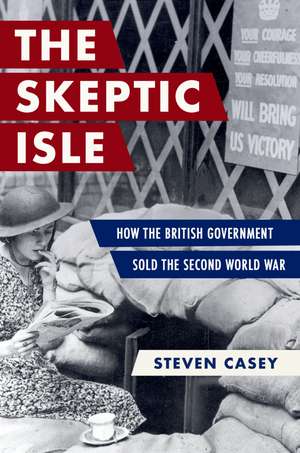
The Sceptic Isle: How the British Government Sold the Second World War
Autor Steven Caseyen Limba Engleză Hardback – 27 aug 2026
Preț: 207.70 lei
Preț vechi: 239.69 lei
-13% Nou
Puncte Express: 312
Carte disponibilă
Livrare economică 19-25 noiembrie
Livrare express 03-07 noiembrie pentru 72.70 lei
Livrare prin curier în România Termenul estimat este afișat lângă disponibilitate.
Transport gratuit de la 400.00 lei Plată online sau ramburs, în funcție de opțiunile comenzii.
Retur gratuit în 14 zile Comandă securizată și suport în română.
Specificații
ISBN-13: 9780197781876
ISBN-10: 019778187X
Pagini: 392
Ilustrații: 25 black and white halftones
Dimensiuni: 165 x 243 x 31 mm
Greutate: 0.7 kg
Editura: Oxford University Press
Colecția OUP USA
Locul publicării:New York, United States
ISBN-10: 019778187X
Pagini: 392
Ilustrații: 25 black and white halftones
Dimensiuni: 165 x 243 x 31 mm
Greutate: 0.7 kg
Editura: Oxford University Press
Colecția OUP USA
Locul publicării:New York, United States
V-ar putea interesa
-
 UnpeopleMark CurtisPreț: 119.39 lei
 -
 Britain's WarDaniel Todman-24%Preț: 107.00 lei140.63 lei
 -
 Goebbels and 'Total War': The Sports Palace Speech of 1943Peter Longerich-19%Preț: 114.92 lei142.64 lei
 -
 The Pacific Campaign in World War II: From Pearl Harbor to GuadalcanalWilliam Bruce JohnsonPreț: 285.55 lei
 -
 How to Win an Information WarPeter PomerantsevPreț: 107.07 lei
 -
 -29%Preț: 122.07 lei171.11 lei
 -
 Britain's Forgotten BattleAdrian And Dawn L. BridgePreț: 167.63 lei
 -
 Churchill's Last Wartime SecretAdrian SearlePreț: 108.34 lei
 -
 Preț: 193.51 lei
 -
 -17%Preț: 91.42 lei109.57 lei
 -
 -16%Preț: 197.96 lei235.40 lei
 -
 The Art of DeliveryMichelle ClementPreț: 192.44 lei
 -
 The People's WarJohn WillisPreț: 232.05 lei
 -
 -25%Preț: 70.21 lei93.80 lei
 -
 Reflections of WarPeter DeleuranPreț: 235.72 lei
 -
 Preț: 193.01 lei
 -
 The Story of British Propaganda FilmScott Anthony-24%Preț: 185.36 lei244.36 lei
 -
 The Invisible CampaignJane Gulliford LowesPreț: 148.53 leiNou
Recenzii
Timely' is all too often applied to books by their publishers, but in an age where communication is all, this history more than merits it.
A gripping account that punctures the myth of a 'People's War' and reveals the immense political effort spent managing fear, hope, and frustration.
From 1939 to 1945, the British people overwhelmingly supported the war effort while often distrusting the willingness of their government to tell them the plain facts about what was going on. Steven Casey's absorbing and richly researched history of the propaganda battle in the forties reminds us that public cynicism and suspicion in wartime are nothing new.
Drawing on Home Intelligence reports to good effect, Steven Casey tells the history of Britain's Second World War as seen through cracks in the façade of 'morale'. While providing a smoothly readable narrative of more or less familiar events, Casey puts a new spin on them by showing the British public and press to be attentive, probing, and yes, sceptical recipients of the messages disseminated by their government during the war.
Compelling
[An] impressive and persuasive book.
A brilliant and richly detailed study, deeply thought- provoking, of how narratives of the war were shaped and presented; how the public was psychologically manipulated, massaged and fooled.
An excellent work.
A thoroughly researched and sometimes surprising study (****).
This is a worthy, extensively sourced and original work that has something new to say about the Second World War.
A gripping account that punctures the myth of a 'People's War' and reveals the immense political effort spent managing fear, hope, and frustration.
From 1939 to 1945, the British people overwhelmingly supported the war effort while often distrusting the willingness of their government to tell them the plain facts about what was going on. Steven Casey's absorbing and richly researched history of the propaganda battle in the forties reminds us that public cynicism and suspicion in wartime are nothing new.
Drawing on Home Intelligence reports to good effect, Steven Casey tells the history of Britain's Second World War as seen through cracks in the façade of 'morale'. While providing a smoothly readable narrative of more or less familiar events, Casey puts a new spin on them by showing the British public and press to be attentive, probing, and yes, sceptical recipients of the messages disseminated by their government during the war.
Compelling
[An] impressive and persuasive book.
A brilliant and richly detailed study, deeply thought- provoking, of how narratives of the war were shaped and presented; how the public was psychologically manipulated, massaged and fooled.
An excellent work.
A thoroughly researched and sometimes surprising study (****).
This is a worthy, extensively sourced and original work that has something new to say about the Second World War.
Notă biografică
Steven Casey is Professor of International History The London School of Economics and Political Science. He is the author of eleven multi-awarding-winning books, including Cautious Crusade: Franklin D. Roosevelt, American Public Opinion and Nazi Germany, 1941-45 (OUP, 2001); Selling the Korean War: Propaganda, Politics, and the Press in the United States, 1950-1953 (OUP, 2008); The War Beat, Europe: The American Media at War against Nazi Germany (OUP, 2017); and The War Beat, Pacific: The American Media at War against Japan (OUP, 2021). His articles appear in such outlets as Foreign Affairs, History Today, the Sydney Morning Herald, and The Spectator.