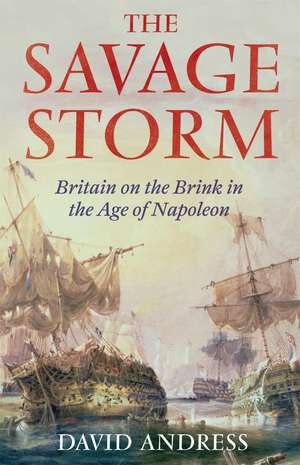
The Savage Storm: Britain on the Brink in the Age of Napoleon
Autor David Andressen Limba Engleză Hardback – 27 sep 2012
Yet, despite all this, and new threats from royal madness and rampant corruption, Britain did not become a revolutionary republic. Her elites proved remarkably resilient, and drew on the power of an already-global empire to find the strength to defeat Napoleon abroad, and continued popular unrest at home.
In this brilliant, sweeping history of the period, David Andress fuses two hitherto separate historical perspectives - the military and the social - to provide a vivid portrait of the age. From the conditions of warfare faced by the British soldier and the great battles in which they fought, to the literary and artistic culture of the time, The Savage Storm is at once a searing narrative of dramatic events and an important reassessment of one of the most significant turning points in our history.
Preț: 136.81 lei
Preț vechi: 193.48 lei
-29%
Puncte Express: 205
Carte disponibilă
Livrare economică 02-16 noiembrie
Livrare prin curier în România Termenul estimat este afișat lângă disponibilitate.
Transport gratuit de la 400.00 lei Plată online sau ramburs, în funcție de opțiunile comenzii.
Retur gratuit în 14 zile Comandă securizată și suport în română.
Specificații
ISBN-13: 9781408701928
ISBN-10: 1408701928
Pagini: 428
Ilustrații: Section: 16, b/w photos
Dimensiuni: 236 x 170 x 42 mm
Greutate: 0.83 kg
Editura: Little Brown
Colecția Little, Brown
Locul publicării:London, United Kingdom
ISBN-10: 1408701928
Pagini: 428
Ilustrații: Section: 16, b/w photos
Dimensiuni: 236 x 170 x 42 mm
Greutate: 0.83 kg
Editura: Little Brown
Colecția Little, Brown
Locul publicării:London, United Kingdom
Recenzii
Praise for 1789:
'Andress writes with verve, never allowing the pace to slacken, moving swiftly from one character or episode to another. The result is exciting, exhilarating even. Not one chapter fails to delivery sharp insights, illuminating details and entertaining anecdotes' Tim Blanning, Sunday Telegraph
'A truly global story . . . This is a compelling, humane account' Independent
Praise for The Terror:
'Commendably fair and even-handed . . . A lucid study' Munro Price, Sunday Telegraph
'The most authoritative treatment we are likely to have for many years' William Doyle, Independent
'A meticulous account . . . stands beside Simon Schama's Citizens' Literary Review
David Andress writes well, charts the British experience of the struggle against Napoleon in a manner that is as thorough as it is enthusiastic, approaches his subject from a refreshing perspective and fills a serious gap in the historiography . . . The Savage Storm is a book that . . . should be read by all those interested in Britain's role in the Revolutionary and Napoleonic Wars
Andress's vivid account of Britain's history during the war years . . . He writes movingly about the reality of war, the experience of the common soldier and especially of the sailor . . . He shows commendable skill in interweaving the two narratives, the military and the political, to offer a convincing overview of the age
'Andress writes with verve, never allowing the pace to slacken, moving swiftly from one character or episode to another. The result is exciting, exhilarating even. Not one chapter fails to delivery sharp insights, illuminating details and entertaining anecdotes' Tim Blanning, Sunday Telegraph
'A truly global story . . . This is a compelling, humane account' Independent
Praise for The Terror:
'Commendably fair and even-handed . . . A lucid study' Munro Price, Sunday Telegraph
'The most authoritative treatment we are likely to have for many years' William Doyle, Independent
'A meticulous account . . . stands beside Simon Schama's Citizens' Literary Review
David Andress writes well, charts the British experience of the struggle against Napoleon in a manner that is as thorough as it is enthusiastic, approaches his subject from a refreshing perspective and fills a serious gap in the historiography . . . The Savage Storm is a book that . . . should be read by all those interested in Britain's role in the Revolutionary and Napoleonic Wars
Andress's vivid account of Britain's history during the war years . . . He writes movingly about the reality of war, the experience of the common soldier and especially of the sailor . . . He shows commendable skill in interweaving the two narratives, the military and the political, to offer a convincing overview of the age