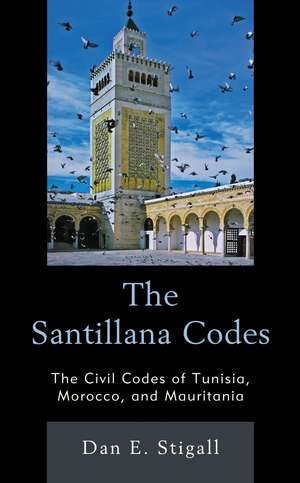
The Santillana Codes: The Civil Codes of Tunisia, Morocco, and Mauritania
Autor Dan E. Stigallen Limba Engleză Hardback – 11 oct 2017
Preț: 567.00 lei
Preț vechi: 830.34 lei
-32%
Puncte Express: 851
Carte tipărită la comandă
Livrare economică 03-17 decembrie
Livrare prin curier în România Termenul estimat este afișat lângă disponibilitate.
Transport gratuit pentru acest produs Plată online sau ramburs, în funcție de opțiunile comenzii.
Retur gratuit în 14 zile Comandă securizată și suport în română.
Specificații
ISBN-13: 9781498561754
ISBN-10: 1498561756
Pagini: 218
Ilustrații: 5 b/w photos; 6 tables;
Dimensiuni: 150 x 232 x 18 mm
Greutate: 0.46 kg
Editura: Bloomsbury Publishing
Colecția Lexington Books
Locul publicării:New York, United States
ISBN-10: 1498561756
Pagini: 218
Ilustrații: 5 b/w photos; 6 tables;
Dimensiuni: 150 x 232 x 18 mm
Greutate: 0.46 kg
Editura: Bloomsbury Publishing
Colecția Lexington Books
Locul publicării:New York, United States
Cuprins
Chapter 1: Civil Law and Civil CodesChapter 2: Islamic LawChapter 3: The Genesis of the Santillana Codes
Chapter 4: The Sources of LawChapter 5: Obligations in GeneralChapter 6: Sale and Other Nominate ContractsChapter 7: Conclusion
Chapter 4: The Sources of LawChapter 5: Obligations in GeneralChapter 6: Sale and Other Nominate ContractsChapter 7: Conclusion
Recenzii
The Santillana Codes: The Civil Codes of Tunisia, Morocco, and Mauritania succeeds in inviting more jurisdictions to the codification table. It likewise fills a gap in the English-language literature on the codification endeavors undertaken in the Maghreb, focusing on the interplay of civil law and Islamic law.
This book provides an excellent comparative in-depth study of how the civil legal tradition and the Islamic legal tradition interact in the context of a code. The book demonstrates in an innovative and thought-provoking way that Islamic law can indeed function well in a contemporary context side-by-side the civil legal tradition as a part of a "mixed-law jurisdiction," where a variety of sources contribute to the domestic legal system. I see this book as a truly remarkable contribution to a variety of scholarly disciplines, including comparative law and Islamic law in particular.
In an innovative, historical, conceptual, and analytical thesis of the codification movement in Tunisia, Morocco, and Mauritania, Dan Stigall makes a valuable contribution to the areas of comparative law, civil law, Islamic law, and the Middle Eastern legal systems.
Part history of North Africa and the Sahel, part ethnography, and fully a text in comparative law. This book recovers the memory and introduces the work of the Middle Eastern and African legislators who labored on connecting the civilian legal tradition to Islamic law. The approach is highly recommended in a world which is increasingly skeptical of attempts to reconstruct Middle Eastern or African societies from a tabula rasa.
This book provides an excellent comparative in-depth study of how the civil legal tradition and the Islamic legal tradition interact in the context of a code. The book demonstrates in an innovative and thought-provoking way that Islamic law can indeed function well in a contemporary context side-by-side the civil legal tradition as a part of a "mixed-law jurisdiction," where a variety of sources contribute to the domestic legal system. I see this book as a truly remarkable contribution to a variety of scholarly disciplines, including comparative law and Islamic law in particular.
In an innovative, historical, conceptual, and analytical thesis of the codification movement in Tunisia, Morocco, and Mauritania, Dan Stigall makes a valuable contribution to the areas of comparative law, civil law, Islamic law, and the Middle Eastern legal systems.
Part history of North Africa and the Sahel, part ethnography, and fully a text in comparative law. This book recovers the memory and introduces the work of the Middle Eastern and African legislators who labored on connecting the civilian legal tradition to Islamic law. The approach is highly recommended in a world which is increasingly skeptical of attempts to reconstruct Middle Eastern or African societies from a tabula rasa.