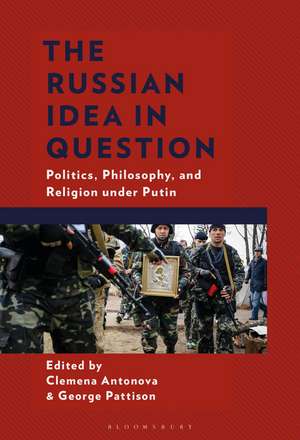
The Russian Idea in Question: Politics, Philosophy, and Religion under Putin
Editat de Clemena Antonova, George Pattisonen Limba Engleză Hardback – 26 noi 2026
In the face of challenges of any single definition, the collection brings together theologians, historians, literary scholars, political theorists, and art historians to focus on different aspects of this complex concept and uncover the sometimes irreconcilable tensions at the heart of it.
The selection of topics and figures is occasioned by Putin's own speeches and policies, with the addition of religious and cultural themes that are salient in contemporary Russian neo-imperialist thinking. A special case is that of Anti-Semitism, insofar as Putin seems not to have pursued this aspect of Russia's political heritage (manifest in both Tsarist and Soviet eras), although elements of this have been aired by public figures. Under the broad umbrella of Russian Studies, the work is fully inter-disciplinary, with contributors representing a range of academic disciplines, including political theory, literary studies, history, philosophy, theology, and aesthetics.
Preț: 597.35 lei
Preț vechi: 879.41 lei
-32% Precomandă
Puncte Express: 896
Carte nepublicată încă
Livrare prin curier în România Precomanda se expediază când titlul devine disponibil.
Transport gratuit pentru acest produs Plată online sau ramburs, în funcție de opțiunile comenzii.
Retur gratuit în 14 zile Comandă securizată și suport în română.
Doresc să fiu notificat când acest titlu va fi disponibil:
Se trimite...
Specificații
ISBN-13: 9781666976977
ISBN-10: 1666976970
Pagini: 266
Ilustrații: 2 figures
Dimensiuni: 152 x 229 mm
Editura: Bloomsbury Publishing
Colecția Bloomsbury Academic
Locul publicării:New York, United States
ISBN-10: 1666976970
Pagini: 266
Ilustrații: 2 figures
Dimensiuni: 152 x 229 mm
Editura: Bloomsbury Publishing
Colecția Bloomsbury Academic
Locul publicării:New York, United States
Cuprins
Introduction
Part 1. The Political Context
Chapter 1. The Political Philosophy of Putin's Speeches
Chapter 2. The Importance of the State in Russian Thought and Contemporary Political Rhtetoric
Chapter 3. The Russian Orthodox Church as a Political Weapon
Part 2. Historical Perspectives
Chapter 4. Tolstoy
Chapter 5. Dostoevsky
Chapter 6. Ivan Illyin
Chapter 7. Nikolai Berdyaev
Chapter 8. Eurasianism
Chapter 9. The Icon as Russian Idea
Chapter 10. Anti-Semitism
Part 3 Review and Reflection
Conclusion
Part 1. The Political Context
Chapter 1. The Political Philosophy of Putin's Speeches
Chapter 2. The Importance of the State in Russian Thought and Contemporary Political Rhtetoric
Chapter 3. The Russian Orthodox Church as a Political Weapon
Part 2. Historical Perspectives
Chapter 4. Tolstoy
Chapter 5. Dostoevsky
Chapter 6. Ivan Illyin
Chapter 7. Nikolai Berdyaev
Chapter 8. Eurasianism
Chapter 9. The Icon as Russian Idea
Chapter 10. Anti-Semitism
Part 3 Review and Reflection
Conclusion
Recenzii
"'The Russian idea,' a term introduced by Dostoevsky in 1861, asserts Russia's spiritual and moral superiority over the liberalism, individualism, and materialism of the West. The idea has metastasized into the violent "Russian World" ideology of Putin and the Moscow Patriarchate. This book is an essential guide for understanding how that happened. It shows, as the editors write, "how readily major elements of Russian political, philosophical, religious, and literary culture have lent themselves to appropriation in the cause of an aggressive and repressive authoritarianism."
"This original and thoughtful volume of essays proves that the proper intellectual response to Putin's war in Ukraine is not canceling Russian culture but re-thinking it."
"A must-read for those who want to understand the intellectual genealogy of Russia's ideological construction and delve into the continuities, disruptures and reinterpretations of Russian philosophy by the Kremlin."
"This original and thoughtful volume of essays proves that the proper intellectual response to Putin's war in Ukraine is not canceling Russian culture but re-thinking it."
"A must-read for those who want to understand the intellectual genealogy of Russia's ideological construction and delve into the continuities, disruptures and reinterpretations of Russian philosophy by the Kremlin."