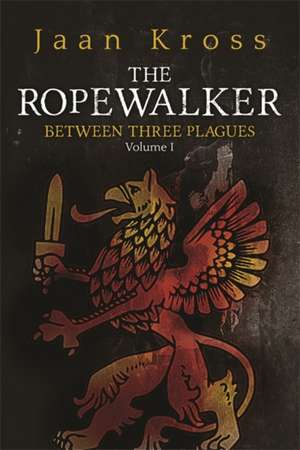
The Ropewalker: Between Three Plagues Volume I
Autor Jaan Kross Traducere de Merike Lepasaar Beecheren Limba Engleză Paperback – 8 mar 2018
Jaan Kross's trilogy dramatises the life of the renowned Livonian Chronicler Balthasar Russow, whose greatest work described the effects of the Livonian War on the peasantry of what is now Estonia. Like Hilary Mantel's Thomas Cromwell, Russow is a diamond in the rough, a thoroughly modern man in an Early Modern world, rising from humble origins to greatness through wit and learning alone.
As Livonia is used as a political football by the warring powers of Russia, Sweden, Poland and Lithuania, he continues to climb the greasy pole of power and influence. Even as a boy, Russow has the happy knack of being in the right place and saying the right thing at the right time.
He is equally at home acting as friend and confidante to his ambitious patron and as champion for his humble rural relatives. Can anything halt his vertiginous rise? Like most young men he is prey to temptations of the flesh . . .
Preț: 66.30 lei
Preț vechi: 90.37 lei
-27%
Puncte Express: 99
Preț estimativ în valută:
11.74€ • 13.67$ • 10.20£
11.74€ • 13.67$ • 10.20£
Carte disponibilă
Livrare economică 02-16 februarie
Livrare express 16-22 ianuarie pentru 50.67 lei
Preluare comenzi: 021 569.72.76
Specificații
ISBN-13: 9781784299781
ISBN-10: 1784299782
Pagini: 544
Dimensiuni: 129 x 198 x 32 mm
Greutate: 0.37 kg
Editura: Quercus Books
Colecția MacLehose Press
Locul publicării:London, United Kingdom
ISBN-10: 1784299782
Pagini: 544
Dimensiuni: 129 x 198 x 32 mm
Greutate: 0.37 kg
Editura: Quercus Books
Colecția MacLehose Press
Locul publicării:London, United Kingdom
Recenzii
He's a marvellous novelist - his scope and depth make him a world writer - and they should just hurry up and give him the Nobel
He deserved a Nobel prize and would probably have got it had he written in any other language but Estonian
He's almost alone in writing in the older European tradition of the large-scale historical novel. I'd argue that Kross is heir to the 'great' Russo-European 19th century novelists; his fiction has Tolstoyan sweep. On reading him, moreover, we rediscover that Estonia was always resolutely in Europe and not some obscure outpost this side of the Urals
No stranger to oppression himself, Kross writes about it with a poignancy devoid of anger
He deserved a Nobel prize and would probably have got it had he written in any other language but Estonian
He's almost alone in writing in the older European tradition of the large-scale historical novel. I'd argue that Kross is heir to the 'great' Russo-European 19th century novelists; his fiction has Tolstoyan sweep. On reading him, moreover, we rediscover that Estonia was always resolutely in Europe and not some obscure outpost this side of the Urals
No stranger to oppression himself, Kross writes about it with a poignancy devoid of anger