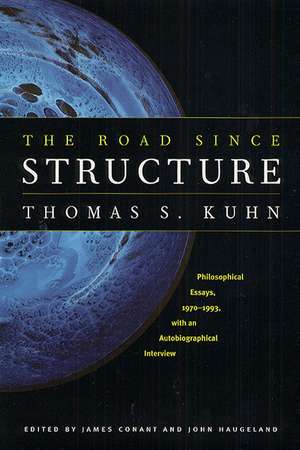
The Road since Structure: Philosophical Essays, 1970-1993, with an Autobiographical Interview
Autor Thomas S. Kuhn Editat de James Conant, John Haugelanden Limba Engleză Paperback – noi 2002
Recomandăm această colecție esențială pentru înțelegerea evoluției gândirii lui Thomas S. Kuhn, structurată metodologic pentru a oferi o imagine de ansamblu asupra rafinării conceptelor sale post-1962. Materialul este organizat în trei secțiuni principale: prima parte se concentrează pe reconceptualizarea revoluțiilor științifice, a doua include comentarii și replici metodice la adresa criticilor, iar ultima secțiune oferă o perspectivă personală printr-un interviu autobiografic detaliat. Remarcăm cum volumul documentează tranziția autorului de la o perspectivă predominant istorică asupra științei către una mai apropiată de filosofia limbajului și evoluționism.
În prima parte, eseuri precum „Commensurability, Comparability, Communicability” demonstrează cum Kuhn a nuanțat termenul de „incomensurabilitate”, răspunzând acuzațiilor de iraționalism. Această abordare extinde cadrul propus de Kuhn's The Structure of Scientific Revolutions Revisited de Vasso Kindi cu date noi din perioada 1980-1990, oferind clarificări pe care lucrarea originală din 1962 doar le sugera. De asemenea, volumul se raportează direct la The Structure of Scientific Revolutions, funcționând ca un amendament necesar și o defensivă argumentată în fața criticilor de formalism.
Analizând progresia conținutului, observăm că textele selectate de editorii James Conant și John Haugeland nu sunt simple reluări, ci explorări ale „lumilor posibile” și ale metaforei în știință. Față de studiile istorice aplicate din Black-Body Theory and the Quantum Discontinuity, 1894-1912, The Road since Structure reprezintă efortul teoretic final de a construi o epistemologie coerentă care să explice natura schimbării științifice.
Preț: 293.84 lei
Carte tipărită la comandă
Livrare economică 25 noiembrie-09 decembrie
Specificații
ISBN-10: 0226457990
Pagini: 336
Ilustrații: 6 halftones
Dimensiuni: 152 x 229 x 23 mm
Greutate: 0.46 kg
Ediția:1
Editura: University of Chicago Press
Colecția University of Chicago Press
V-ar putea interesa
-
 Hilary Putnam: Pragmatism and RealismJames Conant-15%Preț: 463.17 lei544.91 lei
 -
 Preț: 261.39 lei
 -
 Is the Welfare State Justified?Daniel ShapiroPreț: 410.39 lei
 -
 Having Thought – Essays in the Metaphysics of MindJohn HaugelandPreț: 314.72 lei
 -
 Philosophical Topics 42.1Sebastian RödlPreț: 204.77 lei
 -
 Philosophical Topics 34.1 and 34.2James ConantPreț: 211.13 lei
 -
 Farewell to Freedom: A Western Genealogy of LibertyRicardo BaldissonePreț: 175.16 lei
 -
 Preț: 113.56 lei
 -
 Libre PhilosophieErnest BersotPreț: 123.37 lei
 -
 Preț: 208.07 lei
 -
 Preț: 193.20 lei
 -
 Examen des critiques du livre intitulé De l'EspritCharles-Georges LeroyPreț: 161.23 lei
 -
 Preț: 109.02 lei
 -
 Die Struktur wissenschaftlicher RevolutionenThomas S. KuhnPreț: 110.41 lei
 -
 Juegos de lenguaje en WittgensteinGustavo LaguardiaPreț: 233.79 lei
 -
 La música de las esferas. ¿Suenan los cielos?L. Carolina Durán-8%Preț: 518.11 lei563.17 lei
 -
 Sol de Oriente: El Camino del PeregrinoPablo D. BodnarPreț: 88.01 lei
De ce să citești această carte
Această lucrare este indispensabilă pentru studenții și cercetătorii în filosofia științei care doresc să înțeleagă forma finală a ideilor lui Kuhn. Cititorul câștigă acces la explicațiile autorului despre incomensurabilitate și la un interviu biografic rar, care clarifică contextul personal al scrierii operelor sale majore. Este puntea necesară între intuițiile revoluționare din tinerețe și rigoarea analitică a ultimelor decenii de activitate.
Despre autor
Thomas S. Kuhn (1922–1996) a fost profesor emerit la Massachusetts Institute of Technology, fiind considerat unul dintre cei mai influenți filosofi ai științei din secolul XX. Cariera sa a fost marcată de trecerea de la fizică la istoria și filosofia științei, transformând radical discursul academic prin introducerea conceptelor de „paradigmă” și „știință normală”. Opera sa cuprinde titluri fundamentale precum The Copernican Revolution și The Essential Tension. Această ultimă culegere de eseuri, publicată post-mortem, reflectă preocupările sale târzii pentru lingvistică și structura taxonomică a teoriilor științifice.
Descriere scurtă
Notă biografică
John Haugeland is also a professor of philosophy at the University of Chicago. He is the author of two books, Artificial Intelligence, the Very Idea and Having Thought: Essays in the Metaphysics of Mind, and the editor of two books, Mind Design and Mind Design II.
Cuprins
Editors' Introduction
PART 1: RECONCEIVING SCIENTIFIC REVOLUTIONS
1. What Are Scientific Revolutions?
2. Commensurability, Comparability, Communicability
3. Possible Worlds in History of Science
4. The Road since Structure
5. The Trouble with the Historical Philosophy of Science
PART 2: COMMENTS AND REPLIES
6. Reflections on My Critics
7. Theory Change as Structure Change: Comments on the Sneed Formalism
8. Metaphor in Science
9. Rationality and Theory Choice
10. The Natural and Human Sciences
11. Afterwords
PART 3: A DISCUSSION WITH THOMAS S. KUHN
Publications of Thomas S. Kuhn