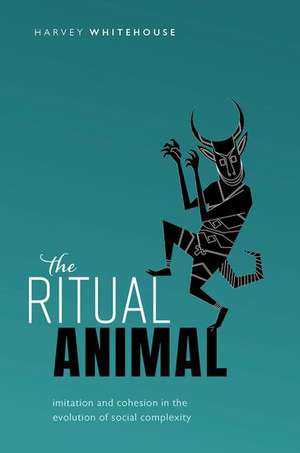
The Ritual Animal: Imitation and Cohesion in the Evolution of Social Complexity
Autor Harvey Whitehouseen Limba Engleză Hardback – 25 noi 2021
În The Ritual Animal, Harvey Whitehouse propune o analiză riguroasă a modului în care ritualurile au modelat istoria și complexitatea socială, situând lucrarea la intersecția dintre antropologie, psihologie cognitivă și biologie evoluționistă. Considerăm că forța acestui volum rezidă în explicarea unui paradox fundamental: de ce specia umană investește resurse colosale în acțiuni fără un beneficiu instrumental direct. Autorul demonstrează că, spre deosebire de alte primate care imită doar comportamente utile, oamenii manifestă o tendință de a copia acțiuni cauzal opace, proces esențial pentru coeziunea de grup.
Structura argumentației se bazează pe distincția între două „moduri ritualice” pe care Harvey Whitehouse le-a explorat anterior în lucrări precum Modes of Religiosity sau Mind and Religion. Găsim aici o rafinare a teoriei sale: ritualurile rare și intense emoțional (modul imagistic) creează legături indisolubile în grupuri mici, precum unitățile militare, în timp ce ritualurile frecvente și repetitive (modul doctrinal) permit extinderea comunităților la scară largă, cum sunt marile religii mondiale. Cititorii familiarizați cu Ritual in Human Evolution and Religion de Matt J. Rossano vor aprecia modul în care Whitehouse trece dincolo de gestionarea resurselor, oferind un cadru teoretic ce poate fi testat empiric.
Această ediție publicată de OUP OXFORD nu este doar o sinteză academică, ci și un manifest pentru utilizarea științelor sociale în rezolvarea problemelor globale. Analizând „adezivul social” produs de ritual, autorul oferă soluții practice pentru provocări precum extremismul sau criza climatică, transformând antropologia într-un instrument de supraviețuire colectivă. Este o lucrare de o ambiție rară, care reușește să pună ordine în diversitatea culturală a lumii prin prisma sistemelor de memorie și a evoluției.
Preț: 239.96 lei
Preț vechi: 276.65 lei
-13%
Carte tipărită la comandă
Livrare economică 05-16 iunie
Livrare express 02-08 mai pentru 74.45 lei
Specificații
ISBN-10: 0199646368
Pagini: 252
Dimensiuni: 167 x 242 x 21 mm
Greutate: 0.53 kg
Editura: OUP OXFORD
Colecția OUP Oxford
Locul publicării:Oxford, United Kingdom
De ce să citești această carte
Recomandăm această carte oricui este interesat de mecanismele psihologice din spatele apartenenței la grup. Cititorul va câștiga o înțelegere profundă a motivului pentru care tradițiile aparent inutile sunt, de fapt, esențiale pentru stabilitatea societății. Este o lectură fundamentală pentru studenții la sociologie și antropologie, dar și pentru liderii care caută să înțeleagă cum se construiește cooperarea durabilă într-o lume din ce în ce mai polarizată.
Despre autor
Harvey Whitehouse este profesor și cercetător de renume, director al Centrului pentru Studiul Coeziunii Sociale la Universitatea Oxford (anterior activând la Queen's University Belfast). Este unul dintre fondatorii domeniului științelor cognitive ale religiei. Opera sa, care include titluri de referință precum Arguments and Icons, este rezultatul unor ample cercetări de teren în Papua Noua Guinee și al unor studii comparative la nivel global. Whitehouse este recunoscut pentru dezvoltarea teoriei „modurilor de religiozitate”, care explică modul în care funcționarea memoriei umane influențează structura și transmiterea tradițiilor culturale și religioase.
Descriere
Recenzii
Probably the most impressive and important overview of work in the science of culture (not just religion or ritual) that exists today.
Reaching across disciplinary and methodological divides, as well as across geographic and historical boundaries, The Ritual Animal brings a wealth of scholarship in the human sciences to bear on our understanding of ritual.
Whitehouse's call for multidisciplinary and problem-centered approaches to research is especially important if our species is to thrive in the coming centuries.
Whitehouse's Ritual Animal is an extraordinarily rich array of arguments, references to earlier research, empirical evidence, experimental results, and modeling.
Harvey Whitehouse and his collaborators have built an extensive research program investigating rituals from a cognitive and evolutionary perspective. The Ritual Animal presents a compelling synthesis.
Whitehouse shows how his magisterial theory concerning modes of religiosity also offers a rich and compelling account of the social and psychological foundations of the formation of and the cooperation within human groups. Elegantly written, clearly argued, and deeply insightful, The Ritual Animal is an intellectual feast
From big-data mining of the world's historical and ethnographic record to field studies spanning the tribal cultures of New Guinea to the war zones of the Middle East, the reader of The Ritual Animal discovers the science underlying the seemingly arbitrary and irrational rituals that bind together friends or strangers or even humanity as a whole.
In a magisterial survey from pre-history to mass society, from birth to the afterlife, from football fans to terrorists, Harvey Whitehouse offers a compelling, ambitious and testable theory of why we human beings devote so much time and effort to activities with so little instrumental benefit.