Cantitate/Preț
Produs

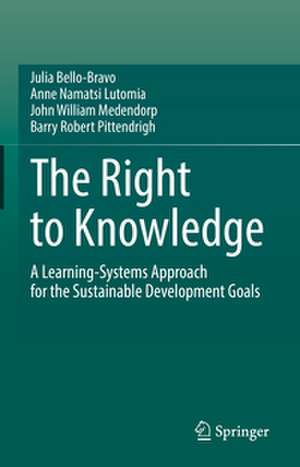
The Right to Knowledge

Autor Julia Bello-Bravo, Anne Namatsi Lutomia, John William Medendorp, Barry Robert Pittendrigh
en Limba Engleză Hardback – 25 noi 2025

Analizăm în această lucrare studiile de caz derivate din inițiativa Scientific Animations Without Borders (SAWBO) a Universității Purdue, care servesc drept fundament pentru un model pedagogic inovator. Autorii propun o abordare practică a sistemelor de învățare, concepută pentru a livra conținut educațional scalabil la nivel global, indiferent de barierele de limbă, alfabetizare sau cultură. Reținem faptul că volumul nu se limitează la teorie, ci explorează modul în care informația poate fi distribuită „viral” sau prin mecanisme sociale digitale pentru a rezolva probleme de dezvoltare complexe, oferind soluții concrete pentru atingerea Obiectivelor de Dezvoltare Durabilă (SDG).

Structura textului integrează parametri esențiali precum genul, statutul socioeconomic și izolarea geografică, transformând accesul la cunoaștere dintr-un concept abstract într-o metodologie măsurabilă. The Right to Knowledge extinde cadrul propus de Who Owns Knowledge? cu date noi din era digitală, mutând accentul de la controlul legal asupra proprietății intelectuale către democratizarea accesului prin tehnologie. În timp ce Global Knowledge Cultures discută puterea culturală a informației, lucrarea de față, publicată de Springer, oferă instrumentele tehnice pentru a depăși „decalajul digital”.

Credem că relevanța acestui titlu rezidă în capacitatea sa de a replica succesul rețelelor sociale pentru scopuri educaționale riguroase. Autorii, printre care Julia Bello-Bravo și Barry Robert Pittendrigh, demonstrează cum animațiile științifice pot deveni vehicule ale schimbării în comunități marginalizate, oferind un manual de bune practici pentru cercetătorii în științe sociale și experții în dezvoltare internațională.

Citește tot Restrânge

Preț: 71942 lei

Preț vechi: 94661 lei
-24%

Puncte Express: 1079

Carte disponibilă

Livrare economică 10-16 noiembrie
Livrare express 31 octombrie-06 noiembrie pentru 7232 lei

Livrare prin curier în România Termenul estimat este afișat lângă disponibilitate.
Transport gratuit pentru acest produs Plată online sau ramburs, în funcție de opțiunile comenzii.
Retur gratuit în 14 zile Comandă securizată și suport în română.

Specificații

ISBN-13: 9783032033598
ISBN-10: 3032033594
Pagini: 144
Ilustrații: XVII, 125 p. 12 illus., 10 illus. in color.
Dimensiuni: 160 x 241 x 14 mm
Greutate: 0.36 kg
Editura: Springer

De ce să citești această carte

Recomandăm această carte pentru viziunea sa pragmatică asupra educației globale. Cititorul va înțelege cum proiectul SAWBO utilizează animația și tehnologia mobilă pentru a depăși analfabetismul și izolarea geografică. Este o resursă esențială pentru cei interesați de politici publice și drepturile epistemice, oferind o strategie clară pentru transformarea informației brute în cunoaștere aplicabilă, esențială pentru un trai sustenabil în orice colț al lumii.


Descriere

This empirically researched and grounded book presents a learning-systems approach for mass-scalable educational content ultimately intended for use across any language, literacy level, culture, or digital divide. The work here is based primarily on Purdue University's Scientific Animations Without Borders (SAWBO) initiative. Addressing the crosscutting issues of resilience, genders, socioeconomic status, geographic isolation, age, and other important development parameters, it provides one answer to how we (as a global development community) should address these issues to meet the SDGs globally and the good life for people and communities locally. At its core, this is a matter of making timely information available (whether by deliberate searching, word-of-mouth/"viral" redistribution, or even "stumbling" across the information, with or without personalized user-targeting)—in other words, by reproducing how the Internet already socially "works" (while avoiding how it doesn’t work) to deliver information in a deliberate, reliable, and measurable way for outcomes, and especially for overcoming "wicked" development problems, attain or surpass the SDGs on-schedule, and open people’s access to the good life where they live.

Notă biografică

Julia Bello-Bravo is an Assistant Professor in the Department of Agricultural Sciences Education and Communications at Purdue University (Ph.D. from Purdue University, West Lafayette, IN, USA). Her research focuses on educational pathways supporting value chains for food production, consumption, and prevention of postharvest losses. She has worked on cropping systems in Africa for the past decade, specifically around the challenges and opportunities for deployment of IPM strategies within the West African context. She is the co-founder and co-director of SAWBO. Anne Namatsi Lutomia is an interdisciplinary Senior Research Associate in the department of Entomology at Purdue University (West Lafayette, Indiana, USA). She holds a doctorate in Human Resource Development with a minor in gender and women studies from the University of Illinois at Urbana-Champaign. Her current research interests encompass scientific international collaboration, gender, leadership, adult learning and learning technologies. She has authored or co-authored several peer reviewed journal articles, book chapters, and a book "Gender, Digitalization, and Resilience in International Development: Failing Forward." John William Medendorp holds a Ph.D. in Higher, Adult, and Lifelong Education with a specialization in international development from Michigan State University. He currently serves as Associate Director of the Urban Center at Purdue University, Department of Entomology. He has also served as Director of the Borlaug Higher Education for Agricultural Research and Development (BHEARD) program, as well as Deputy Director for the Feed the Future Innovation Lab for Legume Systems Research, and Co-PI for the SAWBO-RAPID Scaling Program. In his various roles, he has managed and supported 14 capacity development projects for USAID and USDA in over 40 countries. Barry Robert Pittendrigh is the John V. Osmun Endowed Chair Professor in the Department of Entomology at Purdue University (Ph.D. from University of Wisconsin-Madison, Madison, WI, USA). He was previously an MSU Foundations Professor at Michigan State University, the C.W. Kerns, C.L. Metcalf and W.P. Flint Endowed Chair in Insect Toxicology (2008–2016) at the University of Illinois at Urbana-Champaign and was an Assistant and Associate Professor at Purdue University from 2000–2008. He was also the Director of the Feed the Future Legume Systems Research Innovations Lab (2017-2025). He is the co-founder and co-director of SAWBO.