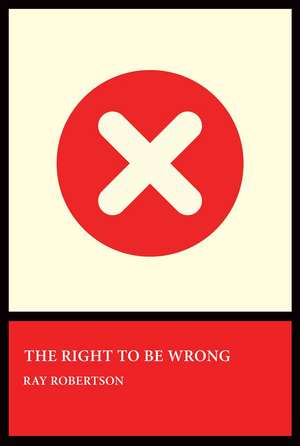
The Right to Be Wrong
Autor Ray Robertsonen Limba Engleză Paperback – 21 feb 2026
- A concise, insightful, and at-times humorous indictment of our increasingly polarized world, with a passionate defence of the necessity of free speech and critical thinking.
- A blend of social observations with political histories, theories, and philosophies, influenced by the writings of Montaigne, Marcus Aurelius, and Friedrich Nietzsche.
- Ray Robertson has won the Independent Publisher Book Award, has been a finalist for the Hillary Weston Prize for Non-Fiction and the Charles Taylor Prize for Non-Fiction, and has been long-listed for the Trillium Book Award.
- The Globe and Mail praised Robertson as “a moral writer and a bitingly intelligent one, a man who writes with penetrating insight of what needs to be written about: beauty, truth and goodness.”
- The National Post described Robertson’s book Why Not? as “intentionally provocative, stirring readers to vehemently agree or disagree. But this is Robertson’s point: to be stirred at all, regardless.”
Preț: 85.58 lei
Preț vechi: 104.75 lei
-18%
Puncte Express: 128
Carte disponibilă
Livrare economică 03-17 noiembrie
Livrare prin curier în România Termenul estimat este afișat lângă disponibilitate.
Transport gratuit de la 400.00 lei Plată online sau ramburs, în funcție de opțiunile comenzii.
Retur gratuit în 14 zile Comandă securizată și suport în română.
Specificații
ISBN-13: 9781770868175
ISBN-10: 1770868178
Pagini: 200
Dimensiuni: 137 x 203 x 10 mm
Greutate: 0.14 kg
Editura: CORMORANT BOOKS
Colecția Cormorant Books
Locul publicării:Toronto, Canada
ISBN-10: 1770868178
Pagini: 200
Dimensiuni: 137 x 203 x 10 mm
Greutate: 0.14 kg
Editura: CORMORANT BOOKS
Colecția Cormorant Books
Locul publicării:Toronto, Canada
Recenzii
“Sharp, accessible, and laced with keen humour, even as it tackles serious ground, The Right to Be Wrong makes a clear case for intellectual humility and independent thought. All while arguing that the freedom to be mistaken is essential if we hope to learn, grow, and live with one another in a divided world.”
“Robertson’s slim volume ... takes as its subject the cleavages — political, religious, ideological — that divide us into reactionary groups incapable of countenancing debate or dissent. … The ability, not to say the responsibility, to disagree is one of the key factors missing from our discourse and Robertson argues persuasively for its restoration.”
“In this slim volume, Robertson distills wisdom about the importance of free speech and full-throated debate to a civilized society from a wide variety of commentators through the ages, from Xenophanes through William Blake and Friedrich Nietzsche — and that’s just on one page … Robertson’s plea for civility will likely not be heard by those who would most benefit from his message — the trolls and thugs who intimidate others on social media. But by simply stating what he believes, Robertson is affirming his own right to be wrong — or right.”
“Reading a well-written and well-reasoned book like The Right to Be Wrong whet my appetite for more … Maybe Robertson’s book will inspire you too?”
“Robertson’s slim volume ... takes as its subject the cleavages — political, religious, ideological — that divide us into reactionary groups incapable of countenancing debate or dissent. … The ability, not to say the responsibility, to disagree is one of the key factors missing from our discourse and Robertson argues persuasively for its restoration.”
“In this slim volume, Robertson distills wisdom about the importance of free speech and full-throated debate to a civilized society from a wide variety of commentators through the ages, from Xenophanes through William Blake and Friedrich Nietzsche — and that’s just on one page … Robertson’s plea for civility will likely not be heard by those who would most benefit from his message — the trolls and thugs who intimidate others on social media. But by simply stating what he believes, Robertson is affirming his own right to be wrong — or right.”
“Reading a well-written and well-reasoned book like The Right to Be Wrong whet my appetite for more … Maybe Robertson’s book will inspire you too?”