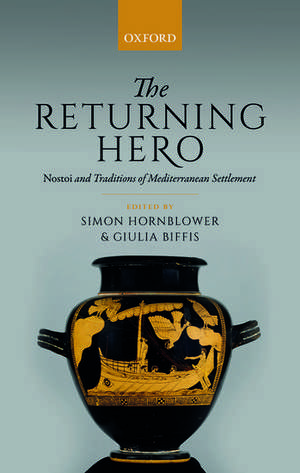
The Returning Hero: nostoi and Traditions of Mediterranean Settlement
Editat de Simon Hornblower, Giulia Biffisen Limba Engleză Hardback – 27 sep 2018
Preț: 821.38 lei
Preț vechi: 1193.16 lei
-31%
Puncte Express: 1232
Carte tipărită la comandă
Livrare economică 20-25 noiembrie
Livrare express 16-22 octombrie pentru 247.97 lei
Livrare prin curier în România Termenul estimat este afișat lângă disponibilitate.
Transport gratuit pentru acest produs Plată online sau ramburs, în funcție de opțiunile comenzii.
Retur gratuit în 14 zile Comandă securizată și suport în română.
Specificații
ISBN-13: 9780198811428
ISBN-10: 019881142X
Pagini: 378
Ilustrații: 22 black-and-white illustrations
Dimensiuni: 148 x 223 x 28 mm
Greutate: 0.61 kg
Editura: OUP OXFORD
Colecția OUP Oxford
Locul publicării:Oxford, United Kingdom
ISBN-10: 019881142X
Pagini: 378
Ilustrații: 22 black-and-white illustrations
Dimensiuni: 148 x 223 x 28 mm
Greutate: 0.61 kg
Editura: OUP OXFORD
Colecția OUP Oxford
Locul publicării:Oxford, United Kingdom
V-ar putea interesa
-
 -31%Preț: 773.12 lei1127.29 lei
 -
 Responses to Suffering in Classical Rabbinic LiteratureDavid Kraemer-31%Preț: 854.18 lei1240.19 lei
 -
 -31%Preț: 1200.51 lei1748.89 lei
 -
 -12%Preț: 366.13 lei413.82 lei
 -
 Wine, Women, and Death: Medieval Hebrew Poems on the Good LifeRaymond P. Scheindlin-22%Preț: 390.45 lei497.58 lei
 -
 Medieval Studies for J. A. W. Bennett: Aetatis suae LXXP. L. Heyworth-30%Preț: 502.77 lei714.70 lei
 -
 -32%Preț: 582.44 lei857.90 lei
 -
 A Commentary on Thucydides: Volume I: Books i-iiiSimon Hornblower-33%Preț: 1093.94 lei1624.98 lei
 -
 A Handbook on Old High German LiteratureJ. Knight Bostock-33%Preț: 1104.98 lei1645.82 lei
 -
 -28%Preț: 456.81 lei634.18 lei
 -
 Thucydidean ThemesSimon Hornblower-31%Preț: 743.86 lei1078.24 lei
 -
 A Commentary on Thucydides: Volume III: Books 5.25-8.109Simon Hornblower-23%Preț: 722.89 lei941.82 lei
 -
 The Circulation of Power in Medieval Biblical DramaRobert S SturgesPreț: 384.75 lei
 -
 -15%Preț: 468.71 lei551.43 lei
 -
 The Chivalric Romance and the Essence of FictionDani CavallaroPreț: 296.18 lei
 -
 Latin Literature and Its TransmissionRichard Hunter-11%Preț: 560.73 lei630.04 lei
 -
 The Late Medieval Origins of the Modern NovelRachel A Kent-15%Preț: 588.24 lei692.05 lei
 -
 The Cold Counsel: The Women in Old Norse Literature and MythSarah M. Anderson-15%Preț: 428.25 lei503.82 lei
 -
 A Literary History of the Fourteenth CenturyNatalino Sapegno-23%Preț: 638.29 lei828.95 lei
 -
 Dante's Idea of FriendshipFilippa Modesto-19%Preț: 541.37 lei668.35 lei
 -
 Athenian Comedy in the Roman EmpireC. W. Marshall-23%Preț: 237.83 lei309.45 lei
 -
 -19%Preț: 169.89 lei210.29 lei
 -
 GesamtregisterRéne Pérennec-9%Preț: 887.93 lei975.75 lei
 -
 -9%Preț: 1777.74 lei1953.57 lei
 -
 The AntiatticistStefano Valente-23%Preț: 886.96 lei1151.89 lei
 -
 Die Basilius-Übersetzung des Georg von TrapezuntChristina Abenstein-23%Preț: 975.90 lei1267.41 lei
 -
 Galeni De locis affectis I-IIGalenus-9%Preț: 2254.73 lei2477.73 lei
 -
 Imprinting IdentitiesKarolina Anna Mroziewicz-23%Preț: 511.65 lei664.49 lei
Recenzii
It is a ... volume that will richly repay anyone interested in the various cultural, historical, psychological, and comparative aspects of home, home -- leaving, and returning home in the ancient Mediterranean.
This is a rich and stimulating collection, which is likely to become a decisive contribution to our understanding of the social and historical background of the mythological tradition of nostoi.
... the collection is a stimulating contribution to cultural history... [Translated from German]
Overall, the volume is strong, with material to engage specialists in nostoi myths, mobility and settlement patterns, and ancient identity formation.
The concept of the returning hero originates with the tales of the Nostoi of the heroes after the Trojan War, and their travels and travails across the Mediterranean; but the volume manages to link these tales to the wider issue of the 'traditions of Mediterranean settlement'.
The topic is presented through the different viewpoints of scholars specialising in history, literature, myth, and archaeology ... This volume offers a range of interesting ideas on the theme of nostos, chiefly by pointing out how difficult it is to return home after absence, when neither the returner nor the home is the same.
This is a rich and stimulating collection, which is likely to become a decisive contribution to our understanding of the social and historical background of the mythological tradition of nostoi.
... the collection is a stimulating contribution to cultural history... [Translated from German]
Overall, the volume is strong, with material to engage specialists in nostoi myths, mobility and settlement patterns, and ancient identity formation.
The concept of the returning hero originates with the tales of the Nostoi of the heroes after the Trojan War, and their travels and travails across the Mediterranean; but the volume manages to link these tales to the wider issue of the 'traditions of Mediterranean settlement'.
The topic is presented through the different viewpoints of scholars specialising in history, literature, myth, and archaeology ... This volume offers a range of interesting ideas on the theme of nostos, chiefly by pointing out how difficult it is to return home after absence, when neither the returner nor the home is the same.
Notă biografică
Simon Hornblower was most recently a Senior Research Fellow in Classical Studies at All Souls College, Oxford, until his retirement in 2016. Earlier in his career he was a Prize Fellow at All Souls College from 1971 until 1977 before becoming Tutorial Fellow in Ancient History at Oriel College and University CUF Lecturer. In 1997 he was appointed Professor of Classics and Professor of Ancient History at UCL, where he remained until 2010 (from 2006 as Grote Professor of Ancient History).Giulia Biffis is Associate Lecturer in Greek at Birkbeck College, London and Research Associate in Classics at the University of Reading for this academic year. She was previously a Teaching Fellow at the University of Reading and at the University of Edinburgh after gaining her PhD in Classics at University College London in 2012. In parallel with her work on myths of return in ancient Greek literature she is also currently working on Lykophron's Alexandra and its relationship with female characterization in the Greek world.
Cuprins
- Frontmatter
- List of Figures and Maps
- List of Abbreviations
- List of Contributors
- 1: Simon Hornblower: Introduction
- 2: Robert L. Fowler: The nostoi and Archaic Greek Ethnicity
- 3: Stephanie West: Odysseus' Eclectic Itinerary
- 4: Irad Malkin: Returning Heroes and Greek Colonists
- 5: Guglielmo Genovese: nostoi as Heroic Foundations in Southern Italy: The Traditions about Epeios and Philoktetes
- 6: Tanja S. Scheer: Women and nostoi
- 7: Giulia Biffis: nostos, a Journey towards Identity in Athenian Tragedy
- 8: N. J. Lowe: Emotional Returns
- 9: Robin Lane Fox: Macedonians and nostos
- 10: Catherine Morgan: nostoi and Material Culture in the Area of the Classical-Hellenistic Ionian and Adriatic Seas
- 11: Naoíse Mac Sweeney: Failed nostoi and Foundations: Kalchas at Kolophon
- 12: Nicholas Purcell: Mediterranean Perspectives on Departure, Displacement, and Home
- Endmatter
- Bibliography
- Index