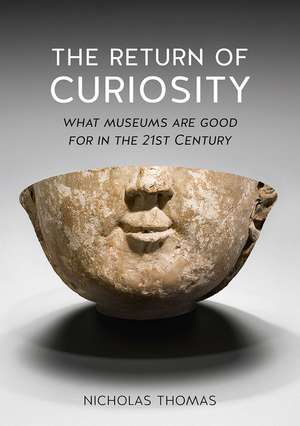
The Return of Curiosity
Autor Nicholas Thomasen Limba Engleză Paperback – iul 2016
Reținem The Return of Curiosity ca fiind o resursă esențială pentru studenții la muzeologie, cercetătorii în antropologie culturală și practicienii din sectorul patrimoniului. Într-o epocă marcată de incertitudine socială, Nicholas Thomas propune o reevaluare a muzeului nu doar ca spațiu de conservare, ci ca forță culturală activă ce stimulează curiozitatea publică. Credem că valoarea acestui volum rezidă în capacitatea de a transforma percepția asupra colecțiilor, de la simple obiecte statice la „tehnologii creative” capabile să genereze noi perspective asupra lumii.
Structura textului este riguroasă, debutând cu o analiză a ascensiunii muzeului în viața publică modernă și continuând cu o explorare a muzeului ca metodă de cunoaștere. Apreciem modul în care autorul navighează între exemple diverse, de la instituții de prestigiu precum Getty Center până la colecții insolite, demonstrând că rolul de „steward” al istoriei este universal. Această lucrare completează perspectiva oferită de What Is a Museum?, adăugând o dimensiune filosofică și antropologică profundă procesului de definire a instituției, dincolo de funcțiile administrative clasice.
În contextul operei sale, volumul se aliniază preocupărilor constante ale lui Nicholas Thomas pentru intersecția dintre cultură și reprezentare, teme vizibile și în Body Art sau Voyagers. Dacă în lucrările anterioare se concentra pe specificul cultural al Pacificului sau pe estetica corporală, aici autorul extinde cadrul analitic către instituția care adăpostește aceste artefacte. Tonul este unul reflexiv și optimist, evitând critica aridă în favoarea unei pledoarii pentru relevanța socială a muzeului în secolul XXI.
Preț: 149.72 lei
Carte disponibilă
Livrare economică 18 mai-01 iunie
Livrare express 01-07 mai pentru 19.93 lei
Specificații
ISBN-10: 1780236565
Pagini: 176
Ilustrații: 35 halftones
Dimensiuni: 149 x 209 x 17 mm
Greutate: 0.24 kg
Editura: REAKTION BOOKS
V-ar putea interesa
-
 Ghosts Behind Glass: Encountering Extinction in MuseumsDolly JørgensenPreț: 114.00 lei
 -
 Why the Museum MattersDaniel H. WeissPreț: 91.38 lei
 -
 Whose Culture?James CunoPreț: 176.92 lei
 -
 The Conservation of Subterranean Cultural HeritageC. Saiz-Jimenez-18%Preț: 917.65 lei1119.08 lei
 -
 -8%Preț: 584.02 lei634.80 lei
 -
 Dispute Management in Heritage ConservationKalliopi FousekiPreț: 316.56 lei
 -
 The Culture Box: Museums as MediaHarley Parker-12%Preț: 165.73 lei188.18 lei
 -
 3D Delineation: A modernisation of drawing methodology for field archaeologyJustin J. L. KimballPreț: 198.79 lei
 -
 History of Archaeology: International PerspectivesGéraldine DelleyPreț: 325.87 lei
 -
 Curious Devices and Mighty MachinesSamuel J M M Alberti-10%Preț: 167.01 lei185.95 lei
 -
 Reframing the Ethnographic Museum: Histories, Politics and FuturesMichael RowlandsPreț: 233.24 lei
 -
 -19%Preț: 72.65 lei90.01 lei
 -
 Performance in the MuseumPierre SaurissePreț: 248.16 lei
 -
 Towards the Ethical Art MuseumGareth HarrisPreț: 156.00 lei
 -
 Recent Advances in Laser Ablation ICP-MS for ArchaeologyLaure Dussubieux-18%Preț: 979.45 lei1194.46 lei
 -
 A New Museum and the Impermanent CanonJoanna Mytkowska-19%Preț: 436.77 lei539.23 lei
 -
 Symbolic Machines: Institutional Transformation through ExhibitionsPernille Lystlund MatzenPreț: 248.21 lei
 -
 FernwehMonique H. van den DriesPreț: 175.89 lei
 -
 European ArchaeologyManolakakis, Laurence-15%Preț: 522.12 lei614.26 lei
 -
 Foundations of Museum StudiesKiersten F Latham-18%Preț: 324.64 lei396.18 lei
De ce să citești această carte
Recomandăm această carte oricărui profesionist din domeniul cultural care dorește să înțeleagă rolul muzeului dincolo de vitrine. Cititorul câștigă o perspectivă proaspătă asupra modului în care curatorii și publicul colaborează pentru a păstra valorile umane. Este un argument convingător despre motivul pentru care, într-o lume digitalizată, avem nevoie mai mult ca niciodată de experiența tactilă și vizuală a colecțiilor fizice pentru a ne înțelege propria identitate.
Despre autor
Nicholas Thomas este un distins profesor de antropologie la Universitatea Națională Australiană și director al Centrului pentru Cercetare Cross-Culturală din Canberra. Cu o carieră dedicată studiului culturilor din Oceania și istoriei artei, Thomas îmbină rigoarea academică cu expertiza practică dobândită în conducerea unor instituții muzeale de renume. Experiența sa vastă în antropologie îi permite să analizeze muzeul nu doar ca pe o clădire, ci ca pe un organism viu, influențat de interacțiuni umane complexe, temă recurentă în întreaga sa bibliografie de specialitate.
Descriere scurtă
Reflecting on art galleries, science and history institutions, and collections all around the world, Nicholas Thomas argues that, in times marked by incredible insecurity and turbulence, museums help us sustain and enrich society. Moreover, they stimulate us to think in new ways about our world, compelling our curiosity and showing us the importance of understanding one another. Thomas looks at museums not simply as storehouses of old things but as the products of meaningful relationships between curators, the public, history, and culture. These relationships, he shows, don’t always go smoothly, but they do always offer new insights into the many ways we value—and try to preserve—the world we live in.
The result is a refreshing and hopeful look at museums as a cultural force, one that, by gathering together paintings, tropical birds, antiques, or even our own bodies, offers an illuminating reflection of who we are.
Notă biografică
Cuprins
The Ascendancy of the Museum
The Museum as Method
The Collection as Creative Technology
Conclusion
References
Acknowledgements
Photo Acknowledgements
Index