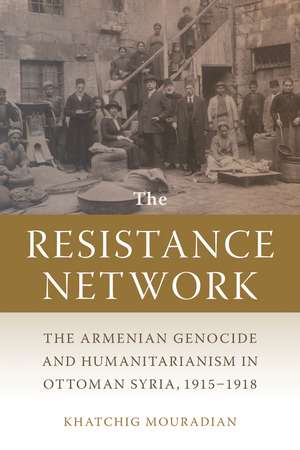
The Resistance Network: The Armenian Genocide and Humanitarianism in Ottoman Syria, 1915–1918: Armenian History, Society, and Culture
Autor Khatchig Mouradianen Limba Engleză Paperback – 2021
Preț: 194.02 lei
Puncte Express: 291
Preț estimativ în valută:
34.35€ • 39.100$ • 29.84£
34.35€ • 39.100$ • 29.84£
Carte indisponibilă temporar
Doresc să fiu notificat când acest titlu va fi disponibil:
Se trimite...
Preluare comenzi: 021 569.72.76
Specificații
ISBN-13: 9781611863949
ISBN-10: 1611863945
Pagini: 262
Dimensiuni: 152 x 229 x 20 mm
Greutate: 0.34 kg
Ediția:1
Editura: Michigan State University Press
Colecția Michigan State University Press
Seria Armenian History, Society, and Culture
ISBN-10: 1611863945
Pagini: 262
Dimensiuni: 152 x 229 x 20 mm
Greutate: 0.34 kg
Ediția:1
Editura: Michigan State University Press
Colecția Michigan State University Press
Seria Armenian History, Society, and Culture
Notă biografică
Khatchig Mouradian is a lecturer in Middle Eastern, South Asian, and African studies at Columbia University. He is the editor of the peer-reviewed journal The Armenian Review and in 2020 was awarded a Humanities War & Peace Initiative Grant from Columbia University.
Cuprins
Contents
Acknowledgments
Introduction
Part One. Genocide and Urban Resistance
Chapter One. Before the Storm: Deportation and Humanitarian Relief
Chapter Two. Aleppo: Urban Resistance to Redeportation
Part Two. From the City to the Desert
Chapter Three. Wartime Civilian Internment: Concentration Camps in Ottoman Syria
Chapter Four. Gateways to the Desert: The Sebil, Karlık, and Bab Camps
Chapter Five. Along the Euphrates: The Meskeneh Concentration Camp
Part Three. Der Zor Bound
Chapter Six. Death and Resilience: The Military Supply Line
Chapter Seven. Zor: That Immense Graveyard of Our Martyrs
Chapter Eight. Surviving Talaat: The Network’s Legacy
Notes
Bibliography
Index
Recenzii
“Khatchig Mouradian has written a pathbreaking book on the Armenian genocide. Using a wealth of untapped sources in multiple languages, he shows how a humanitarian resistance network emerged in Ottoman Syria that saved the lives of many Armenians. The Resistance Network is essential reading not only for the new insights it offers on the Armenian genocide but also for the compelling analysis of humanitarianism and resistance in times
of great atrocities.” —ERIC D. WEITZ, author of A World Divided: The Global Struggle for Human Rights in the Age of Nation-States
"Khatchig Mouradian’s impressive first book, The Resistance Network, highlights the rich potential that Armenian sources hold not only for Armenian Genocide studies but for scholars of mass violence, more broadly. The result is a stunning piece of scholarship that boldly suggests that the defining story of the Armenians is not so much the Armenian Genocide but their resistance to it." - International Journal of Middle East Studies
"I have never thought of any book on the history of the Armenian Genocide as inspiring. All of them have been illuminating and sobering to the core . . . except this one. Khatchig, in his passionate and clear-eyed commitment to his decades long study and heavy lifting, has taken the blue flame of the pain of the Genocide and churned it into an offering of hope and a sincere reminder to all who resist today and who will no doubt resist tomorrow. We need this book for our souls now more than ever. I hope that Khatchig’s scholarly torch will illuminate and inspire you when you read this masterful book." - ERIC NAZARIAN. Armenian Weekly
"Mouradian’s is by far the most thorough and original account of resistance by Armenian victims to the genocide perpetrated by the Ottoman Empire during WW I. His data-rich, precisely crafted investigation of the Turkish policy of deportation and slaughter, using hitherto neglected sources, offers a grounded yet highly original analysis of the murder of a million Armenians expelled from their homeland to Syria." - Choice Reviews
"We now have an impressively straightforward, well-researched, and convincing account of how the genocide of the Armenians, and the mostly local and humanitarian, resistance to that state-initiated and state-led campaign of destruction, played out in Syria 1915-1918." - MATTHIAS BJORNLUND, historian
“This book offers extraordinary research that reveals poignant and undeniable aspects of an untold chapter of the Armenian Genocide in Ottoman Syria. Undoubtedly, Mouradian's work constitutes a valuable recommendation for anyone seeking to understand the details of a planned genocide which was hindered by the numerous acts of courage of the members of a resistance network that helped thousands of Armenians survive.” - María Alejandra Serantes, Revista de Estudios sobre Genocidio
“The Resistance Network is a well-researched, insightful, and valuable contribution to scholarship on the Armenian genocide.” - Deborah Mayersen, Holocaust and Genocide Studies
of great atrocities.” —ERIC D. WEITZ, author of A World Divided: The Global Struggle for Human Rights in the Age of Nation-States
"Khatchig Mouradian’s impressive first book, The Resistance Network, highlights the rich potential that Armenian sources hold not only for Armenian Genocide studies but for scholars of mass violence, more broadly. The result is a stunning piece of scholarship that boldly suggests that the defining story of the Armenians is not so much the Armenian Genocide but their resistance to it." - International Journal of Middle East Studies
"I have never thought of any book on the history of the Armenian Genocide as inspiring. All of them have been illuminating and sobering to the core . . . except this one. Khatchig, in his passionate and clear-eyed commitment to his decades long study and heavy lifting, has taken the blue flame of the pain of the Genocide and churned it into an offering of hope and a sincere reminder to all who resist today and who will no doubt resist tomorrow. We need this book for our souls now more than ever. I hope that Khatchig’s scholarly torch will illuminate and inspire you when you read this masterful book." - ERIC NAZARIAN. Armenian Weekly
"Mouradian’s is by far the most thorough and original account of resistance by Armenian victims to the genocide perpetrated by the Ottoman Empire during WW I. His data-rich, precisely crafted investigation of the Turkish policy of deportation and slaughter, using hitherto neglected sources, offers a grounded yet highly original analysis of the murder of a million Armenians expelled from their homeland to Syria." - Choice Reviews
"We now have an impressively straightforward, well-researched, and convincing account of how the genocide of the Armenians, and the mostly local and humanitarian, resistance to that state-initiated and state-led campaign of destruction, played out in Syria 1915-1918." - MATTHIAS BJORNLUND, historian
“This book offers extraordinary research that reveals poignant and undeniable aspects of an untold chapter of the Armenian Genocide in Ottoman Syria. Undoubtedly, Mouradian's work constitutes a valuable recommendation for anyone seeking to understand the details of a planned genocide which was hindered by the numerous acts of courage of the members of a resistance network that helped thousands of Armenians survive.” - María Alejandra Serantes, Revista de Estudios sobre Genocidio
“The Resistance Network is a well-researched, insightful, and valuable contribution to scholarship on the Armenian genocide.” - Deborah Mayersen, Holocaust and Genocide Studies
Descriere
The Resistance Network is the history of an underground network of humanitarians, missionaries, and diplomats in Ottoman Syria who helped save the lives of thousands during the Armenian Genocide. Piecing together hundreds of accounts, official documents, and missionary records, Mouradian presents a social history of genocide and resistance in wartime Aleppo and a network of transit and concentration camps in this region. He ultimately argues that, despite the violent and systematic mechanisms of control and destruction in the cities, concentration camps, and massacre sites in Aleppo, the genocide of the Armenians did not progress unhindered—unarmed resistance proved an important factor in saving countless lives.