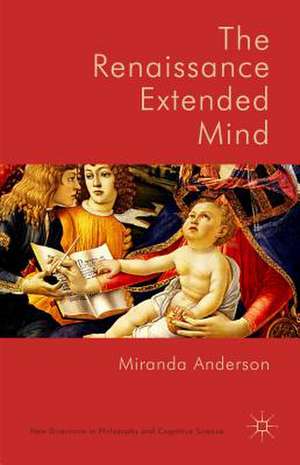
The Renaissance Extended Mind
Autor Miranda Andersonen Limba Engleză Hardback – 8 iul 2015
Preț: 588.56 lei
Preț vechi: 692.42 lei
-15%
Puncte Express: 883
Carte tipărită la comandă
Livrare economică 30 noiembrie-14 decembrie
Livrare prin curier în România Termenul estimat este afișat lângă disponibilitate.
Transport gratuit pentru acest produs Plată online sau ramburs, în funcție de opțiunile comenzii.
Retur gratuit în 14 zile Comandă securizată și suport în română.
Specificații
ISBN-13: 9781137412843
ISBN-10: 1137412844
Pagini: 285
Ilustrații: XIX, 285 p.
Dimensiuni: 140 x 216 x 18 mm
Greutate: 0.49 kg
Ediția:2015 edition
Editura: Palgrave Macmillan UK
Locul publicării:London, United Kingdom
ISBN-10: 1137412844
Pagini: 285
Ilustrații: XIX, 285 p.
Dimensiuni: 140 x 216 x 18 mm
Greutate: 0.49 kg
Ediția:2015 edition
Editura: Palgrave Macmillan UK
Locul publicării:London, United Kingdom
V-ar putea interesa
-
 The Consolations of PhilosophyAlain de Botton-19%Preț: 75.70 lei93.30 lei
 -
 Locke's Philosophy: Content and ContextG. A. J. Rogers-21%Preț: 301.93 lei380.16 lei
 -
 Analysis and Metaphysics: An Introduction to PhilosophyP. F. Strawson-20%Preț: 370.35 lei461.87 lei
 -
 -29%Preț: 517.25 lei723.90 lei
 -
 Aristotle on Meaning and EssenceDavid Charles-28%Preț: 396.60 lei550.02 lei
 -
 Platonopolis: Platonic Political Philosophy in Late AntiquityDominic J. O'Meara-29%Preț: 516.09 lei723.21 lei
 -
 Knowing Persons: A Study in PlatoLloyd P. Gerson-28%Preț: 446.21 lei622.52 lei
 -
 Preț: 193.56 lei
 -
 Spinoza on MonismP. Goff-15%Preț: 728.62 lei857.20 lei
 -
 Max StirnerSaul Newman-15%Preț: 651.96 lei767.01 lei
 -
 Philosophy: Key ThemesJ. Baggini-15%Preț: 459.50 lei540.58 lei
 -
 Organization, Society and PoliticsK. MorrellPreț: 407.29 lei
 -
 Realizing FreedomG. RaePreț: 406.28 lei
 -
 Beyond HumanismB. NooteboomPreț: 393.74 lei
 -
 Memory, History, Justice in HegelAngelica NuzzoPreț: 395.55 lei
 -
 EntreEmmanuel Levinas-42%Preț: 133.62 lei230.00 lei
 -
 How To Read WittgensteinRay MonkPreț: 71.05 lei
Cuprins
1. The Extended Mind
2. Extending Literary Theory and the Psychoanalytic Tradition
3. Renaissance Subjects: Ensouled and Embodied
4. Renaissance Language and Memory Forms
5. Renaissance Intrasubjectivity and Intersubjectivity
6. Shakespeare: Natural-Born Mirrors
7. Shakespeare: Perspectives and Words of Glass
Epilogue
2. Extending Literary Theory and the Psychoanalytic Tradition
3. Renaissance Subjects: Ensouled and Embodied
4. Renaissance Language and Memory Forms
5. Renaissance Intrasubjectivity and Intersubjectivity
6. Shakespeare: Natural-Born Mirrors
7. Shakespeare: Perspectives and Words of Glass
Epilogue
Recenzii
Notă biografică
Miranda Anderson is a literary scholar at the University of Edinburgh. She is the initiator of, and a Research Fellow on, the AHRC-funded project, A History of Distributed Cognition. She received a Leverhulme Early Career Fellowship for work on this book and was a Research Associate on the Balzan Project, based at St John's College, Oxford University. Dr Anderson combines specialization in Renaissance literary, philosophical and scientific texts, with a broader interest in investigating paradigms of the mind and self across historical and disciplinary boundaries.