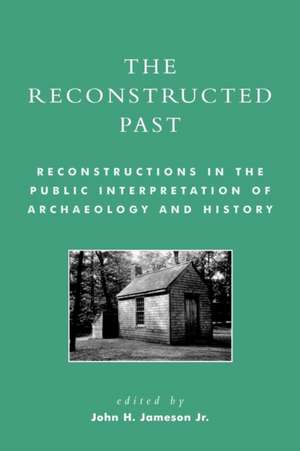
The Reconstructed Past: Reconstructions in the Public Interpretation of Archaeology and History
Editat de John H. Jameson Jr. Contribuţii de Marion Blockley, Marley R. Brown III, Karen A. Brush, Edward A. Chappell, Robert Daniels-Dwyer, Joe Distretti, Peter J. Fowler, Bruce W. Fry, John H. Jameson, Ann E. Killebrew, Carl Kuttruff, Donald W. Linebaugh, Barry Mackintosh, Susan Mills, Haryold Mytum, Lynn A. Neal, Vergil E. Noble, Dwight Pitcaithley, Rodd L. Wheaton, Esther C. White, Ronald F. Williamsonen Limba Engleză Paperback – 27 dec 2003
Preț: 351.59 lei
Preț vechi: 509.10 lei
-31%
Puncte Express: 527
Carte tipărită la comandă
Livrare economică 30 noiembrie-14 decembrie
Livrare prin curier în România Termenul estimat este afișat lângă disponibilitate.
Transport gratuit de la 400.00 lei Plată online sau ramburs, în funcție de opțiunile comenzii.
Retur gratuit în 14 zile Comandă securizată și suport în română.
Specificații
ISBN-13: 9780759103764
ISBN-10: 0759103763
Pagini: 320
Dimensiuni: 150 x 229 x 20 mm
Greutate: 0.49 kg
Ediția:New.
Editura: Bloomsbury Publishing
Colecția AltaMira Press
Locul publicării:New York, United States
ISBN-10: 0759103763
Pagini: 320
Dimensiuni: 150 x 229 x 20 mm
Greutate: 0.49 kg
Ediția:New.
Editura: Bloomsbury Publishing
Colecția AltaMira Press
Locul publicării:New York, United States
V-ar putea interesa
-
 Elements of Archaeological ConservationJ.M. CronynPreț: 420.29 lei
 -
 Preț: 479.22 lei
 -
 The First ArtistsMichel Lorblanchet-23%Preț: 149.44 lei193.84 lei
 -
 Archaeology of the CaribbeanSamuel M. WilsonPreț: 210.98 lei
 -
 Analytical Chemistry in ArchaeologyA M Pollard-11%Preț: 458.02 lei514.63 lei
 -
 Understanding Early CivilizationsBruce G. TriggerPreț: 326.61 lei
 -
 Geographical Information Systems in ArchaeologyJames Conolly-11%Preț: 500.47 lei562.31 lei
 -
 The Cat in Ancient EgyptJaromir Malek-15%Preț: 69.53 lei82.20 lei
 -
 Maps of the Ancient Sea KingsCharles HapgoodPreț: 161.87 lei
 -
 The Complete Archaeology of GreeceJohn Bintliff-8%Preț: 537.75 lei584.51 lei
 -
 The Dream Culture of the NeanderthalsStan GoochPreț: 96.26 lei
 -
 Photography and ArchaeologyFrederick N. Bohrer-22%Preț: 148.42 lei190.40 lei
 -
 Preț: 313.58 lei
Cuprins
Part 1 Foreword
Part 2 Chapter 1: Introduction
Part 3 Part One: Definitions and History
Chapter 4 Chapter 2: Walden Pond and Beyond: The Restoration Archaeology of Roland Wells Robbins
Chapter 5 Chapter 3: Colonial Williamsburg: Archaeological Authenticity and Changing Philosophies
Chapter 6 Chapter 4: National Park Service Reconstruction Policy and Practice
Part 7 Part Two: Measuring Effectiveness for Interpretation and Site Management
Chapter 8 Chapter 5: George Washington's Blacksmith Shop
Chapter 9 Chapter 6: Castell Henllys Iron Age Fort, Wales
Chapter 10 Chapter 7: Ancient Qasrin Synagogue and Village, Golan Region
Chapter 11 Chapter 8: The Iroquian Longhouse
Chapter 12 Chapter 9: Fort Loudoun, Tennessee
Chapter 13 Chapter 10: The Ironbridge Gorge, England
Chapter 14 Chapter 11: Fortress of Louisbourg, Canada
Chapter 15 Chapter 12: Bent's Old Fort and Fort Union Trading Post
Chapter 16 Chapter 13: A Case for Preservation-in-place at Homolovi Ruins State Park, Arizona
Part 17 Part Three: Virtual Reconstructions
Chapter 18 Chapter 14: Modeling Amarna: Computer Reconstructions of an Egyptian Palace
Chapter 19 Chapter 15: From Photo-Realism to Integrated Reconstruction in Buildings Archaeology
Part 20 Part Four: The Future of Reconstruction
Chapter 21 Chapter 16: The Value of Reconstructions: An Archaeologist's Perspective
Part 2 Chapter 1: Introduction
Part 3 Part One: Definitions and History
Chapter 4 Chapter 2: Walden Pond and Beyond: The Restoration Archaeology of Roland Wells Robbins
Chapter 5 Chapter 3: Colonial Williamsburg: Archaeological Authenticity and Changing Philosophies
Chapter 6 Chapter 4: National Park Service Reconstruction Policy and Practice
Part 7 Part Two: Measuring Effectiveness for Interpretation and Site Management
Chapter 8 Chapter 5: George Washington's Blacksmith Shop
Chapter 9 Chapter 6: Castell Henllys Iron Age Fort, Wales
Chapter 10 Chapter 7: Ancient Qasrin Synagogue and Village, Golan Region
Chapter 11 Chapter 8: The Iroquian Longhouse
Chapter 12 Chapter 9: Fort Loudoun, Tennessee
Chapter 13 Chapter 10: The Ironbridge Gorge, England
Chapter 14 Chapter 11: Fortress of Louisbourg, Canada
Chapter 15 Chapter 12: Bent's Old Fort and Fort Union Trading Post
Chapter 16 Chapter 13: A Case for Preservation-in-place at Homolovi Ruins State Park, Arizona
Part 17 Part Three: Virtual Reconstructions
Chapter 18 Chapter 14: Modeling Amarna: Computer Reconstructions of an Egyptian Palace
Chapter 19 Chapter 15: From Photo-Realism to Integrated Reconstruction in Buildings Archaeology
Part 20 Part Four: The Future of Reconstruction
Chapter 21 Chapter 16: The Value of Reconstructions: An Archaeologist's Perspective
Recenzii
The Reconstructed Past is a very affordable reference, which will be of great interest to public archaeologists, historical interpreters, historic site managers, and anyone involved in reconstructions.
For anyone who works in the fields of archaeology, historic presentation, and public education, this book has useful lessons on the benefits and pitfalls associated with reconstructions.
The Reconstructed Past is a thoughtful, varied collection of articles, and collectively, they address many of the preservation issues which must underlie all of public archaeology.
Because this book is written without jargon and tells behind-the-scenes stories about people and places, The Reconstructed Past will benefit both students and professionals. The case studies and the history of applied archeology are appropriate for university or college classrooms, particularly method and theory classes. The book's themese would also interest professionals making decisions about site interpretation. The provocative case studies illuminate the dilemma of reconstruction.
While this entire volume is engaging, two contributions are of particular interest to those involved with industrial archaeology. Linebaugh's article on Roland Wells Robbins gives a very in-depth and fascinating view of the reconstruction of the Saugus Iron Works, including plans and excavation photos from original fieldwork. The article by Blockley is devoted to the pragmatic and ethical complexities of the reconstruction and preservation of large-scale industrial sites.
If you wanted to put a single volume in front of a beginning public historian or archaeologist about the perils of a singular aspect of their chosen professions, this collection of articles would be a good start.
For anyone who works in the fields of archaeology, historic presentation, and public education, this book has useful lessons on the benefits and pitfalls associated with reconstructions.
The Reconstructed Past is a thoughtful, varied collection of articles, and collectively, they address many of the preservation issues which must underlie all of public archaeology.
Because this book is written without jargon and tells behind-the-scenes stories about people and places, The Reconstructed Past will benefit both students and professionals. The case studies and the history of applied archeology are appropriate for university or college classrooms, particularly method and theory classes. The book's themese would also interest professionals making decisions about site interpretation. The provocative case studies illuminate the dilemma of reconstruction.
While this entire volume is engaging, two contributions are of particular interest to those involved with industrial archaeology. Linebaugh's article on Roland Wells Robbins gives a very in-depth and fascinating view of the reconstruction of the Saugus Iron Works, including plans and excavation photos from original fieldwork. The article by Blockley is devoted to the pragmatic and ethical complexities of the reconstruction and preservation of large-scale industrial sites.
If you wanted to put a single volume in front of a beginning public historian or archaeologist about the perils of a singular aspect of their chosen professions, this collection of articles would be a good start.