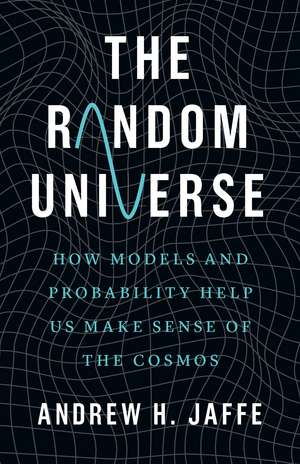
The Random Universe: How Models and Probability Help Us Make Sense of the Cosmos
Autor Andrew H. Jaffeen Limba Engleză Hardback – 11 noi 2025
În literatura academică dedicată astrofizicii, există adesea o falie între rigoarea matematică a calculelor și fundamentele filosofice care justifică de ce alegem un anumit model în detrimentul altuia. The Random Universe vine să completeze exact această lacună, oferind o sinteză necesară între epistemologie și cosmologia observațională. Reținem din această lucrare premisa că știința nu este o simplă acumulare de fapte, ci un proces de rafinare a modelelor prin gestionarea conștientă a incertitudinii.
Autorul, Andrew H. Jaffe, propune o structură narativă ce pune în dialog gânditori ai Iluminismului, precum David Hume, cu arhitecții fizicii moderne, de la Newton la Einstein. Elementul distinctiv al volumului este utilizarea teoremei lui Bayes ca instrument central pentru a naviga prin datele experimentale adesea contradictorii. Găsim în acest text o alternativă la From Cosmos to Chaos de Peter Coles pentru cursurile de cosmologie și statistică, cu avantajul unei abordări care integrează mai profund contextul filosofic al probabilității, nu doar aplicarea ei tehnică.
Publicată de Yale University Press, cartea reprezintă o evoluție conceptuală față de lucrarea anterioară a autorului, Bayesian Methods in Cosmology. Dacă volumul precedent era un instrument tehnic dedicat specialiștilor, The Random Universe extinde aceleași principii către o analiză a modului în care hazardul și probabilitatea au modelat înțelegerea noastră despre Big Bang și mecanica cuantică. Tonul este precis, evitând speculațiile nefondate, dar rămâne accesibil prin utilizarea exemplelor istorice care demonstrează că universul nu este un mecanism de ceasornic perfect, ci unul fascinant de imprevizibil.
Preț: 196.31 lei
Carte disponibilă
Livrare economică 17 noiembrie-01 decembrie
Livrare express 03-07 noiembrie pentru 56.38 lei
Specificații
ISBN-10: 0300250509
Pagini: 288
Ilustrații: 28 b-w illus.
Dimensiuni: 156 x 235 x 35 mm
Greutate: 0.51 kg
Editura: Yale University Press
Colecția Yale University Press
V-ar putea interesa
-
 Knocking On Heaven's DoorLisa Randall-19%Preț: 74.83 lei92.95 lei
 -
 The Drunkard's WalkLeonard MlodinowPreț: 92.91 lei
 -
 The Science of Can and Can'tChiara Marletto-19%Preț: 63.98 lei78.92 lei
 -
 -18%Preț: 82.71 lei100.69 lei
 -
 Probability: A Very Short IntroductionJohn Haigh-21%Preț: 55.69 lei70.23 lei
 -
 Battle of the Big Bang: The New Tales of Our Cosmic OriginsNiayesh AfshordiPreț: 205.76 lei
 -
 The Art of UncertaintyDavid SpiegelhalterPreț: 160.59 lei
 -
 -11%Preț: 137.47 lei155.16 leiRecomandat
 -
 The Quantum UniverseBrian Cox-30%Preț: 64.77 lei92.86 lei
 -
 The Grand DesignLeonard Mlodinow-27%Preț: 79.15 lei109.17 lei
 -
 We Need to Talk About KelvinMarcus ChownPreț: 93.23 lei
 -
 The Biggest Ideas in the Universe 2Sean CarrollPreț: 79.75 lei
 -
 A Brief History of the Universe (and our place in it)Sarah Alam Malik-19%Preț: 99.27 lei122.10 lei
 -
 A Universe From NothingLawrence M. Krauss-26%Preț: 58.30 lei78.39 lei
 -
 50 Universe Ideas You Really Need to KnowJoanne Baker-27%Preț: 51.73 lei71.12 lei
 -
 Do Dice Play God?: The Mathematics of UncertaintyProfessor Ian Stewart-19%Preț: 70.40 lei86.41 lei
 -
 Proof: The Uncertain Science of CertaintyAdam KucharskiPreț: 160.17 lei
 -
 Our Accidental UniverseChris LintottPreț: 85.76 lei
 -
 Thinking Small and LargePeter ForbesPreț: 109.04 lei
De ce să citești această carte
Recomandăm această carte studenților la fizică și filosofie, precum și profesioniștilor din date care doresc să înțeleagă rădăcinile epistemologice ale modelării statistice. Cititorul câștigă o perspectivă clară asupra modului în care probabilitatea bayesiană transformă datele brute în cunoaștere științifică. Este un argument solid împotriva determinismului rigid, oferind în schimb o metodă riguroasă de a cuantifica necunoscutul din cosmos.
Despre autor
Andrew H. Jaffe este profesor de astrofizică și cosmologie la Imperial College London, fiind o figură centrală în comunitatea științifică internațională. Expertiza sa este recunoscută prin implicarea directă în colaborarea pentru satelitul Planck Surveyor, proiect dedicat cartografierii radiației cosmice de fond cu o precizie fără precedent. Cariera sa se concentrează pe aplicarea metodelor statistice avansate în studiul universului timpuriu, o temă pe care o explorează atât în lucrări de specialitate, cât și în volume de sinteză care aduc rigoarea academică în sfera dezbaterii publice.
Descriere scurtă
All of us understand the world around us by constructing models, comparing them to observations, and drawing conclusions. Scientists create, test, and replace these models by applying the twinned concepts of probability and randomness. Exploring how this process has refined our knowledge of quantum mechanics and the birth of the universe, Andrew H. Jaffe offers a unique synthesis of the philosophy of epistemology, the mathematics of probability, and the science of cosmology.
As Jaffe puts Enlightenment thinkers like David Hume in conversation with contemporary philosophers such as Karl Popper and Imre Lakatos and engages with scientists ranging from Isaac Newton and Galileo to Albert Einstein and Arthur Eddington, he uses Thomas Bayes’s seminal studies of statistics and probability to make sense of conflicting currents of thought. This is a deep look into how we have learned to account for uncertainty in our search for knowledge—and a reminder that science is not about facts and data as such but about creating models that correctly account for those facts and data.
Recenzii
“Andrew Jaffe demystifies the role of probability and uncertainty in the scientific process, guiding readers through the logic that underpins inference and discovery. An essential read for anyone curious about how we come to know what we know in science.”—Priyamvada Natarajan, Joseph S. & Sophia S. Fruton Professor of Physics and Astronomy, Yale University, and author of Mapping the Heavens: The Radical Scientific Ideas That Reveal the Cosmos
“Andrew Jaffe’s fascinating mission here is a profound examination of our fundamental beliefs about how the Universe works. Shockingly, he shows how uncertainty is at the root of every physical law.”—Sir Brian May, musician, songwriter, and astrophysicist
“Astrophysics is the science of events that happened long ago and therefore about which we can only learn indirectly and interpret through rigorous theory. Astrophysicist Andrew Jaffe has written a fascinating book about how we know what we know, and how we express our current knowledge of the world.”—Andrew Gelman, Columbia University