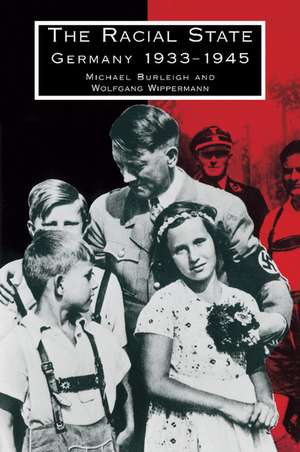
The Racial State: Germany 1933–1945
Autor Michael Burleigh, Wolfgang Wippermannen Limba Engleză Paperback – 6 noi 1991
Bazându-ne pe arhivele și analizele publicate de Cambridge University Press, notăm cu interes modul în care Michael Burleigh și Wolfgang Wippermann recalibrează înțelegerea Germaniei naziste. Premisa centrală a lucrării The Racial State nu este doar cronicizarea persecuției, ci demonstrarea modului în care ideologia rasială a înlocuit structura de clasă a societății, transformând instituțiile statului în instrumente de inginerie umană. Remarcăm rigoarea cu care autorii documentează tranziția de la idei marginale la politici oficiale de stat, oferind o perspectivă asupra sistemului care a vizat nu doar comunitatea evreiască, ci și grupuri precum Sinti, Roma, persoanele cu dizabilități sau cele etichetate drept „asociale”.
Din punct de vedere al experienței de lectură, textul menține un ton academic sobru, fiind structurat pentru a servi drept fundament în curriculumul universitar de istorie europeană. Considerăm că această lucrare completează perspectiva oferită de Social Outsiders in Nazi Germany de Robert Gellately; în timp ce volumul lui Gellately se concentrează prin eseuri pe diversele categorii de marginalizați, The Racial State oferă o sinteză sistemică a întregului aparat de stat care a făcut posibile aceste marginalizări. Față de abordările autorului din The Third Reich, unde acesta oferă o istorie generală premiată, volumul de față este mult mai focalizat pe mecanismul ideologic al „statului rasial”. Stilul este analitic, evitând senzaționalismul, și propune o concluzie tulburătoare: regimul nu a fost o simplă întoarcere la reacționarism, ci o formă modernă și fără precedent de barbarie administrată birocratic.
Preț: 239.30 lei
Carte disponibilă
Livrare economică 13-27 mai
Livrare express 29 aprilie-05 mai pentru 191.26 lei
Specificații
ISBN-10: 0521398029
Pagini: 404
Ilustrații: 77 b/w illus.
Dimensiuni: 152 x 229 x 23 mm
Greutate: 0.65 kg
Editura: Cambridge University Press
Colecția Cambridge University Press
Locul publicării:Cambridge, United Kingdom
V-ar putea interesa
-
 Earthly PowersMichael BurleighPreț: 117.16 lei
 -
 Sacred CausesMichael BurleighPreț: 117.42 lei
 -
 The Cretan RunnerGeorge PsychoundakisPreț: 82.81 lei
 -
 Studies in Settler ColonialismF. Bateman-15%Preț: 676.16 lei795.48 lei
 -
 -18%Preț: 995.23 lei1213.70 lei
 -
 The Third ReichMichael Burleigh-33%Preț: 94.39 lei140.27 lei
 -
 Small Wars, Far Away PlacesMichael Burleigh-23%Preț: 115.35 lei150.70 lei
 -
 Preț: 197.39 lei
 -
 Preț: 270.55 lei
 -
 Italy in the Making January 1st 1848 to November 16th 1848G. F. -H BerkeleyPreț: 364.69 lei
 -
 The Legend of Basil the Bulgar-SlayerPaul StephensonPreț: 174.43 lei
 -
 Preț: 430.60 lei
 -
 -23%Preț: 1326.64 lei1722.91 lei
 -
 Alexander the GreatKeyne CheshirePreț: 206.93 lei
 -
 Preț: 274.35 lei
De ce să citești această carte
Această lucrare este esențială pentru studenții și cercetătorii istoriei secolului XX care doresc să înțeleagă birocrația genocidului. Cititorul câștigă o viziune de ansamblu asupra modului în care politicile sociale naziste au remodelat viața cotidiană a fiecărui cetățean german. Este o resursă fundamentală pentru a înțelege că Holocaustul nu a fost un eveniment izolat, ci vârful unei piramide de politici rasiale sistematice.
Despre autor
Michael Burleigh, născut în 1955, este un istoric și autor britanic de renume, specializat în istoria Germaniei naziste și a regimurilor totalitare. Expertiza sa este recunoscută la nivel internațional, fiind laureat al premiului Samuel Johnson pentru non-ficțiune cu lucrarea The Third Reich. Burleigh este cunoscut pentru capacitatea de a sintetiza volume vaste de date istorice în narațiuni coerente și tăioase, explorând teme precum barbaria modernă, populismul și radicalizarea politică. Activitatea sa include și contribuții valoroase în televiziune, aducând rigoarea istorică în spațiul public.
Descriere scurtă
Cuprins
Recenzii
' … deserves a wide readership … the lessons taught by this book should be learned by all of us'. The Times Higher Education Supplement
'The Racial State may be recommended as one of the best introductions available to the still burgeoning and highly charged scholarly literatures on the Third Reich.' Ethnic and Racial Studies