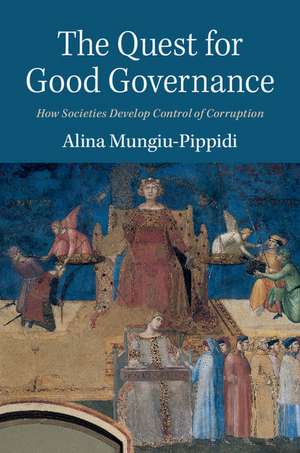
The Quest for Good Governance
Autor Alina Mungiu-Pippidien Limba Engleză Paperback – 23 feb 2016
Publicul țintă pentru această lucrare este format din studenți ai facultăților de științe politice, cercetători în domeniul bunei guvernări și practicieni din sfera politicilor publice care urmăresc să înțeleagă mecanismele reale ale controlului corupției. Prin The Quest for Good Governance, cititorul câștigă o perspectivă riguroasă, fundamentată empiric, asupra modului în care integritatea devine normă în administrarea resurselor publice. Apreciem rigoarea cu care Alina Mungiu-Pippidi deconstruiește miturile instituționale contemporane. Subliniem faptul că, spre deosebire de abordările pur teoretice, volumul utilizează 17 tabele și date statistice pentru a arăta de ce agențiile anticorupție eșuează adesea în absența unei capacități de acțiune colectivă. Reținem structura logică a cărții: după stabilirea metodelor de diagnostic, autoarea explorează „Drumul spre Danemarca” — metafora pentru societățile cu integritate deplină — analizând atât parcursuri istorice, cât și „campioni” contemporani ai bunei guvernări. Lucrarea reprezintă o alternativă necesară la Institutions, Governance and the Control of Corruption de Kaushik Basu pentru cursurile de politici comparative. În timp ce Kaushik Basu se concentrează pe designul instituțional în economiile emergente, Alina Mungiu-Pippidi aduce avantajul unei analize politice care pune accent pe agenția internă și pe limitele asistenței internaționale. În contextul operei sale, volumul sintetizează temele despre instituțiile balcanice din Ottomans Into Europeans și scepticismul față de rolul de „fixer” al UE abordat în Europe's Burden, oferind o teorie unificată asupra modului în care se poate genera o „masă critică” pentru schimbare.
Preț: 195.49 lei
Carte disponibilă
Livrare economică 28 iulie-11 august
Specificații
ISBN-10: 1107534577
Pagini: 314
Ilustrații: 11 b/w illus. 17 tables
Dimensiuni: 152 x 229 x 18 mm
Greutate: 0.46 kg
Editura: Cambridge University Press
Locul publicării:New York, United States
V-ar putea interesa
-
 -14%Preț: 936.57 lei1089.04 lei
 -
 Mobilizing for Democracy: Comparing 1989 and 2011Donatella Della Porta-14%Preț: 709.25 lei824.71 lei
 -
 Government AgenciesKoen Verhoest-15%Preț: 703.06 lei827.13 lei
 -
 European Politics: Pasts, presents, futuresKlaus H GoetzPreț: 323.73 lei
 -
 State Repression and the Domestic Democratic PeaceChristian DavenportPreț: 300.20 lei
 -
 Radical RightPippa NorrisPreț: 282.88 lei
 -
 Party Politics and Economic Reform in Africa's DemocraciesM. Anne PitcherPreț: 280.51 lei
 -
 Economic Crises and the Breakdown of Authoritarian RegimesThomas B. PepinskyPreț: 281.55 lei
 -
 Strangers at the GatesSidney TarrowPreț: 245.49 lei
 -
 The Political Construction of Business InterestsCathie Jo MartinPreț: 261.23 lei
 -
 Preț: 247.50 lei
 -
 Reclaiming Public Ownership: Making Space for Economic DemocracyProfessor Andrew Cumbers-26%Preț: 184.79 lei249.22 lei
 -
 JusticeRaymond WacksPreț: 74.14 lei
De ce să citești această carte
Recomandăm această carte oricărui specialist care dorește să depășească soluțiile „la cheie” în lupta anticorupție. Cititorul dobândește instrumente de diagnostic precise și o înțelegere istorică a modului în care s-au construit statele curate. Este un ghid esențial pentru a înțelege de ce reformele instituționale eșuează fără o bază socială solidă, oferind concluzii de politici publice aplicabile în contextul actual al guvernării globale.
Despre autor
Alina Mungiu-Pippidi este profesor de democratizare și analiză a politicilor publice la Hertie School of Governance din Berlin. Coordonează Centrul European de Cercetare pentru Anticorupție și Construcție Statală și proiectul ANTICORRP al Uniunii Europene. Experiența sa academică este dublată de o vastă activitate de consultanță pentru organisme internaționale precum Banca Mondială, Comisia Europeană și UNDP. Expertiza sa în măsurarea bunei guvernări și analiza istorică a instituțiilor politice o plasează printre cele mai influente voci în studiul corupției contemporane.
Cuprins
1. Understanding control of corruption; 2. Diagnosis and measurement; 3. The road to Denmark: historical paths to corruption control; 4. Structure and agency: determining control of corruption; 5. Understanding contemporary achievers; 6. Domestic collective action capacity; 7. International agency and its anticorruption impact; 8. From critical mess to critical mass: some tentative policy conclusions.
Recenzii
'Reformers who read this essential book will learn rather than seeking 'toolkits' to attack specific corrupt activities, successful societies have made integrity and accountability widely-accepted norms, backed up by the self-interest of a wide range of citizens. Alina Mungiu-Pippidi makes clear that societies which keep corruption under control have succeeded not just a due to their present laws and enforcement, but through a longer-term story of political development, widespread expectations and the building of effective performance of public institutions.' Michael Johnston, Charles A. Dana Professor of Political Science Emeritus, Colgate University
'Alina Mungiu-Pippidi uniquely straddles the worlds of theory and practice, adding to both worlds with her comprehensive perspective, honesty about what is not known, and bold speculations about the drivers of change.' Robert Klitgaard, Claremont Graduate University
'A strong argument for framing the anti-corruption debate in terms of ethical universalism and impartiality with a focus on grassroots citizen involvement. Mungiu-Pippidi realistically acknowledges the difficulty of lasting reform, but at the same time she usefully seeks to move the policy debate beyond platitudes to concrete proposals that can attract domestic support and fit local contexts.' Susan Rose-Ackerman, Henry R. Luce Professor of Law and Political Science, Yale University
'Mungiu-Pippidi writes that creating collective action and providing political support is the only proven effective strategy against corruption. Specialists will appreciate the comprehensive summary and review of the literature … Highly recommended.' R. E. Hartwig, Choice
'Mungiu-Pippidi's work is a significant contribution to our understanding of the subject, and one to which policymakers and international donors should pay attention. Her work systematically explores the failed and successful trajectories of different countries in arriving at norms of universalism in governance. It is an important work in its welcome focus on the importance of societal norms in creating and sustaining various types of political corruption, and in the finding that what matters most is not international efforts, but domestic ones … [The book] would be a welcome addition to an advanced undergraduate or graduate course on the political economy of corruption, and on the political economy of development. It should also serve as required reading for domestic and international policymakers, donors, and NGO activists concerned about corruption.' Carolyn M. Warner, Governance
'The Quest for Good Governance combines sophisticated conceptual discussion (for example, of the varying definitions of corruption and their consequences) with a historical perspective and a critical statistical analysis of various databases. It is a good example of a multi-method approach to a huge and complex problem … I find this an accomplished and important book, and one which deserves very wide readership.' Christopher Pollitt, International Review of Administrative Sciences
'Along with Tilly and Acemoglu and Robinson, Mungiu-Pippidi in this volume smartly re-frames the nature of the modern state. Elsewhere in her superbly thoughtful and conceptually enriching book, [she] focuses on how the Italian city-states in their rise to republicanism largely contained corrupt practices and, by focusing on equality, avoided the kinds of wholesale corruption that is (and has been for years) widespread in the modern Italian state. Fortunately, Mungiu-Pippidi's remarkable book provides a welcome trove of possible solutions to the historical problem of corruption.' Robert Rotberg, Journal of Interdisciplinary History
Descriere
Why do some societies manage to control corruption so that it manifests itself only occasionally, while other societies remain systemically corrupt? This book is about how societies reach that point when integrity becomes the norm and corruption the exception in regard to how public affairs are run and public resources are allocated. It primarily asks what lessons we have learned from historical and contemporary experiences in developing corruption control, which can aid policy-makers and civil societies in steering and expediting this process. Few states now remain without either an anticorruption agency or an Ombudsman, yet no statistical evidence can be found that they actually induce progress. Using both historical and contemporary studies and easy to understand statistics, Alina Mungiu-Pippidi looks at how to diagnose, measure and change governance so that those entrusted with power and authority manage to defend public resources.