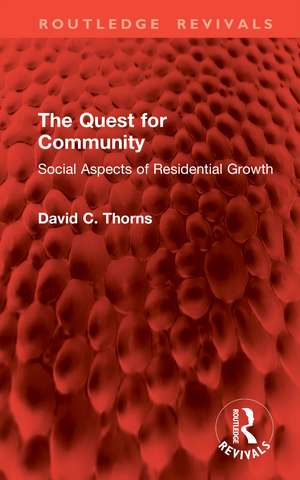
The Quest for Community: Social Aspects of Residential Growth: Routledge Revivals
Autor David C. Thornsen Limba Engleză Hardback – apr 2026
Din seria Routledge Revivals
-
 Preț: 337.77 lei
 - 9%
 Preț: 1329.58 lei
 - 9%
 Preț: 1332.92 lei
 -
 Preț: 334.61 lei
 - 9%
 Preț: 1329.13 lei
 -
 Preț: 340.35 lei
 -
 Preț: 331.26 lei
 -
 Preț: 330.56 lei
 - 9%
 Preț: 1328.58 lei
 - 9%
 Preț: 1650.78 lei
 -
 Preț: 331.62 lei
 - 9%
 Preț: 1353.30 lei
 -
 Preț: 332.63 lei
 -
 Preț: 314.21 lei
 - 8%
 Preț: 437.60 lei
 -
 Preț: 314.42 lei
 -
 Preț: 319.14 lei
 - 9%
 Preț: 1149.18 lei
 - 5%
 Preț: 303.54 lei
 - 9%
 Preț: 981.60 lei
 - 9%
 Preț: 1331.10 lei
 - 9%
 Preț: 1328.90 lei
 -
 Preț: 359.67 lei
 - 9%
 Preț: 6718.93 lei
 -
 Preț: 466.95 lei
 -
 Preț: 332.93 lei
 - 9%
 Preț: 1328.05 lei
 -
 Preț: 415.66 lei
 -
 Preț: 328.42 lei
 -
 Preț: 331.26 lei
 -
 Preț: 324.38 lei
 -
 Preț: 322.28 lei
 - 14%
 Preț: 680.54 lei
 -
 Preț: 332.96 lei
 - 14%
 Preț: 649.36 lei
 -
 Preț: 238.51 lei
 -
 Preț: 329.60 lei
 -
 Preț: 330.98 lei
 - 14%
 Preț: 988.50 lei
 - 11%
 Preț: 379.69 lei
 - 9%
 Preț: 1628.13 lei
 - 18%
 Preț: 983.06 lei
 - 9%
 Preț: 1330.09 lei
 -
 Preț: 366.47 lei
 - 9%
 Preț: 809.58 lei
 - 9%
 Preț: 967.93 lei
 -
 Preț: 425.61 lei
 - 9%
 Preț: 1329.44 lei
 - 9%
 Preț: 1328.58 lei
 - 9%
 Preț: 3516.85 lei
Preț: 458.51 lei
Preț vechi: 585.47 lei
-22%
Puncte Express: 688
Carte indisponibilă temporar
Doresc să fiu notificat când acest titlu va fi disponibil:
Se trimite...
Specificații
ISBN-13: 9781041276432
ISBN-10: 1041276435
Pagini: 164
Dimensiuni: 138 x 216 mm
Greutate: 0.46 kg
Ediția:1
Editura: Taylor & Francis
Colecția Routledge
Seria Routledge Revivals
Locul publicării:Oxford, United Kingdom
ISBN-10: 1041276435
Pagini: 164
Dimensiuni: 138 x 216 mm
Greutate: 0.46 kg
Ediția:1
Editura: Taylor & Francis
Colecția Routledge
Seria Routledge Revivals
Locul publicării:Oxford, United Kingdom
Public țintă
Postgraduate and Undergraduate AdvancedCuprins
1.Introduction 2. The Development of New Residential Areas 3. New Residential Areas 4. New Towns 5. Transitional Urban Communities 6. Ideological Communities 7. The Sociology of New Communities
.
.
Recenzii
Original Review of The Quest for Community:
‘The range of comparable material is broad and the analysis illuminating…Thorns writes succinctly and well.’ Martin Bulmer, American Journal of Sociology Vol 82, No. 6 (1977).
‘The range of comparable material is broad and the analysis illuminating…Thorns writes succinctly and well.’ Martin Bulmer, American Journal of Sociology Vol 82, No. 6 (1977).
Notă biografică
David C. Thorns (1943-2020) was born and brought up in a small mining village in County Durham, England, in a family strongly imbued with Methodist values that remained influential throughout his work and life. This semi-rural setting and his subsequent experience of urban residence in Sheffield, where he acquired a comparative social science degree, were instrumental in shaping his initial interest in questions of place, belonging, inequality, and social change. Issues he developed further while lecturing at Exeter University and during his subsequent career in New Zealand at the universities of Auckland and then Canterbury.
What remained consistent was his unwavering belief that social scientists, and he was comfortable with that phrase, should always seek to display strong links between theoretical insights, empirical findings, and social policy. This is evident in his earliest work on localised planned and unplanned residential spaces in The Quest For Community and Suburbia and is clearly discernible in all his subsequent research and writings, although his ecological focus continually shifted in tune with changing academic and political perspectives.
David Thorns had a facility to work with all kinds of people in various university and governmental settings, and his career is marked by several successful research and writing collaborations with other colleagues within and beyond his own and cognate disciplines. Hence, he typified what later became characterised as public sociology, with his reports for UNESCO and various New Zealand official bodies enhancing his scholarly reputation. A further glance at current media swiftly reveals how prescient his research remains. Hardly a day goes by without a further example of worldwide environmental or political conflagrations. Thus, whether we consider his work on housing, urban and regional development, environmental sustainability, social and economic inequality, and globalisation, the quest that David Thorns set out on remains highly relevant today.
What remained consistent was his unwavering belief that social scientists, and he was comfortable with that phrase, should always seek to display strong links between theoretical insights, empirical findings, and social policy. This is evident in his earliest work on localised planned and unplanned residential spaces in The Quest For Community and Suburbia and is clearly discernible in all his subsequent research and writings, although his ecological focus continually shifted in tune with changing academic and political perspectives.
David Thorns had a facility to work with all kinds of people in various university and governmental settings, and his career is marked by several successful research and writing collaborations with other colleagues within and beyond his own and cognate disciplines. Hence, he typified what later became characterised as public sociology, with his reports for UNESCO and various New Zealand official bodies enhancing his scholarly reputation. A further glance at current media swiftly reveals how prescient his research remains. Hardly a day goes by without a further example of worldwide environmental or political conflagrations. Thus, whether we consider his work on housing, urban and regional development, environmental sustainability, social and economic inequality, and globalisation, the quest that David Thorns set out on remains highly relevant today.
Descriere
Originally published in 1976, this book is a wide comparative study of residential area development which discusses the key components in community formation and persistence. The actions of inhabitants as they have affected the development of the areas are studied and contrasted with the original aims of the creators, planners and others.