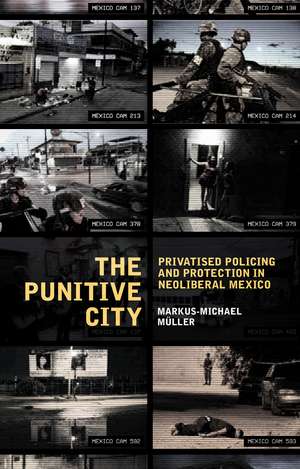
The Punitive City: Privatized Policing and Protection in Neoliberal Mexico
Autor Markus-Michael Mülleren Limba Engleză Paperback – 15 iun 2016
Vital reading for anyone seeking to understand the implications of a phenomenon that is becoming increasingly widespread across Latin America.
| Toate formatele și edițiile | Preț | Express |
|---|---|---|
| Paperback (1) | 170.32 lei 3-5 săpt. | |
| Bloomsbury Publishing – 15 iun 2016 | 170.32 lei 3-5 săpt. | |
| Hardback (1) | 523.22 lei 6-8 săpt. | |
| Bloomsbury Publishing – 15 iun 2016 | 523.22 lei 6-8 săpt. |
Preț: 170.32 lei
Preț vechi: 231.34 lei
-26%
Puncte Express: 255
Preț estimativ în valută:
30.12€ • 35.71$ • 26.22£
30.12€ • 35.71$ • 26.22£
Carte disponibilă
Livrare economică 09-23 martie
Specificații
ISBN-13: 9781783606962
ISBN-10: 1783606967
Pagini: 191
Dimensiuni: 134 x 214 x 16 mm
Greutate: 0.32 kg
Editura: Bloomsbury Publishing
Colecția Zed Books
Locul publicării:London, United Kingdom
ISBN-10: 1783606967
Pagini: 191
Dimensiuni: 134 x 214 x 16 mm
Greutate: 0.32 kg
Editura: Bloomsbury Publishing
Colecția Zed Books
Locul publicării:London, United Kingdom
V-ar putea interesa
-
 Running with the FirmJames Bannon-31%Preț: 70.27 lei101.94 lei
 -
 -31%Preț: 500.01 lei726.77 lei
 -
 An Inspector RecallsGraham SatchwellPreț: 142.81 lei
 -
 Securing Transportation SystemsS Hakim-8%Preț: 613.90 lei667.28 lei
 -
 Tracking the HooligansMichael LaytonPreț: 181.63 lei
 -
 UndercoverPaul LewisPreț: 89.09 lei
 -
 Preț: 119.97 lei
 -
 -27%Preț: 86.05 lei117.45 lei
 -
 A Likely Tale, LadMike PannettPreț: 63.56 lei
Cuprins
Introduction
1. The Making of the Punitive City
2. Neoliberal Insecurities and Resilient Clientelism
3. Lawfare and Resistance at the New Urban Frontier
4. Securitizing Civic Activism
5. Self-Policing, Commodified Protection and Community Justice
Conclusion
1. The Making of the Punitive City
2. Neoliberal Insecurities and Resilient Clientelism
3. Lawfare and Resistance at the New Urban Frontier
4. Securitizing Civic Activism
5. Self-Policing, Commodified Protection and Community Justice
Conclusion
Recenzii
[A]n outstanding contribution to critical urban security studies.
Provides wonderful insights into the complex practices of security in contemporary Mexico City. Building on strong foundations in theory and on-the-ground data this book blazes a new trail in understanding the multiple layers of security debates in Latin America's largest city and the region more generally.
Müller's work on urban security is deeply compelling. He makes the institutional, political and community consequences of Mexico City's punitive turn legible through exacting empirical insight. This is not just analytically productive, but also absolutely necessary for a thoughtful analysis of violence and urban life in Latin America.
Müller offers a wealth of original and stimulating insights, including a critical exploration of the role of the transnational NGO-Foundation-Academic nexus in vernacularizing common principles of punitive urban security governance throughout the region and beyond.
Müller's conceptually sophisticated and empirically grounded critical gaze spares nobody and nothing.
Provides wonderful insights into the complex practices of security in contemporary Mexico City. Building on strong foundations in theory and on-the-ground data this book blazes a new trail in understanding the multiple layers of security debates in Latin America's largest city and the region more generally.
Müller's work on urban security is deeply compelling. He makes the institutional, political and community consequences of Mexico City's punitive turn legible through exacting empirical insight. This is not just analytically productive, but also absolutely necessary for a thoughtful analysis of violence and urban life in Latin America.
Müller offers a wealth of original and stimulating insights, including a critical exploration of the role of the transnational NGO-Foundation-Academic nexus in vernacularizing common principles of punitive urban security governance throughout the region and beyond.
Müller's conceptually sophisticated and empirically grounded critical gaze spares nobody and nothing.