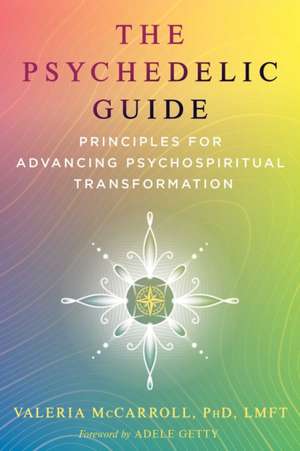
The Psychedelic Guide: Principles for Advancing Psychospiritual Transformation
Autor Valeria McCarroll Cuvânt înainte de Adele Gettyen Limba Engleză Paperback – 11 feb 2027
• Defines a comprehensive psychospiritual framework for psychedelic guiding rooted in embodiment, nondual wisdom, and social justice
• Explains how healing individual trauma contributes to collective and cultural transformation
• Guides you to cultivate ethical presence, right relationship, and inner guidance as the foundation of healing and guiding others
As psychedelics enter more clinical and therapeutic settings, the role of the psychedelic guide is expanding. Drawing on decades of clinical experience, transpersonal psychology, somatics, and traditions of nondual wisdom, Valeria McCarroll asks the central question—who will guide the guides?
The Psychedelic Guide is a grounded, comprehensive manual for those called to facilitate safe, therapeutic, and sacred journeys. McCarroll defines guiding as both a personal calling and a social responsibility, where the guide becomes a healer within society as a whole—bridging the gap between individual healing and collective liberation.
Offering a psychospiritual framework that brings depth, presence, and accountability to psychedelic guiding, she looks at imagination as a tool for healing, rites of passage as modes of initiation, and desire as a force for liberation. Through guided reflection and practical applications, McCarroll equips psychedelic guides to deepen their self-awareness, navigate power and ethics, and translate mystical experiences into grounded practices to transform insight into appropriate action.
Preț: 92.87 lei
Preț vechi: 122.40 lei
-24% Precomandă
Puncte Express: 139
Carte nepublicată încă
Livrare prin curier în România Precomanda se expediază când titlul devine disponibil.
Transport gratuit de la 400.00 lei Plată online sau ramburs, în funcție de opțiunile comenzii.
Retur gratuit în 14 zile Comandă securizată și suport în română.
Doresc să fiu notificat când acest titlu va fi disponibil:
Se trimite...
Specificații
ISBN-13: 9798888505175
Pagini: 256
Dimensiuni: 152 x 229 mm
Greutate: 0.24 kg
Editura: Inner Traditions/Bear & Company
Colecția Park Street Press
Pagini: 256
Dimensiuni: 152 x 229 mm
Greutate: 0.24 kg
Editura: Inner Traditions/Bear & Company
Colecția Park Street Press
Notă biografică
VALERIA McCARROLL, PhD, LMFT, is a psychedelic educator, writer, and therapist whose work integrates transpersonal psychology, somatics, and nondual wisdom with social and transformative justice. She is on the teaching faculty in the Department of Research Psychology at the California Institute of Integral Studies (CIIS) and maintains a private practice in Northern California.
Extras
1
The Seat of the Guide
I knew what my destiny was. I felt it deep within me. I felt that I had a great power, a power that awakened in me.
María Sabina
Deep within every person lies an innate wisdom, a voice of inner guidance that whispers the truth of who we are. We call this voice by many names: for some it is intuition, others name it the soul’s knowing, the inner healing intelligence, or simply “trusting your gut.” This guidance is a birthright—a gnostic umbilical cord that connects our individual self into the vast field of consciousness in which we are all embedded. Though often hidden from external view, this inner compass makes itself apparent to us through the body’s knowing, through dreams and synchronicities, and through the quiet moments when we pause long enough to listen to its resonant chorus. This voice, our soul’s whisper, is our guide. Its nature is paradoxical, bridging between self and other, inner and outer, spirit and matter.
Externally, we find guides in many forms. As children, our first guides are often our parents and caregivers. As we grow, we find guidance in teachers and mentors, in spiritual friends and elders, and in the ancestral memory carried in our bones and blood. The elements offer their own forms of guidance: the magnificent stillness of the rocks and minerals, the flowing rhythms of the waters, the vastness of the open sky, and the transformative heat of fire. In the natural world we encounter the teachings of the plants and fungi and the wisdom of the animal kingdom. We find guidance in the cycles of time itself: the wheel of the year in its seasonal turn, the endless waxing and waning of the moon, and the timeless celestial patterns of the stars. These various forms of guidance—whether appearing through spiritual entities, beneficent deities, the natural elements, or ancestral presences—form a web of support and wisdom that surrounds us always.
This guidance is inherently available to everyone, regardless of belief system or background. At the same time, guidance is not something that exists only outside of us. Rather, it is an intrinsic part of who we are. Like a pellucid thread of light woven through the fabric of our being, our inner voice acts as a mediator between our individual self—the “me” we typically identify with—and the larger field of consciousness of which we are a part. When we learn to attune to this inner knowing, we discover it often speaks to us through symbols and metaphors, through bodily sensations and felt sense, and through the language of the imaginal realm. There is a numinosity to the voice of our inner guide, a timelessness that continues to call to us regardless of when, how, or whether or not we manifest its wisdom into our life.
While the nature of this voice transcends the thinking mind, it brings intuition into harmonious relationship with the merits of rationality and logic. It appears as a quiet certainty, a gut feeling, a creative impulse that flows through us. It manifests as the crystalline clarity of the heart. Like a compass forever oriented toward true north, this guidance is eternally available to connect us more deeply to our soul’s calling, or our purpose in this life. As such, it speaks the language of the soul. To hear it asks us to cultivate a discerning capacity to listen between and beyond our usual mental chatter.
Why cultivate a relationship with this inner guidance? Because it is a profound source of empowerment, and ultimately, the pathway of our liberation. It serves as our personal North Star—an inner guiding light—whether in the moment-to-moment decisions of the day, in navigating our relationships, finding meaningful and purposeful engagement in the world, or in journeying through dark nights of the soul or moments of cataclysm, personal or collective in nature. For those of us called to be guides for others, developing this relationship with one’s inner guidance is an essential practice. Yet what distinguishes the authentic callings of soul from the conditioned, colonizing whispers that mimic our internal guidance while perpetuating suffering and harm? In order to support others in accessing their own innate wisdom, we must learn to recognize and relate to the voice of the guide within.
THE PATH OF THE GUIDE
As vital as inner guidance is, many of us have lost connection with this interior wisdom. This disconnection reveals the profound importance of the guide as one who helps others reconnect with their own inner knowing. A guide’s work is to illuminate the path toward wholeness not by simply pointing the way but by helping others recognize their own inner light. They ask us to carefully consider what is real, while aiding us in bringing forth the hidden wisdom of the deep self we hold within. Regardless of title, their essential function is consistent: to open the doorways between realms and to support others in crossing the inevitable thresholds of life, helping to separate the dross of who we once were from the gold of who we are becoming. As initiators of liberation, their calling lies in service to the numinosity of a soul’s purpose.
The role of the guide carries specific qualities and responsibilities. Guides are alchemists of trauma, working with the raw energy of human suffering to reveal its transformative potential. They are mirrors of wholeness, reflecting back to others their inherent completeness even when obscured by wounds or conditioning. As midwives of soul, they support the on-going, ever-present birthing and re-creation of the self, holding space for new possibilities in each moment while staying present with the labor of transmutation. They are the tricksters who compassionately entice us to transgress our own ego-based boundaries of the personal self and playfully invite us into an expanded reconsideration of who we are.
To truly understand what it means to be a guide today requires a recognition of both the timeless and timely aspects of this role. A guide is a living intervention, one whose very presence inherently affects a field of transformation. In order for this to be possible, a guide must cultivate a deep relationship with the interplay between their shadows—that which lies outside conscious awareness—and their light—the conscious power of loving awareness that they wield. It is the relationship we have with our shadow that refracts our light in a particular way. A guide knows that what they carry inside themselves, including their history, their personal work, their training, and even their moment-to-moment intention and attention holds the potential to affect another’s healing.
The guide exists within a social context. To be a psychedelic guide today is vastly different than to be a shaman during the Upper Paleolithic or an Apollonian Priestess of Pythia. For one, the role of the guide is situated within Western culture. While one can compare similarities between the guide and the role of the ayahauscero or a traditional curandera, we have to be careful not to appropriate a definition across culture or across time. At the same time, it is essential to honor the influences of Indigenous lineages, and how they have preserved powerful healing practices in the face of the forces of colonization and oppression.
What distinguishes a guide from the other various psychedelic space holders today? And why have one to begin with? To understand what a guide is asks us to understand what it is not. While a guide shares similar responsibilities in terms of being charged with the safe and ethical holding of expanded states of consciousness, a guide’s intention meaningfully differs from that of a psychedelic-assisted therapist or a sitter. The role of the sitter—“sitter” being a shortened term for “trip-sitter”—is primarily that of harm reduction and anchoring a safe space for the person in a psychedelic experience. Sitting is a form of peer support.
A psychedelic-assisted therapist works within a framework of psychotherapeutic healing, approaching psychedelic work through inner-directed, patient-centered therapy sessions aimed at client healing within a clinical container. This model has contributed enormously to the legitimization of psychedelic medicine in the eyes of mainstream culture and continues to do vital work. At the same time, its embeddedness within the medical-industrial complex can limit the fuller healing potential of psychedelic work, reducing what is fundamentally a transpersonal and initiatory process to a set of clinical outcomes and measurable symptom relief. Perhaps most importantly, the psychotherapeutic model claims a stance of therapist neutrality, yet neutrality itself is not neutral. It is a position that reflects the assumptions of the scientific and biomedical framework, one that carries its own embedded biases and power dynamics without acknowledging them as such.
This understanding of the guide also has important historical roots. Psychedelic pioneer Ralph Metzner—collaborator of Timothy Leary and Richard Alpert at Harvard and Professor Emeritus at the California Institute of Integral Studies—developed what he called Alchemical Divinations: a methodology for purposeful inquiry and healing in expanded states of consciousness. Metzner understood psychedelics as nonspecific amplifiers of consciousness, and as such found that without intentional direction from a guide—or intentionality within a client—psychedelic experience would simply amplify whatever was already arising in a person’s consciousness.
Metzner’s approach stands in productive tension with Stanislav Grof’s inner-directed model, which emphasized following one’s own healing intelligence without external intervention. Where Grof’s model prioritizes the protection of an autonomous inner healing trajectory, Metzner’s recognizes that the guide’s active, intentional presence, when ethically exercised in service of a client’s own insight and meaning-making, could expand the healing potential of a psychedelic experience.
Crucially, Metzner’s approach is never about directing another’s journey toward a predetermined destination and does not approach guiding from a position of authority over a client’s experience. Rather, it is about opening doors and offering possibilities, always leaving a client with choice to follow or not follow where they are being guided toward. This lineage of guidance within a healing framework is an essential aspect of what informs the understanding of the guide developed here.
Cuprins
Foreword by Adele Getty
Acknowledgments
INTRODUCTION
Becoming the Instrument of Peace
1 The Seat of the Guide
The Contemporary Psychedelic Practitioner
2 The Cosmic Mirror
A Cosmology for Transformation
3 Spirals of Initiation
Rites of Passage for Guiding
4 Threads of Light and Shadow
The Lineage of the Guide
5 At the Threshold of Rebirth
The Alchemical Potential of Trauma
6 Reclaiming Eros
The Liberatory Chariot of Desire
7 The Magical Imago
Nonordinary Creativity
8 Awakening the Light Within
Psychedelic Peak Experiences
9 Articulating Infinity
The Embodied Symbol of the Guide
10 Multidimensional Swim Lessons
Navigating the Waters of Memory
11 Embodying the Revelation
The Practice of Integration
Notes
Bibliography
Index
Recenzii
“A tremendous resource for practitioners and trainers of practitioners alike. Those who sit with people in psychedelic states hold enormous influence over the experience and are more critical to therapeutic outcomes than the psychedelics themselves. Practitioners shape the healing process more than any protocol. McCarroll asks us to take that seriously: training practitioners is essential to the successful introduction of psychedelics into mental health care around the world.”
“A profound, unique contribution to the widening field of psychedelic healing and transformation. Valeria McCarroll brings to this work a combination of vast reading and study in Western and Eastern psychospiritual disciplines, seasoned experience as a therapist, mentoring by great teachers such as Ralph Metzner, and her own deep inquiry. She weaves ‘who we are with what we are becoming.’”
“Written with erudition and heart, McCarroll’s book takes the reader on a deep journey. She makes it clear that any current or prospective psychedelic guide is a ‘midwife of the soul’ and thus encourages and challenges such guides to know themselves and the universal consciousness at the deepest level. This book should be mandatory reading for anyone contemplating the awesome responsibility of occupying the ‘seat of the guide.’”
“For anyone who is practicing as or considering becoming a guide and embarking on the journey to become an instrument of transformative change with impeccable integrity, consciousness, and heart, this book is one you’ll want to treasure and return to often. A richly woven guidebook that offers a map toward becoming intimately conversant with the inner-outer fractal through which life always seems to manifest best.”
“The Psychedelic Guide is a powerful call for personal accountability within the psychedelic space. Both humble and unapologetic, this book offers a framework for psychedelic care by boldly facing our personal and collective shadow with compassion and rigorous study. Free from grandstanding and condescension, McCarroll’s multidimensional vision honors the time-tested philosophies, lineages, and wisdom practices of generations before us. Read it if you dare. Read it if you care.”
“This book is an extraordinary gift to psychedelic practitioners at every stage of their development. McCarroll articulates a profound vision of guidework that reaches far beyond any other written work on the subject. This is the kind of book practitioners would be well served to return to again and again.”
“The Psychedelic Guide is far more than a guidebook for psychedelic guides. In her exquisite new book, McCarroll has brilliantly interwoven the threads of ancient and modern wisdom to create a map for anyone considering the subject of psychedelics. Let this book help you dream, negotiate, translate, name, and remember the most precious journeys of your life.”
“McCarroll brings to this important and useful book a special authority earned by her unique integration of three practical bodies of knowledge needed to navigate the intense challenges posed by the use of substance-induced consciousness transformations. It is a promising aid for those brave guides who assist in these amazing journeys.”
“Raising a much-needed lantern in the psychedelic depths, Valeria McCarroll has the authority of a seasoned clinician and the heart of a true elder-in-the-making.”
Descriere
Cultivating integrity and ethical awareness in psychedelic healing