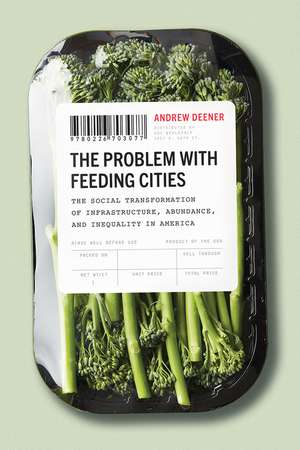
The Problem with Feeding Cities: The Social Transformation of Infrastructure, Abundance, and Inequality in America
Autor Andrew Deeneren Limba Engleză Paperback – 5 sep 2020
Găsim în The Problem with Feeding Cities o analiză sociologică și istorică riguroasă a infrastructurii invizibile care susține consumul alimentar contemporan. Autorul Andrew Deener își organizează materialul plecând de la premisa că abundența din supermarketuri nu este un accident, ci rezultatul unei transformări sistemice profunde. Structura cărții urmărește evoluția de la piețele locale la rețelele globale de logistică, evidențiind modul în care inovații precum codul de bare (analizat detaliat în capitolul patru) au recalibrat puterea în cadrul lanțului de aprovizionare. Metodologia utilizată, explicată în anexa finală, îmbină cercetarea istorică cu interviuri extinse, oferind o perspectivă rară asupra modului în care deciziile logistice și corporative generează inegalitate socială.
Putem afirma că lucrarea deconstruiește mitul eficienței pieței libere în hrănirea populației urbane. În timp ce capitolele centrale explorează cum au fost „învinse” sezoanele prin transportul global, secțiunile ulterioare subliniază „crăpăturile” din sistem, unde infrastructura eșuează sistematic în a deservi comunitățile marginalizate. Această abordare completează perspectiva oferită de Food Chains de Warren Belasco, adăugând o dimensiune spațială și infrastructurală crucială: Deener nu se oprește la instituțiile care mișcă alimentele, ci investighează modul în care orașele înseși au fost reconstruite pentru a servi profitul, nu accesibilitatea.
În contextul operei sale, The Problem with Feeding Cities extinde interesul lui Andrew Deener pentru dinamica urbană și diversitatea comunitară, teme explorate anterior în Venice. Dacă în lucrarea precedentă se concentra pe proximitatea geografică și tensiunile de clasă într-un cartier specific, aici autorul ridică miza spre un sistem macro care dictează supraviețuirea urbană. Tonul este unul academic, precis, evitând speculațiile în favoarea datelor culese de la operatori de depozite frigorifice și experți în sănătate publică.
Preț: 267.74 lei
Carte tipărită la comandă
Livrare economică 27 noiembrie-11 decembrie
Specificații
ISBN-10: 022670307X
Pagini: 328
Ilustrații: 30 halftones, 2 tables
Dimensiuni: 152 x 229 x 25 mm
Greutate: 0.48 kg
Ediția:First Edition
Editura: University of Chicago Press
Colecția University of Chicago Press
V-ar putea interesa
-
 Venice: A Contested Bohemia in Los AngelesAndrew DeenerPreț: 310.71 lei
 -
 The Sociology of Housing: How Homes Shape Our Social LivesBrian J. McCabePreț: 213.13 lei
 -
 Making Our Neighborhoods, Making Our SelvesGeorge C. GalsterPreț: 287.55 lei
 -
 Preț: 251.26 lei
 -
 American Fascism and the New Deal: The Associated Farmers of California and the Pro-Industrial MovementNelson A. Pichardo Almanzar-23%Preț: 337.35 lei436.19 lei
 -
 Imagine Lagos: Mapping History, Place, and Politics in a Nineteenth-Century African CityAdemide Adelusi-AdeluyiPreț: 241.60 lei
 -
 Growing Up in East L.A.Tamara J. WelterPreț: 149.49 lei
 -
 The Reverend Jennie Johnson and African Canadian History, 1868-1967Nina Reid-Maroney-23%Preț: 747.44 lei970.71 lei
 -
 The Psychogeography of Urban ArchitectureDavid Prescott-SteedPreț: 165.48 lei
 -
 Advanced Topics in Urban StudiesChayma Hamdani-18%Preț: 727.78 lei887.54 lei
 -
 Advances in Population ResearchLuke Chesterton-18%Preț: 732.72 lei893.56 lei
 -
 Urban Studies HandbookDominque Craft-18%Preț: 764.72 lei932.59 lei
 -
 Baianidade: Entre as Vozes Em Coro E O SilencioJorge Ubiratan de Almeida Silva JuniorPreț: 234.15 lei
 -
 Apropriacao de Estrutura de Oportunidades Em Areas Urbanas Pobres: Um Enfoque SistemicoFernando Antonio AmoniPreț: 319.42 lei
 -
 Criminalidade urbana violentaMarianna de Barros Afonso Ferreira-8%Preț: 462.88 lei503.13 lei
 -
 Análise da acessibilidade no centro urbano da cidade de MacaéPaulo Roberto dos SantosPreț: 218.95 lei
 -
 -8%Preț: 486.22 lei528.50 lei
 -
 O Espaco Publico Da Rua: Shag Za ShagomGiovana Helena de Miranda MonteiroPreț: 389.27 lei
 -
 Dinamica Espacial: Modelagem E Analise de Sistemas UrbanosNiara Clara PalmaPreț: 234.15 lei
 -
 Preț: 139.31 lei
 -
 O Programa Minha Casa Minha Vida e o Meio Ambiente LocalMichelle Lucas Cardoso Balbino-8%Preț: 430.47 lei467.90 lei
 -
 -23%Preț: 688.17 lei893.73 lei
 -
 Preț: 348.38 lei
 -
 -19%Preț: 425.97 lei525.90 lei
De ce să citești această carte
Recomandăm această carte cercetătorilor și profesioniștilor din urbanism și sociologie care doresc să înțeleagă rădăcinile structurale ale inegalității alimentare. Cititorul câștigă o perspectivă tehnică asupra modului în care logistica și designul urban influențează direct ce găsim pe rafturile magazinelor. Este un instrument esențial pentru a înțelege de ce „deșerturile alimentare” nu sunt simple accidente de piață, ci rezultate directe ale unei infrastructuri proiectate pentru profit.
Despre autor
Andrew Deener este profesor asistent de sociologie la Universitatea din Connecticut. Preocupările sale academice se concentrează pe sociologia urbană, studiul comunităților și modul în care infrastructura modelează interacțiunile sociale. În lucrările sale, precum studiul despre comunitatea Venice din Los Angeles, Deener analizează adesea intersecția dintre rasă, clasă și spațiul geografic. Prin The Problem with Feeding Cities, el își consolidează poziția de observator critic al sistemelor care organizează viața modernă, aducând o abordare interdisciplinară care îmbină istoria economică cu etnografia organizațională.
Descriere scurtă
The Problem with Feeding Cities is a sociological and historical examination of how this remarkable network of abundance and convenience came into being over the last century. It looks at how the US food system transformed from feeding communities to feeding the entire nation, and it reveals how a process that was once about fulfilling basic needs became focused on satisfying profit margins. It is also a story of how this system fails to feed people, especially in the creation of food deserts. Andrew Deener shows that problems with food access are the result of infrastructural failings stemming from how markets and cities were developed, how distribution systems were built, and how organizations coordinate the quality and movement of food. He profiles hundreds of people connected through the food chain, from farmers, wholesalers, and supermarket executives, to global shippers, logistics experts, and cold-storage operators, to food bank employees and public health advocates. It is a book that will change the way we see our grocery store trips and will encourage us all to rethink the way we eat in this country.
Notă biografică
Cuprins
One / The Transformation of the Food System
Two / The Rise and Fall of the Urban Middlemen
Three / Infrastructural Exclusion
Four / The Bar Code: A Micro-technical Force of Change
Five / Defeating Seasons: Reassembling the Produce Aisle
Six / Cracks in the System
Seven / Food Distribution as Unfinished Infrastructure
Eight / The Problem with Feeding Cities
Acknowledgments
Methods Appendix: Strategic Variation and Historical Excavation
Notes
References
Index