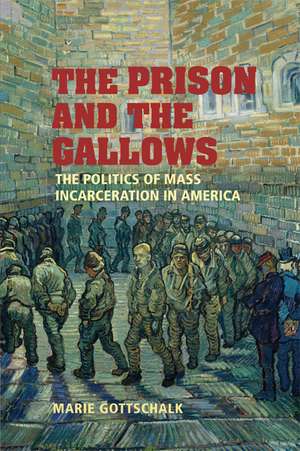
The Prison and the Gallows
Autor Marie Gottschalken Limba Engleză Paperback – 9 dec 2010
Această monografie academică, publicată sub egida Cambridge University Press, oferă o analiză riguroasă și detaliată a fenomenului încarcerării în masă în Statele Unite, un stat care a atins o rată de detenție fără precedent în istoria modernă a Occidentului. Considerăm că forța acestei lucrări rezidă în abordarea politologică: Marie Gottschalk nu tratează criminalitatea ca pe un simplu indicator social, ci ca pe un element central al dezvoltării politice americane. Găsim în acest volum o deconstrucție a modului în care politici penale extrem de punitive au fost modelate nu doar de instituții, ci și de mișcări sociale precum cele pentru drepturile femeilor sau ale victimelor, care, paradoxal, au contribuit la consolidarea statului carceral. Cititorii familiarizați cu Mass Imprisonment de David W Garland vor aprecia modul în care Gottschalk trece de la sociologia penală la o analiză instituțională comparativă, explicând de ce Statele Unite au urmat o cale atât de diferită față de alte democrații vestice. Cartea se plasează strategic între lucrarea sa anterioară, The Shadow Welfare State, care explora natura privată a politicilor sociale, și volumul ulterior Caught, continuând să investigheze cum interesele de grup și moștenirile istorice blochează reformele autentice. Este o lectură densă, argumentată cu date factuale, esențială pentru înțelegerea mecanismelor de putere din spatele sistemului de justiție american.
Preț: 295.73 lei
Carte tipărită la comandă
Livrare economică 18 noiembrie-02 decembrie
Specificații
ISBN-10: 0521682916
Pagini: 468
Ilustrații: 1 table
Dimensiuni: 152 x 229 x 28 mm
Greutate: 0.75 kg
Editura: Cambridge University Press
Locul publicării:New York, United States
V-ar putea interesa
-
 Orange Is the New Black: My Time in a Women's PrisonPiper Kerman-26%Preț: 59.23 lei79.69 lei
 -
 -27%Preț: 68.17 lei93.18 lei
 -
 Preț: 153.39 lei
 -
 Marching PowderRusty Young-38%Preț: 58.16 lei93.95 lei
 -
 -27%Preț: 997.98 lei1361.42 lei
 -
 Pain and RetributionDavid Wilson-15%Preț: 208.80 lei246.54 lei
 -
 Fifty-One MovesBen AshcroftPreț: 96.03 lei
De ce să citești această carte
Recomandăm această carte cercetătorilor și studenților la științe politice, sociologie sau drept penal care doresc să înțeleagă rădăcinile politice ale sistemului carceral american. Cititorul câștigă o perspectivă nuanțată asupra modului în care activismul social poate influența, uneori neintenționat, politicile punitive. Este un instrument teoretic solid pentru oricine analizează de ce SUA rămâne lider mondial în ratele de încarcerare.
Despre autor
Marie Gottschalk este profesor de științe politice la Universitatea din Pennsylvania, fiind o voce autorizată în studiul statului carceral și al politicilor sociale americane. Cu un doctorat obținut la Yale și un master la Princeton, ea și-a dedicat cariera analizării modului în care munca, afacerile și mișcările sociale interacționează cu politicile publice. Experiența sa de editor la World Policy Journal și activitatea în cadrul World Policy Institute din New York îi conferă o perspectivă interdisciplinară, vizibilă în toate lucrările sale, inclusiv în celebrul volum The Shadow Welfare State.
Descriere scurtă
Cuprins
Recenzii
"The Prison and the Gallows provides important insight into the perplexing question of how the United States came to embark upon a policy of mass incarceration over the past several decades. Marie Gottschalk documents how a particular set of political and historical conditions intersected with the agendas of both liberal and conservative interest groups to produce an outcome that is unique by world standards. Her analysis suggests that these developments were not inevitable, an important lesson to understand if we are to develop strategies for reversing these disastrous policies." -- Marc Mauer, Executive Director, The Sentencing Project; author, Race to Incarcerate
"One of the most important books I've read in years. Marie Gottschalk shows --in vivid and mournful detail-- how Americans lock one another up at unprecedented rates. The Prison and the Gallows provides the big picture, analytic nuance, historical context, comparative evidence, policy proposals, and a touch of outrage. Splendid scholarship presented with flair and passion." -- James Morone, author, Hellfire Nation: The Politics of Sin in American History
"Marie Gottschalk's multilayered account is thought-provoking and convincingly argued. It unites historical observations with the analysis of current situations, it provides both a big picture and nuanced analysis, and it helps us to understand how institutional and political constellations, familiar in the explanation of the politics of mass incarceration in America, went hand in hand with the work of pressure groups and popular movements usually not associated with today's crime and punishment policy." -Juergen Martschukat, H-Law
"Marie Gottschalk, a political scientist at the University of Pennsylvania who previously has written about the welfare state and health care, offers an extraordinarily ambitious and comprehensive analysis using history and political science to try to explain why, over the last three decades, the United States has built a carceral state that is unrivaled in size among Western countries...This useful book has many excellent features that should stimulate needed discussion about America's penal policies and the often unintended consequences of social reform." - Scott Christianson, Sand Lake, New York The Journal of American History
"This is an important, carefully argued, and richly detailed analysis that deserves wide attention. As Gottschalk emphasizes in a largely prescriptive concluding chapter, any efforts to reverse current penal policy should be clear about its origins." - Charles Williams, University of Washington