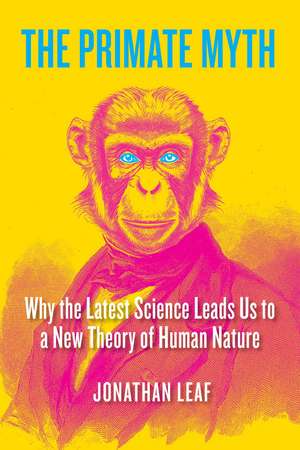
The Primate Myth: Why the Latest Science Leads Us to a New Theory of Human Nature
Autor Jonathan Leafen Limba Engleză Paperback – 20 noi 2025
În The Primate Myth, observăm o reevaluare curajoasă a fundamentelor biologice care definesc specia noastră, pornind de la o aplicabilitate practică imediată: modul în care ne înțelegem comportamentele sociale complexe, de la politică la modă. Jonathan Leaf propune o ruptură față de paradigma clasică a antropologiei evoluționiste, argumentând că simpla încadrare a omului în ordinul primatelor este o barieră în calea înțelegerii unicității noastre. Descoperim în paginile volumului o analiză detaliată a diferențelor de design cerebral, metabolism și chimie hormonală care ne separă radical de cimpanzei.
Această lucrare completează perspectiva oferită de Mind the Gap de Joan Silk, adăugând o critică sistematică a modului în care datele biologice au fost folosite pentru a susține agende ideologice, nu doar științifice. În timp ce Adam Rutherford în Humanimal explorează paradoxul „animalului uman” prin prisma asemănărilor genetice, Jonathan Leaf inversează lentila, concentrându-se pe ceea ce el numește „mitul primatei” — ideea că suntem doar niște maimuțe mai evoluate. Autorul demonstrează că până și structura noastră osoasă, lipsită de adaptările pentru cățărat, infirmă o continuitate comportamentală absolută.
Deși anterior Jonathan Leaf a explorat dinamica socială prin ficțiune în City of Angles, unde analiza intersecția dintre imagine și realitate în Hollywood, în The Primate Myth el aplică aceeași rigoare observațională asupra științei. Tonul este unul precis, ancorat în genetică și neuroștiințe, oferind cititorului un cadru teoretic nou pentru a procesa dileme umane universale precum războiul sau altruismul, fără a recurge la reducționismul biologic obișnuit.
Preț: 119.35 lei
Carte disponibilă
Livrare economică 09-23 noiembrie
Specificații
Pagini: 320
Dimensiuni: 152 x 229 x 23 mm
Greutate: 0.34 kg
Editura: BOMBARDIER BOOKS
Colecția Bombardier Books
V-ar putea interesa
-
 ProgressSamuel Miller McDonaldPreț: 161.19 lei
 -
 Third Chimpanzee, TheJared M DiamondPreț: 113.53 lei
 -
![Sapiens [Tenth Anniversary Edition]](https://i0.books-express.ro/bt/9780063422001/sapiens-tenth-anniversary-edition.jpg) Sapiens [Tenth Anniversary Edition]Yuval Noah HarariPreț: 182.98 lei
Sapiens [Tenth Anniversary Edition]Yuval Noah HarariPreț: 182.98 lei -
 The Rise And Fall Of The Third ChimpanzeeJared Diamond-20%Preț: 73.43 lei92.12 lei
 -
 Primate Adaptation and EvolutionJohn G. Fleagle-23%Preț: 388.79 lei504.30 lei
 -
 The Blank SlateSteven Pinker-28%Preț: 78.74 lei109.00 lei
 -
 Human PeoplesLluís Quintana-MurciPreț: 188.44 lei
 -
 The Bonobo and the AtheistFrans De WaalPreț: 181.27 lei
 -
 The Gap: The Science of What Separates Us from Other AnimalsThomas Suddendorf-31%Preț: 131.75 lei190.54 lei
 -
 Primal Intelligence: You Are Smarter Than You KnowAngus Fletcher-26%Preț: 90.91 lei122.67 lei
 -
 DifferentFrans De WaalPreț: 66.92 lei
 -
 The Arrogant Ape: And A New Way To See HumanityChristine Webb-25%Preț: 92.37 lei123.57 lei
 -
 Seven and a Half Lessons About the BrainLisa Feldman Barrett-35%Preț: 50.86 lei78.19 lei
 -
 -24%Preț: 72.24 lei95.44 lei
 -
 -25%Preț: 53.99 lei72.45 lei
 -
 SapiensYuval Noah Harari-37%Preț: 119.84 lei189.48 lei
 -
 The Genius MythHelen LewisPreț: 123.24 lei
 -
 We, HominidsFrank Westerman-38%Preț: 55.84 lei89.41 lei
 -
 What Makes Us Human?Charles PasternakPreț: 79.69 lei
 -
 Our Inner ApeFrans De WaalPreț: 79.15 lei
De ce să citești această carte
Recomandăm această carte cititorilor pasionați de antropologie și biologie care doresc să exploreze o perspectivă nonconformistă asupra evoluției. Veți câștiga o înțelegere mai profundă a distincțiilor neurologice și fiziologice care fac specia umană unică, dincolo de clișeul celor 98% gene comune cu cimpanzeii. Este o lectură esențială pentru a vedea cum cele mai noi date din neuroștiințe pot demonta mituri vechi de decenii.
Despre autor
Jonathan Leaf este un autor și dramaturg american cunoscut pentru capacitatea sa de a analiza critic structurile sociale și culturale. Cu o carieră ce pendulează între jurnalism, dramaturgie și beletristică, Leaf a publicat anterior City of Angles, un roman noir care investighează discrepanța dintre aparență și esență în industria cinematografică. În The Primate Myth, el își folosește spiritul analitic pentru a chestiona consensul științific actual, aducând în discuție rigoarea cu care sunt interpretate datele despre natura umană. Stilul său se remarcă prin claritate și o abordare multidisciplinară care îmbină biologia cu sociologia.
Descriere scurtă
Humans are primates, much like chimps—or so we’ve been continually told. Yet recent discoveries show that our species has a different brain design, function, and chemistry; different eating, sleeping, mating, and rearing patterns; a different metabolism; and a different physiology than apes. Nor is our behavior much like theirs, and we don’t even have the feet made for climbing trees that define the primate order.
Could it be that conceiving of ourselves as primates isn’t helping us understand what it is to be human? By examining the latest research in neuroscience and genetics, we are propelled toward a radically different conception of our nature. In this way, we can begin to grasp the distinctively human dimensions of war, murder, suicide, and homosexuality, along with our fascinations with subjects like sports, politics, and fashion. Here is the path by which to understand our species’ essential problems and uncover the answers for how we should live our lives.
Notă biografică
In 2018, The Wall Street Journal called his play Pushkin a “triumph,” naming it one of the year’s four best. Kirkus Reviews has called his novel City of Angles “literary entertainment at its best.” Now Leaf turns his attention to the subject that his parents devoted their lives to and with which he has had a lifelong fascination: what neuroscience is revealing about human nature.
Recenzii
“The surprise in Jonathan Leaf’s The Primate Myth is that our relationship to the apes may be more distant than we think…. This, Leaf argues, would allow us to develop a species self-image that would be more accurate. It would be good for science, and also good for us.”
“A remarkable book. Ambitious in scope, highly learned, and engagingly written, Leaf’s work accomplishes two important goals: It gives a real-life and real-time example of how scientific revolutions occur, and it (definitively) changes our understanding of exactly who our closest relatives are and what that relationship tells us about who we are.”
“Illuminating and paradigm changing! Jonathan Leaf overturns decades of assumptions about our human nature and its origin. Realizing that perhaps we have become too complacent in our human story, he poses the empirically driven question, what really has been our path of evolution? Leaf challenges and sheds light on our social, political, and truly life-or-death human decision-making. In a culture of individualism, do we truly realize our capacity for original thought and courage? Leaf is a profound, rare generational thinker. You will rethink our times with a renewed curiosity for human nature and our evolutionary cousins.”
“It’s easy to be cynical about human beings. This book is an antidote. Leaf thinks scientists have made too much of our evolutionary continuity with chimpanzees, which are horrifically violent. In fact, we act more like wolves and dolphins—more altruistic, more prosocial, more creative. Leaf rethinks the famous Milgram electric-shock experiments, the factors leading to suicide, how and why we seek status, and the origins of sexual jealousy. It’s a provocative, wide-ranging book—a must-read for anyone trying to understand human nature.”
“Jonathan Leaf is a brilliant amateur who can illuminate almost anything and who sometimes sees clearly what the experts miss. The experts who have told us that humans are essentially upgraded chimpanzees, he says, have missed a wealth of details that make us more similar to dolphins and whales. We share a remote ancestor with chimps, but once our forebears left the canopy of the tropical forest, we evolved into a large-brained, pair-bonding, cooperative, organizing, and language speaking species. The key is that we became a special kind of herd animal. Leaf fearlessly follows this thread through unexpected territory including why we fight wars; why men are more likely than women to be homosexual; and why humans (but not chimps) commit suicide. The book reflects his deep reading in a dozen disciplines, but Leaf's career as a successful dramatist serves him well. Every page is alive with anecdotes, recollections, and stories of the people who enthroned chimpanzees as our close cousins and thus diverted attention from who we really are.”
“This book shreds conventional wisdom about the origins of human nature. Leaf is a compelling writer and, whichever side of the argument you come down on, you will emerge with a clearer understanding of the challenges facing humanity in an age of ubiquitous information and global aggression.”
“Jonathan Leaf delves into our brains and our prehistory to discover who we are: animals that hunt, speak, and follow the leader. Moving at ease through a mass of data, The Primate Myth is fascinating, occasionally contentious, and sometimes frightening.”
“No one can come away from Jonathan Leaf’s extraordinary survey of the twists and turns of what we know about human nature without recognizing how our understanding of human nature has been abused and distorted for agenda-driven causes. The Primate Myth should be required reading for generalists and specialists alike.”